

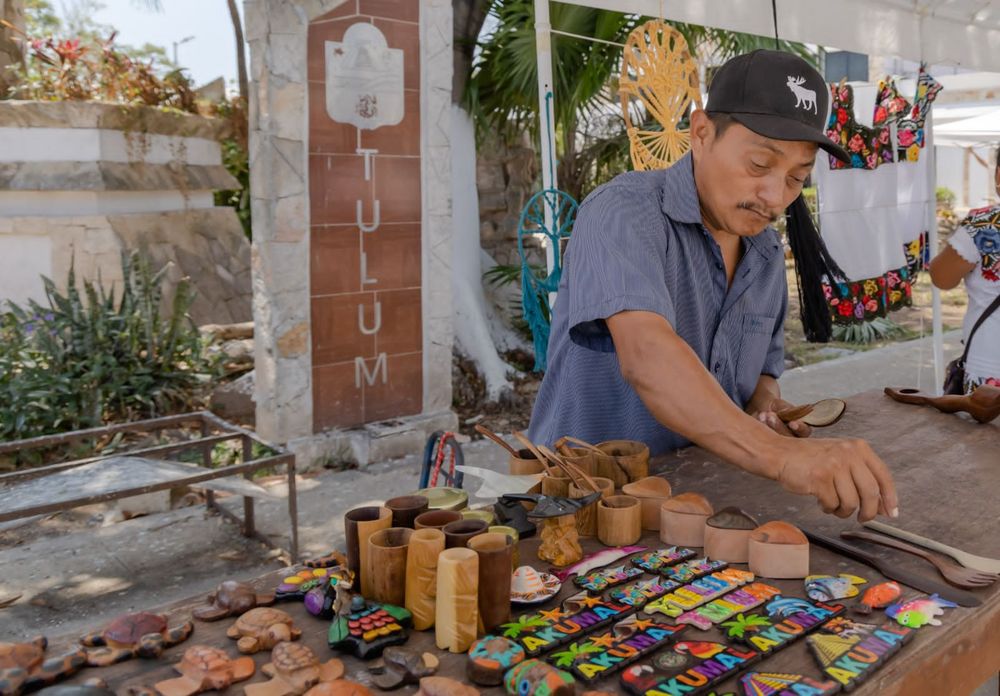
Merchants at the artisan center near the Tulum Archaeological Zone say Grupo Mundo Maya is not honoring agreements reached with municipal, state, and federal authorities to make access easier for visitors and residents entering the Parque del Jaguar area. The complaint centers on restrictions reported on Sundays, which local vendors say are limiting movement inside the park and affecting access to the commercial area tied to one of Tulum’s most important tourism corridors.
According to Rufino Hernández Jiménez, treasurer of the artisan center condominium, the restrictions are affecting both domestic visitors and residents of Quintana Roo who enter the park area. He said the measures now being applied do not reflect what was agreed in prior meetings with authorities.
That matters in Tulum because access to the archaeological zone is directly linked to local commerce, visitor circulation, and the daily operation of businesses that depend on foot traffic near one of the municipality’s best-known sites. The people affected, according to the merchants’ account, include local vendors, domestic tourists, and state residents seeking entry or mobility within the park. What changes now is that traders are publicly asking authorities at all three levels of government to intervene and enforce the terms they say were already settled.
Merchants say Sunday restrictions remain in place
Hernández Jiménez said the main problems have been most visible on Sundays, when access conditions have allegedly made it harder for people to move through the Parque del Jaguar area. He argued that the current restrictions are affecting national visitors as well as residents of Quintana Roo, despite earlier commitments intended to ease that process.
He said those commitments were discussed in meetings with authorities that included Quintana Roo Governor Mara Lezama and Federal Tourism Secretary Josefina Rodríguez. According to his account, the agreements reached in mid-November were meant to allow easier access for local residents and domestic tourists.
But Hernández Jiménez said the situation on the ground has not changed in the way that had been promised.
“Realmente, los acuerdos no han sido respetados hasta hoy en día. Yo estuve en las reuniones y ahí se dijo una cosa, pero en la práctica no se está aplicando”, he said.
His statement frames the complaint not as a dispute over a new policy, but over the implementation of commitments that merchants say were already defined. In practical terms, the issue is not only whether visitors can enter, but whether they can move through the park in a way that supports normal activity around the artisan center.

Access concerns reach the local economy
For merchants working near the archaeological zone, access is not a secondary issue. It shapes whether visitors reach commercial areas, how long they remain in the zone, and whether local businesses see the traffic they depend on.
Hernández Jiménez said the agreements were supposed to facilitate the transit of people living in Quintana Roo and improve mobility inside the park. Instead, he said, there are now reports of limitations affecting entry and movement in the area.
That complaint carries economic weight in Tulum because the artisan center depends on the flow of visitors linked to the archaeological zone. Any restriction that slows circulation, reduces convenience, or discourages domestic travelers from entering the area could affect sales for local tenants and workers whose income is tied to tourism.
The concern expressed by merchants is also broader than a single weekend inconvenience. Their argument is that repeated obstacles at the entrance to such a high-traffic site can damage the destination itself if left unresolved. In a tourism-dependent municipality, the difference between open access and restricted movement can quickly become visible in local commerce.
And the issue is especially sensitive because the archaeological zone is more than a landmark. It is also a gateway. That makes every access decision carry consequences beyond the park itself, extending to merchants, transport patterns, and the public image of the destination.
Tourist train suspension adds pressure
Hernández Jiménez also said the tourist “train” operating inside the park has been suspended on Sundays. He described that service as an important transportation option for visitors moving through the area and said it helped generate more flow toward the artisan center’s commercial spaces.
The suspension matters because internal mobility can determine whether visitors continue through the zone or limit their movement. For businesses located along or near those paths, the availability of transport can shape commercial activity in direct ways.
From the merchants’ perspective, the issue is not only access at the point of entry, but the conditions visitors face once inside. Easier movement within the park was, according to Hernández Jiménez, part of what had been discussed with authorities. The suspension of the Sunday transport service appears, in his telling, to run against that objective.
That combination of reported entrance restrictions and reduced internal transportation is what appears to be driving the complaint from local traders. The concern is operational, but also symbolic: a destination known for receiving visitors at one of Mexico’s most recognized coastal archaeological sites depends on a system that functions predictably for both tourists and local residents.
A subtle point runs through the merchants’ message. Access policy is often discussed as an administration, but in places like Tulum, it is experienced as a daily reality by workers and small businesses first.
Calls for authorities to enforce prior commitments
Hernández Jiménez warned that these conditions could harm tourism and local economic activity if they are not corrected. His concern was framed not only around current inconvenience, but around the possibility of returning to earlier situations that, in his view, did not benefit the destination.
“Esperamos que no se llegue a situaciones como las anteriores, porque eso no beneficia al destino, al contrario, lo perjudica”, he said.
He called on authorities from the municipal, state, and federal governments to address the problem and guarantee compliance with the agreements previously established. That appeal reflects the fact that the dispute, as described by the merchants, involves coordination among more than one level of government and the role of Grupo Mundo Maya in the management of access conditions.
For Tulum residents and businesses, the immediate issue is straightforward. Merchants want the access conditions discussed with officials to be applied in practice, especially on Sundays, and they want mobility inside the park restored in a way that benefits visitors and local commerce.
The Tulum Times notes that the complaint places attention on enforcement rather than announcement. The merchants’ position is that the commitments were already made, and that what is missing now is compliance.
Hernández Jiménez closed his remarks by describing Tulum as deserving better treatment, given its role as the main entrance to the Tulum Archaeological Zone and an important point of access for both the municipality and the state.
That is what is at stake going forward: whether authorities move to align actual entry and mobility conditions with the Parque del Jaguar agreements that merchants say were reached months ago. We’d love to hear your thoughts. Join the conversation on The Tulum Times’ social media. How should access to Parque del Jaguar be managed to protect both visitors and local businesses?