

Some streets in Tulum tell their own story. Calle 8 in La Veleta, for example, whispers of years of neglect, sudden hope, and a resurfacing that, quite literally, doesn’t hold. In a town reshaping itself daily for tourism and investment, this small residential artery has become a symbol of what happens when promises sink into gravel.
A street long left behind
For years, Calle 8 was less of a road and more of a rugged dirt track. Riddled with potholes, strewn with debris, and prone to flooding every rainy season, it was notorious among locals. Residents remember navigating it like an obstacle course, motorbikes slipping, bicycles getting stuck, and cars bouncing through uneven terrain.
“It was practically impassable,” said one longtime neighbor. “Every rainy season, we knew we were in trouble.”
This street wasn’t just bad, it was widely seen as one of the worst residential roads in Tulum. But in early 2025, something changed.
Hope paved in black gravel
When municipal workers rolled into La Veleta, the reaction was one of cautious celebration. After years of complaints, complaints, and more complaints, the government was finally taking action. The community watched closely as machinery moved in and the street was prepped for what many assumed would be proper paving.
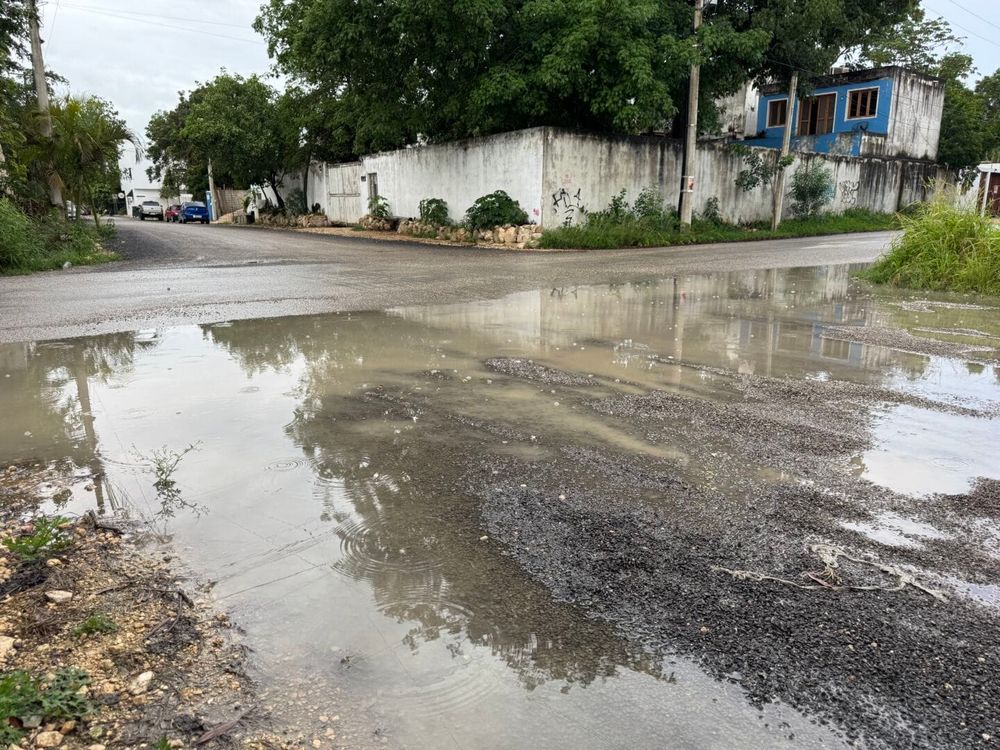
The result? A layer of black gravel over a slick base of brea. It looked more like a shortcut than a solution. Workers reportedly told residents that over time, the gravel would compact naturally into a solid surface.
But months later, that promise is crumbling underfoot and tiring.

Problems emerge beneath the surface
Instead of hardening into anything resembling pavement, the gravel has shifted to the sides, piling up along the street’s edges. Vehicles, especially those with automatic traction systems, now struggle to maneuver without skidding. The issue goes beyond inconvenience, it’s a safety concern.
Motorcyclists have it worst. A quick turn or a sudden brake can send a rider sliding, as loose gravel offers no grip. The danger peaks where Calle 8 meets Calle 5, where pooled rainwater and blocked drainage form a seasonal lagoon.
“It’s worse than before,” said a resident who’s lived in La Veleta for nearly a decade. “They traded dust and potholes for instability and accidents.”

Pedestrians left behind
Perhaps the cruelest irony? The road upgrade seems to have made things more dangerous for those on foot. Without sidewalks, pedestrians are forced to share the road with increasingly fast-moving vehicles.
That’s right, fast-moving. With the bumps and holes gone, drivers now fly down Calle 8, hitting speeds up to 70 km/h between the main avenue and Calle 7. Where once rough terrain naturally slowed traffic, the new surface has turned the road into a straightaway.
One chilling incident recently caught the neighborhood’s attention. A dog was struck and killed by a speeding vehicle, right in front of its owner. For many, it was a tragic but unsurprising event that underscored what they’d been fearing all along.
“This was supposed to make the street safer,” one resident told The Tulum Times. “Instead, it’s more dangerous than ever.”
La Veleta demands action
The community hasn’t been silent. Neighbors have repeatedly requested the installation of speed bumps at key points along Calle 8. Their aim is simple: slow down the cars before another life, human or otherwise, is lost.
But so far, the calls have gone unanswered.
There’s growing frustration in La Veleta, not just with the current state of Calle 8, but with what it represents. A half-solution. A box ticked without real change. A reminder that in a town where tourism often comes first, residential needs can be left to rattle in the gravel.
A local issue with broader echoes
What’s happening on Calle 8 isn’t just a La Veleta problem. Tulum’s infrastructure has long struggled to keep up with its explosive growth. From Playa del Carmen to the heart of Quintana Roo, development races ahead while basic services like drainage, paving, and pedestrian safety often lag behind.
Tourists might see Tulum’s glimmering facade, but for residents navigating daily life, stories like this are all too familiar.
Streetlights Out of Service, Adding to the Risk
Calle 8 is also facing the same issue that has affected many streets in Tulum over the past few months. Public streetlights that once worked without problems have stopped functioning, and there has been no visible action from the municipality to address the situation. As a result, large sections of Calle 8, like other areas of the town, remain in complete darkness. Combined with the existing road problems, the lack of lighting makes traveling at night almost an open invitation for accidents.
What lies ahead for Calle 8?
Without intervention, the risks will only grow. Rainy season is approaching again, and without drainage solutions or traffic-calming measures, the same cycle is likely to repeat. The gravel won’t fix itself. The water won’t drain on its own. And people will continue walking a road that doesn’t welcome them.
Calle 8 is more than a neglected road. It’s a test of the municipality’s priorities.
Are they listening?
We’d love to hear your thoughts. Join the conversation on The Tulum Times’ social media.
Will Calle 8 finally get the fix it deserves, or will it be left to sink further into disrepair?