

In Tulum, some of the most consequential transformations are not only architectural. They are atmospheric.
Over the past decade, the destination has evolved from an aesthetic beachfront escape into a laboratory of immersive encounters. The most resonant gatherings are no longer defined only by celebrity lineups or spectacle, but by how intentionally they orchestrate space, sound, and collective presence. A recent candlelight concert on the beach offered a revealing example of this evolution, not through scale or hype, but through how the night was composed.
This matters in Tulum because experiences increasingly shape how the town is understood, used, and remembered. Visitors, residents, and the people who build and host events are all directly affected by the choices that turn a beach into a venue. And what changes going forward, at least in the direction suggested by this concert, is the growing emphasis on design that treats the landscape as collaborator rather than commodity.
A night that began with transition
The evening began not with music, but with a passage.
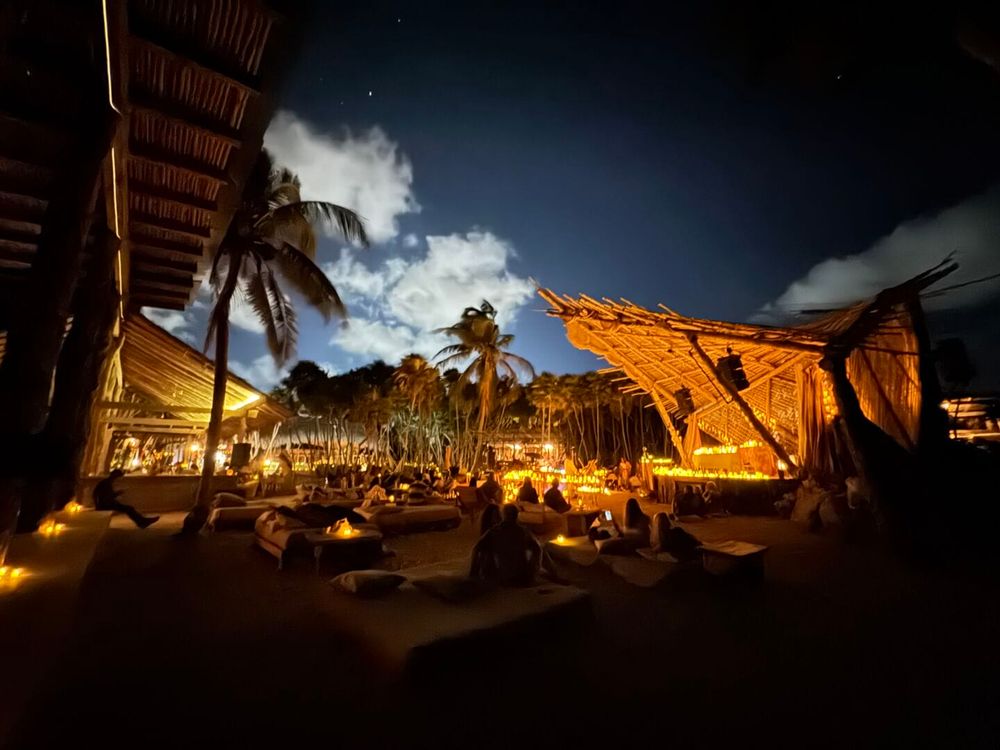
A narrow path through dense vegetation, illuminated entirely by candlelight, acted as a sensory threshold. The warm flicker softened edges and slowed movement. By the time sand replaced stone underfoot, perception had already shifted. The event’s first message was not delivered by a microphone or a spotlight. It was delivered by pace, by light, and by the quiet instruction to arrive differently.
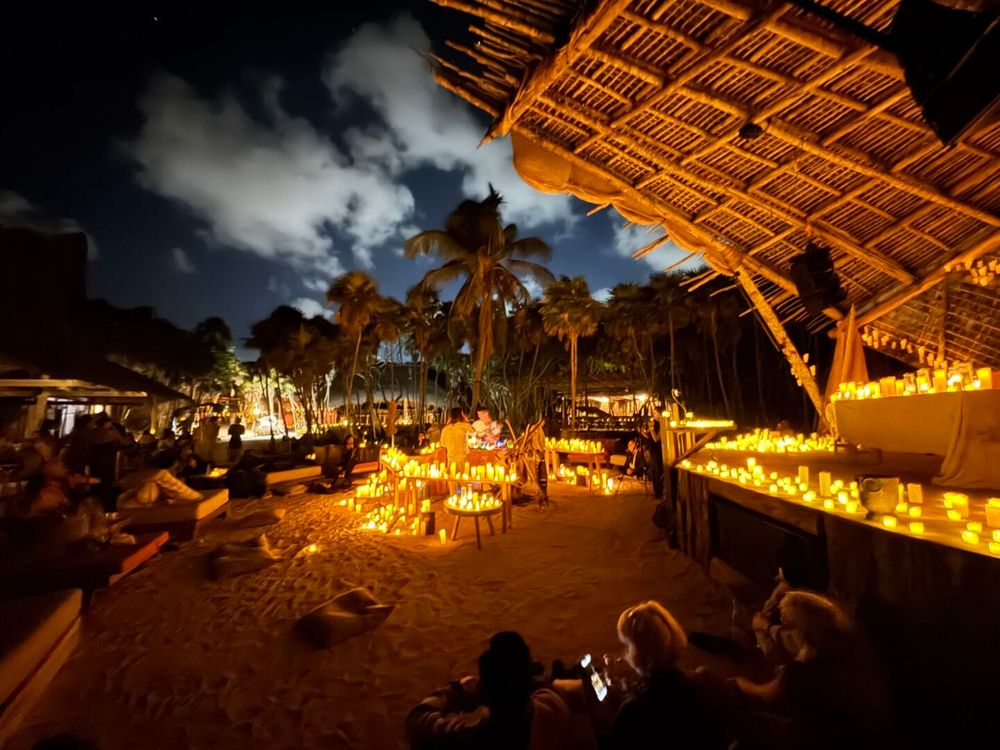
On the beach, hundreds of candles reframed the landscape. Light traced the curves of palm trunks and softened architectural contours. The Caribbean was not a backdrop but a pulse, its rhythm audible beneath conversation. Overhead, a clear night sky expanded uninterrupted, anchoring the entire setting in something vast and elemental.
In this configuration, the beach itself became an instrument.
When intimacy expands beyond exclusivity
In Tulum, intimacy is often conflated with exclusivity. Yet here, intimacy felt spatial rather than social, created less by separation from others and more by the way the environment invited stillness.
Low beds placed directly on the sand asked guests to settle rather than circulate. Some sat near the waterline. Others gathered around a modest fire. A few lay back entirely, shifting their gaze from performers to constellations in one seamless motion.
It was in that gesture, from stage to sky, that the experience found its dimension. The finite met the infinite. Human breath, string vibration, and melodic phrasing rose into an open atmosphere that dwarfed them without diminishing them. Rather than shrinking into privacy, intimacy expanded outward.
There is a subtle distinction here that can be easy to miss in a place whose public image is often compressed into extremes. Not every gathering has to be a spectacle, and not every quiet night has to be framed as exclusivity. Sometimes the most defining choice is simply allowing a setting to remain legible as itself: sand underfoot, salt in the air, darkness still intact.
Lattice and the decision not to dominate
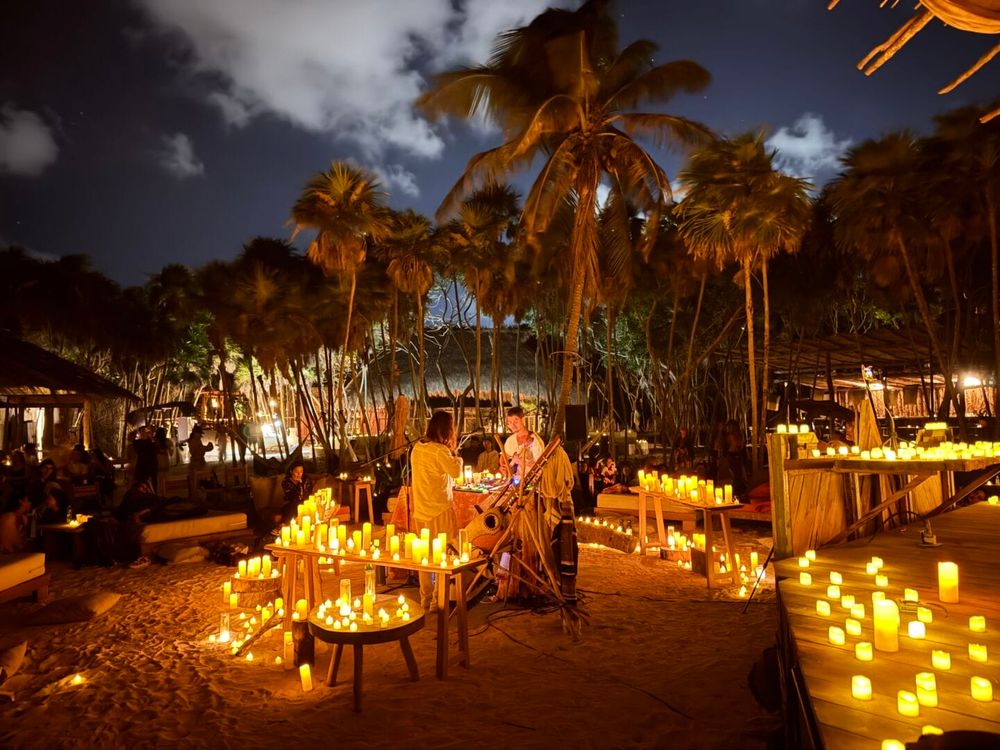
The evening’s music was led by Lattice, a world-music duet blending organic textures, ancestral roots, and contemporary minimalism. Formed by multi-instrumentalist and kora player Nico Waiyari and guitarist Eric Marteau, whose musical language draws from Argentinian folklore and flamenco, the duo constructs sound as a kind of living architecture.
Their compositions carried harmonic depth without excess and rhythmic subtlety without urgency. This was not a traditional stage-forward performance designed to push attention in one direction. Their format placed the musicians at the center of a 360-degree environment, dissolving the conventional boundary between performer and audience.
The effect was not theatrical immersion. It was a shared presence.
What stood out most was restraint. The music did not overpower the ocean or attempt to dominate the landscape. Instead, it functioned as connective tissue, threading breath, movement, wind, and silence into cohesion. In experiential design, this balance can be rare. Amplification often overwhelms context. Here, sound made room for waves, for palm fronds shifting in the breeze, for the low murmur of collective awareness.

Sound as thread, not spectacle
The concert suggested a different hierarchy of elements.
Rather than asking the beach to serve the performance, the performance seemed to serve the beach, or at least to meet it on equal terms. The ocean remained audible beneath the music. The night sky remained present above it. The candles did not erase darkness so much as measure it, marking boundaries without turning the coastline into a lit stage.
For Tulum, this approach carries implications beyond one evening. The destination’s future is shaped not only by new buildings or new openings, but by how spaces are activated and what those activations demand. When an event’s design centers integration rather than imposition, it can shift expectations about what a “successful” gathering looks like.
And for people who care about Tulum as terrain, not as trend, that shift is not trivial. It suggests a path that values synthesis over volume.

A collective without choreography
Perhaps most revealing was the absence of prescription.
Some couples sat quietly with foreheads touching. Small groups moved gently near the shoreline. Others remained still, eyes upward. A few chose solitude within proximity. The gathering became less about attendance and more about inhabitation.
Candlelight on sand is not inherently profound. A concert on a beach is not inherently transformative. What lends significance is intentionality: how light alters perception, how sound integrates rather than imposes, how individuals are permitted to coexist without choreography.
When landscape is treated as a collaborator rather than a commodity, something shifts. The event demonstrated how a gathering can be shaped by what it refuses to force: no hard separation between performer and listener, no pressure to perform social belonging, no attempt to drown out the environment to prove the event is “working.”
It is a quiet formula, but in Tulum’s current ecosystem, quiet can be a statement.

What this signals for Tulum now
This is the layer of Tulum that rarely fits into headlines or polarized debates. It is not easily reduced to a checklist of features or an argument about what the destination “is.” It is the dimension discovered by those willing to experience the place beyond assumption, to move past narrative and into presence.
Experiences like this reaffirm the destination’s ongoing evolution, not toward spectacle, but toward synthesis. Under an open sky, where music threads through salt air and darkness remains intact, the distance between intimacy and infinity can briefly dissolve. And in that dissolution, Tulum can feel less like a brand and more like a place.
The Tulum Times has reported on many of the forces reshaping the town, but moments like this underline a parallel reality: the most meaningful changes are sometimes the ones that do not announce themselves loudly. They emerge in how a path is lit, how a stage is positioned, and how an audience is allowed to be human without instruction.
What is at stake is not just aesthetics. It is the relationship between people and the environment they gather within, and the kind of attention a place like Tulum asks for, and receives, going forward. The primary keyword in that shift is candlelight concert in Tulum.
We’d love to hear your thoughts. Join the conversation on The Tulum Times’ social media.