
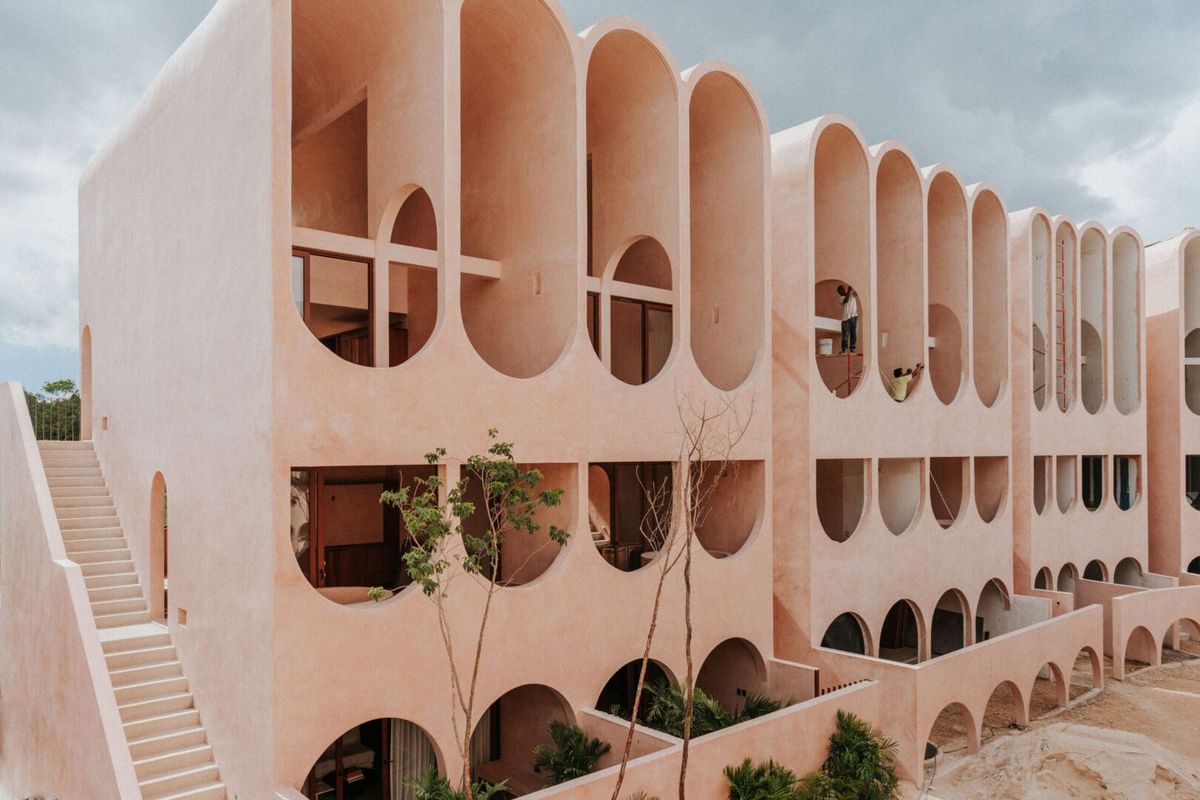
Can a building speak the soul of a region? In Tulum, that question will echo loudly this November, as the Caribbean welcomes its First International Architecture Biennial, an ambitious gathering poised to redefine how we perceive built environments across Quintana Roo and the broader Caribbean.
Under the bold banner of “¡Por Tulum!”, the event brings together top architects, scholars, and creatives from across the region, converging at the Colegio de Arquitectos de Tulum. For many, it’s more than just a showcase, it’s a call to action.
A New Landmark in the Caribbean Design Scene
Launched by the Colleges of Architects of Quintana Roo, in alliance with the Federation of Mexican Architects (FCARM) and the Pan American Federation of Architects Associations (FPAA), the Biennial aims to celebrate the most outstanding architectural achievements across the Caribbean.
It’s a milestone not just for Mexico’s Riviera Maya, but for the entire architectural community of Latin America. According to Guadalupe Portilla Mánica, president of the Colegio de Arquitectos de Tulum, this Biennial is set to highlight work that “embraces creativity, sustainability, and cultural sensitivity in contemporary architecture.”
And it’s not just theory. The Biennial is grounded in practice, accepting built projects completed between January 2020 and January 2025 across Quintana Roo and Caribbean member nations of the FPAA.
An Open Call to Visionaries
Architects, engineers, and design studios from across Mexico are invited to submit their work. As Portilla Mánica emphasized, submissions are open to licensed professionals with valid credentials and extend beyond buildings to include academic research, theses, and publications.
The official call for entries opened on August 1, 2025, and will remain open until September 25, with final submissions due by September 30 at 11:59 PM. Projects will be judged between October 1 and 21, with the awards ceremony scheduled for November 21, at the Conrad Hilton Tulum, a fittingly elegant setting for a celebration of form and function.
But the significance of the event reaches far beyond the awards.
Architecture as Cultural Dialogue
In a region where concrete meets coral, and heritage blends with high-rise ambition, the Biennial comes at a pivotal moment. From Cancun’s hotel strips to Tulum’s boho-luxe eco-lodges, the face of the Mexican Caribbean is evolving rapidly, and not without controversy.
The event aims to go deeper. It invites critical reflection on what architecture should represent in a region as culturally rich and ecologically sensitive as the Caribbean. “We are not just recognizing beautiful buildings,” said a spokesperson close to the organizing team. “We’re spotlighting projects that engage with place, identity, and sustainability.”
The categories reflect this ambition. Entries can include everything from affordable housing and mixed-use spaces to religious structures, cultural centers, and sustainable mobility projects. Interior design, restoration efforts, and lighting design will also be considered, as will publications and investigative work that enrich the discourse around architecture.
A Story of One Studio: Building with Roots
In the heart of Tulum, a small architecture studio led by two young graduates is preparing its submission. Their project, a modest health clinic built with local materials and designed for natural airflow, may not be as flashy as the resorts rising along the coast. But it tells a different story. One of respect for place, of design that listens before it speaks.
“We worked with the local community from the start,” said one of the architects, who asked not to be named until the results are in. “Our biggest challenge wasn’t budget, it was learning how to honor the land and the people.”
This is the spirit the Bienal seeks to elevate.
The Logistics of Participation
All entries must follow strict digital submission guidelines, including anonymous presentation and high-quality graphic materials. Participants are required to submit a payment receipt, registration forms, release of rights, registration request, project narrative, and digital boards.
The entry fee is tiered:
- $275 USD for the first entry by registered architects, with additional works at $175 USD.
- $375 USD for non-members, with subsequent entries at $225 USD.
- Academic submissions (publications, theses, research): $150 USD for members and $250 USD for external participants.
Payment details, including bank account information, are provided after official registration. All participants will receive a digital participation diploma, and the prestige of being part of a landmark regional event.
For more information, submissions, and updates, interested parties are encouraged to contact inscripciones@biarqc.com or visit the Facebook pages of the Colegio de Arquitectos de Tulum (@/ciattulum/) and CARMMX.
The Stakes: Why It Matters
Architecture in the Caribbean isn’t just about aesthetics, it’s about survival, memory, identity. The Biennial offers a moment to step back and ask: What kind of future are we building in Quintana Roo?
From the pressures of tourism in Playa del Carmen to preservation challenges in Tulum, the region stands at a crossroads. As more developers eye the coastline, the need for a critical, human-centered architectural dialogue grows louder.
And this Bienal could be a spark.
The Tulum Times will be following the event closely, capturing not just the winners, but the ideas, debates, and dreams shaping the built future of the Riviera Maya.
We’d love to hear your thoughts. Join the conversation on The Tulum Times’ social media.
Which project, category, or idea do you think deserves more attention in Caribbean architecture today?
Photo: Babel Tulum.