
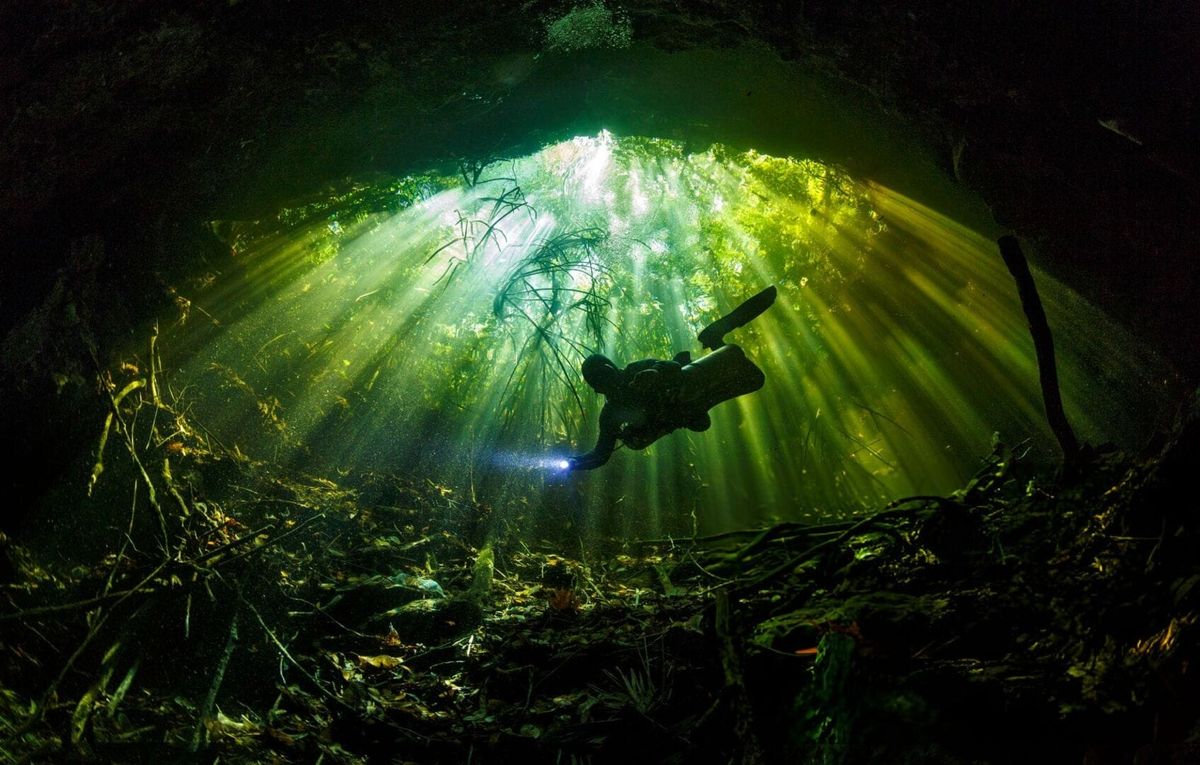
Beneath the chaos of jungle calls and sunburnt tourists, under the hum of scooters and mezcal buzz, Tulum holds its breath. Because not far from its turquoise shores and Instagrammed beaches lies a world so quiet, so ancient, and so hauntingly beautiful, it changes how you see everything above the surface.
This is not a place for casual snorkelers or curious swimmers. This is for those willing to descend into the veins of the Earth, through watery tunnels carved by time and myth. Here, in the cenotes of Tulum, diving isn’t a sport. It’s a ceremony.
Where water speaks in light and stone
Forget what you think diving is. Most travelers come expecting coral reefs, flitting fish, and the sway of ocean currents. But in Tulum, the real story unfolds in freshwater, cool, impossibly clear, and flowing through an underground cathedral of limestone and shadow.
Inside a cenote, visibility often exceeds 100 feet. Light bends like prayer through cracks in the stone ceiling, forming beams that feel almost sacred. You float through ancient stalactites and stalagmites, brush past walls that remember a time before humans, and in some places, slip into pitch-black passageways where even your heartbeat feels too loud.
This isn’t just scuba. It’s a deep, almost mystical immersion into geology, history, and something harder to name.

The soul of Tulum’s underwater world
Tulum rests atop a sprawling limestone platform, a porous canvas shaped over millions of years by rain, collapse, and subterranean rivers. The result? A jaw-dropping network of cenotes: natural sinkholes formed by collapsed cave ceilings, filled with fresh (and sometimes salty) water.
Researchers from Northwestern University have documented more than 630 kilometers of mapped underwater cave systems across the Yucatán Peninsula. It’s the largest such system on Earth. One of them, Sistema Ox Bel Ha, just south of Tulum, spans over 524 kilometers, connecting more than 160 cenotes.
Incredibly, this is just the part we know.
These are not just dive sites. They’re a geological marvel, a spiritual echo, and a biological outlier.
And they’re calling.

Diving through time and myth
The Maya believed cenotes were portals to the underworld, known as Xibalba. Archaeologists have found remains of ceremonial offerings, jade, pottery, even human bones, deep in their chambers. These weren’t swimming holes. They were sacred.
When you descend into places like Cenote Dreamgate, with its tight turns and ghostly light shafts, it’s not hard to understand why. Or Dos Ojos, where the “Barbie Line” and “Bat Cave” circuits offer a surreal mix of wide open spaces and claustrophobic silence.
And yet, the underwater experience isn’t only about history. It’s about biology. The mix of freshwater and saltwater in many cenotes creates haloclines, visible layers where two water types refuse to blend. The result? Light refraction that distorts space like a funhouse mirror and makes you feel like you’re swimming through liquid glass.
Each cenote tells its own story. Some are shallow, open to sunlight, and surrounded by vegetation. Others are deep, closed systems, accessible only with specialized cave diving credentials. And the further you go, the stranger and more mesmerizing it gets.

Scientific wonder beneath the surface
Diving in Tulum is not just an adventure, it’s an immersion into a living laboratory. A U.S. Geological Survey study of Cenote Bang, conducted between March and August 2018, detailed the complex hydrological balance that governs these ecosystems. Parameters like pH, temperature gradients, oxygen levels, and nutrient flow vary dramatically within a single dive, revealing micro-environments rarely seen elsewhere.
And it’s not just U.S. researchers taking note. The Tulum 2000 Project uncovered the importance of these cenotes in understanding regional climate history, karst formation, and freshwater dynamics. These are not isolated waterholes. They’re part of a massive, interconnected underground river system that filters rainwater and sustains the region.
Diving through it isn’t just about skill. It’s about science.

A playground for experts, or a trap for the unprepared?
The allure of these cenotes is powerful. But so are the risks.
Unlike ocean diving, where you can ascend to the surface in an emergency, cenote diving often involves overhead environments, tight spaces, pitch-black tunnels, and no direct access to air. Mistakes here are rarely forgiven.
That’s why certification matters.
Most dive sites require at least an Advanced Open Water Certification. But to enter more technical systems like Nohoch Nah Chich or Sistema Sac Actun, divers must have Cavern Diving, Cave Diving, and Advanced Buoyancy Control certifications.
As the Divers Alert Network warns, these environments demand not just training, but discipline. Managing gas reserves, navigating blind, and communicating without sound become second nature, or they’d better, fast.
The U.S. Department of State also emphasizes the importance of travel and health insurance that covers high-risk activities, along with awareness of the nearest decompression chambers (the closest is typically in Playa del Carmen).
In short: don’t treat this like a recreational dip. Treat it like you’re entering another world, with the caution it deserves.

Tulum’s reef-side marvels
While cenotes steal the spotlight, Tulum also offers spectacular ocean diving. Just offshore lies the Mesoamerican Barrier Reef, the second-largest reef system in the world. Dive sites like:
- Palancar Reef (stunning coral formations)
- Colombia Reef (wall dives and large pelagics)
- Tortugas Reef (a haven for sea turtles and vibrant biodiversity)
provide a vibrant contrast to the muted, cathedral-like serenity of cenotes.
Many divers split their time, half in freshwater caverns, half in saltwater reefs. It’s a yin and yang few places on Earth can match.
The human side of the dive
Ask any local diver why they do it, and you’ll rarely hear about visibility or water chemistry. They’ll tell you about the stillness. The way the beam of your light seems to stop time. The heartbeat-like echo in flooded tunnels.
Take Carlos, a cave guide who’s led hundreds through the same twisting passages: “Every time I go down, I see something different. A new reflection. A new silence. The caves change you.”
Or Anika, a German biologist who came for a week and stayed for six months after one dive in Tak Be Lum. “It felt like the Earth was breathing,” she says. “I didn’t want to leave the lungs.”
Stories like these are common in Tulum. The cenotes don’t just offer beauty. They offer awakening.

Choosing your guide wisely
With Tulum’s popularity exploding, new dive shops pop up faster than taco stands. But quantity isn’t quality.
A 2023 study in the Journal of Ecotourism found that poorly managed dive operations contributed significantly to ecosystem degradation, stirred sediment, broken formations, and damaged coral.
So how do you choose right?
- Check certifications. Guides should have full cave and cavern credentials.
- Ask about group size. Smaller is better.
- Inspect gear. It should be modern, clean, and well-maintained.
- Look for an environmental ethos. Good operators care about the customer as much as the cenote.
Some dive shops offer specialized tours, including:
- Beginner Cenote Tours in open pools like Casa Cenote
- Advanced Cave Expeditions in systems like Dreamgate
- Scientific and Photography Tours with low-impact protocols and detailed ecological briefings
This is not about finding the cheapest option. It’s about choosing a partner for a once-in-a-lifetime experience, and protecting that experience for the next diver.
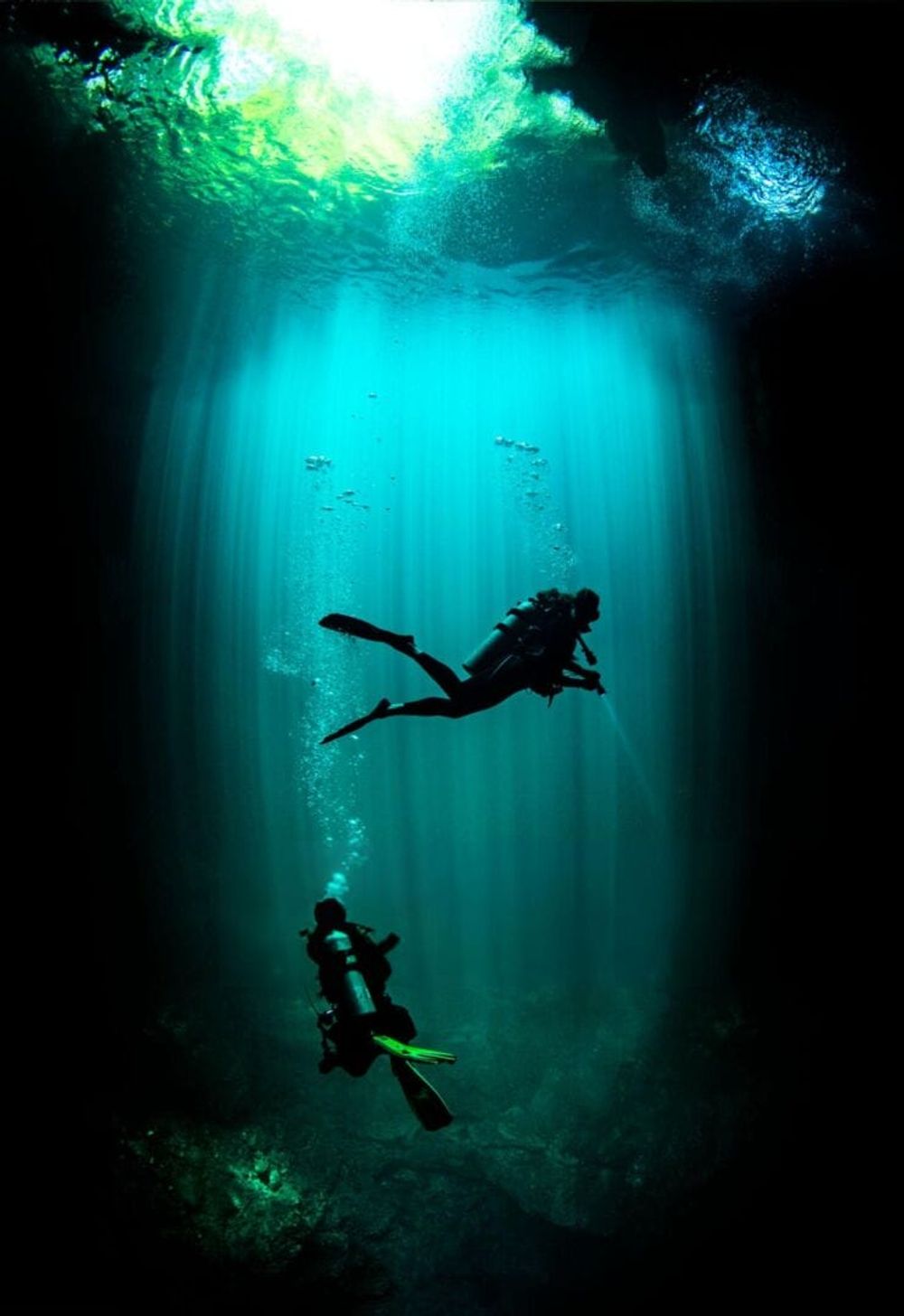
The fragile future of a submerged paradise
Everything about Tulum’s dive scene feels eternal. But it’s not.
Pollution, construction, and tourism pressures threaten the very systems divers come to see. Studies from Duke University’s Nicholas School of the Environment have documented increased contaminants during high season, altering microbial balances and oxygen levels in delicate systems.
Many cenotes now require permits or limit diver traffic. Some are closed altogether during sensitive periods like turtle nesting or cave restoration.
And locals worry. Not just dive pros, but the Mayan communities who’ve lived alongside these sacred waters for generations.
“The cenotes gave us water, stories, life,” one elder told The Tulum Times. “But they’re not forever if we don’t listen.”
That’s the quiet tension under the surface. The beauty of Tulum’s diving is also its burden.

What divers find, and what they leave behind
Diving in Tulum is not just about going deep. It’s about going inward.
Through rock and silence. Through light and dark. Through past and present. It challenges your body, expands your mind, and taps into something few destinations offer: the chance to explore a living, breathing history that begins where the light ends.
And once you’ve floated through a halocline, felt your pulse slow in a silent chamber, or stared at a stalactite older than civilization, you never quite come back the same.
We’d love to hear your thoughts. Join the conversation on The Tulum Times’ social media.
What would you dive for, adventure, connection, or silence?