

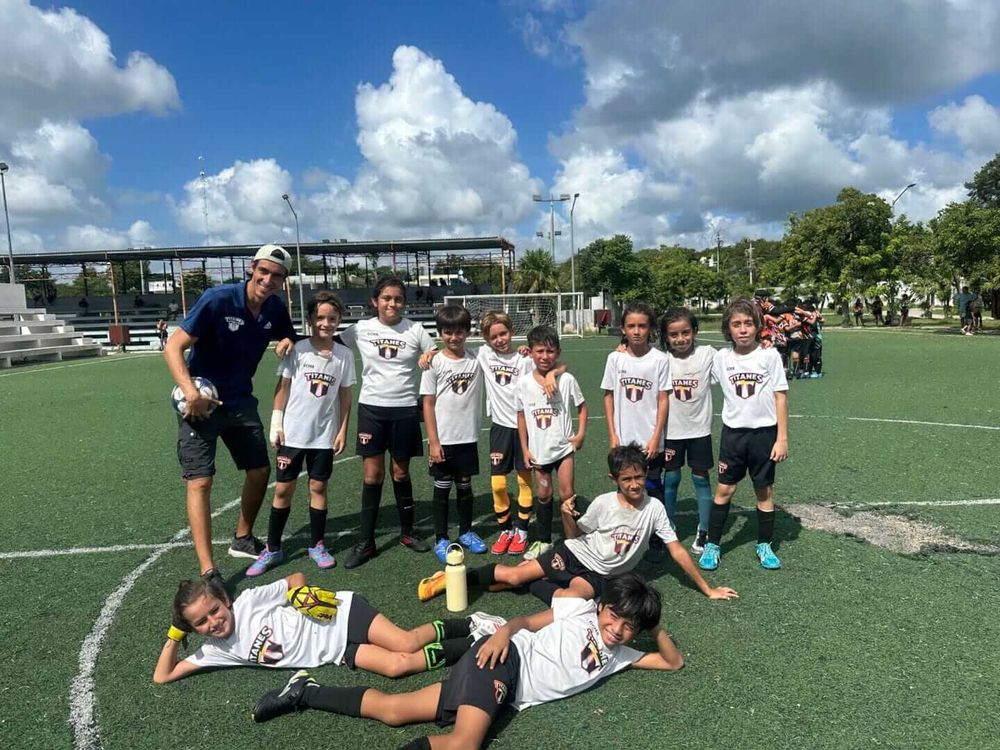
Club Titanes, a youth soccer school operating in Tulum since 2017, is marking nine consecutive years of activity with weekly training programs for children ages 3 to 13 and regular participation in local tournaments in Tulum and Playa del Carmen.
In a city defined by rapid population growth and constant migration, structured youth sports programs play a practical role in community integration. For families in Tulum, Club Titanes has become one of the consistent options for organized child development through sport, combining age-based training with competitive experience at the local level.
Age-based training structure shapes development
The club organizes its players by age and developmental stage, beginning with categories as young as 3 years old and advancing progressively through 13 years old.
Training plans are designed according to motor, emotional, and social development. In early childhood groups, sessions focus on basic coordination, guided play, and adaptation to a structured sports environment. As players grow, coaches incorporate technical fundamentals, teamwork exercises, decision-making, and introductory tactical understanding.
This staged approach is intended to avoid excessive physical or competitive pressure at early ages, prioritizing gradual development aligned with each group’s maturity. For parents navigating youth sports options in Tulum, this structure offers a defined pathway rather than a performance-first model.

Football as a formative tool beyond competition
While the club participates in tournaments in Tulum and Playa del Carmen, its stated philosophy extends beyond competitive results.
According to its institutional approach, soccer functions as a vehicle for teaching discipline, respect, autonomy, and creativity. The objective is to support personal development alongside athletic growth. Training environments are structured to help children learn teamwork, manage frustration, assume responsibilities, and build confidence.
The club’s long-term vision is to become the youth soccer organization in Mexico with the highest index of joy, autonomy, and creativity among its players. Although aspirational, that statement reflects a model centered on overall well-being rather than immediate results.
For Tulum, where many families arrive from different regions of Mexico and abroad, programs that combine structure and social integration carry added relevance. Organized sports often serve as one of the first entry points for children to build friendships and routines.

Expansion in older categories and girls’ soccer
This year, Club Titanes is actively strengthening its 12 and 13-year-old category and is currently integrating new players in that age group. The expansion creates additional openings for families seeking structured sports participation for preteens.
A recent development is the creation of a fully female team composed of girls ages 10 to 13. The group began operating a few months ago, and the club is seeking to expand and consolidate it. All other categories continue to function in mixed format.
The growth of girls’ participation in organized soccer at the local level aligns with a broader national trend of increased female involvement in sports. In Tulum, where access to consistent extracurricular programming can vary, the establishment of a dedicated girls’ group adds a new option for families.
The integration of more girls into organized training also reflects changing expectations around youth sports participation and access. And at the community level, expanding structured activities for girls may contribute to more balanced opportunities across neighborhoods.
Local impact in a high-mobility city
Tulum’s demographic profile is marked by migration and cultural diversity. Families often arrive without extended support networks, making organized activities more than recreational spaces.
Beyond training sessions, Club Titanes facilitates interaction among families, encourages healthy routines, and provides a supervised environment for children. Participation in tournaments in both Tulum and Playa del Carmen allows players to gain competitive experience while remaining connected to the club’s developmental focus.
For parents, this combination of local training and intercity competition offers exposure without requiring travel outside the Riviera Maya region. For children, it provides structured goals within a familiar setting.
The Tulum Times has previously reported on how youth initiatives contribute to social cohesion in fast-growing municipalities. In that context, sports academies like Club Titanes form part of a broader ecosystem of community-building efforts.

Open enrollment and search for sponsors
The club currently maintains open enrollment, with particular emphasis on the 12 and 13-year-old category and the girls’ team.
In addition, it is seeking sponsors for the next two seasons. Financial backing could support infrastructure improvements, uniforms, tournament logistics, and institutional growth.
For local businesses in Tulum, sponsorship opportunities may offer brand visibility tied to youth development and community engagement. For families, continued sponsorship can translate into more stable programming and expanded resources.
More information about training schedules and activities is available through the club’s official Instagram account at https://www.instagram.com/titanesfut.
As Club Titanes approaches a decade of continuous work in Tulum, its next phase will depend on enrollment growth and community support. In a city that continues to expand, structured youth programs remain one of the clearest indicators of how that growth translates into everyday life for families.
The evolution of youth soccer in Tulum will likely depend not only on athletic performance but on sustained access, inclusive participation, and stable local backing.
We’d love to hear your thoughts. Join the conversation on The Tulum Times’ social media.
How should Tulum strengthen community sports programs as the city continues to grow?