
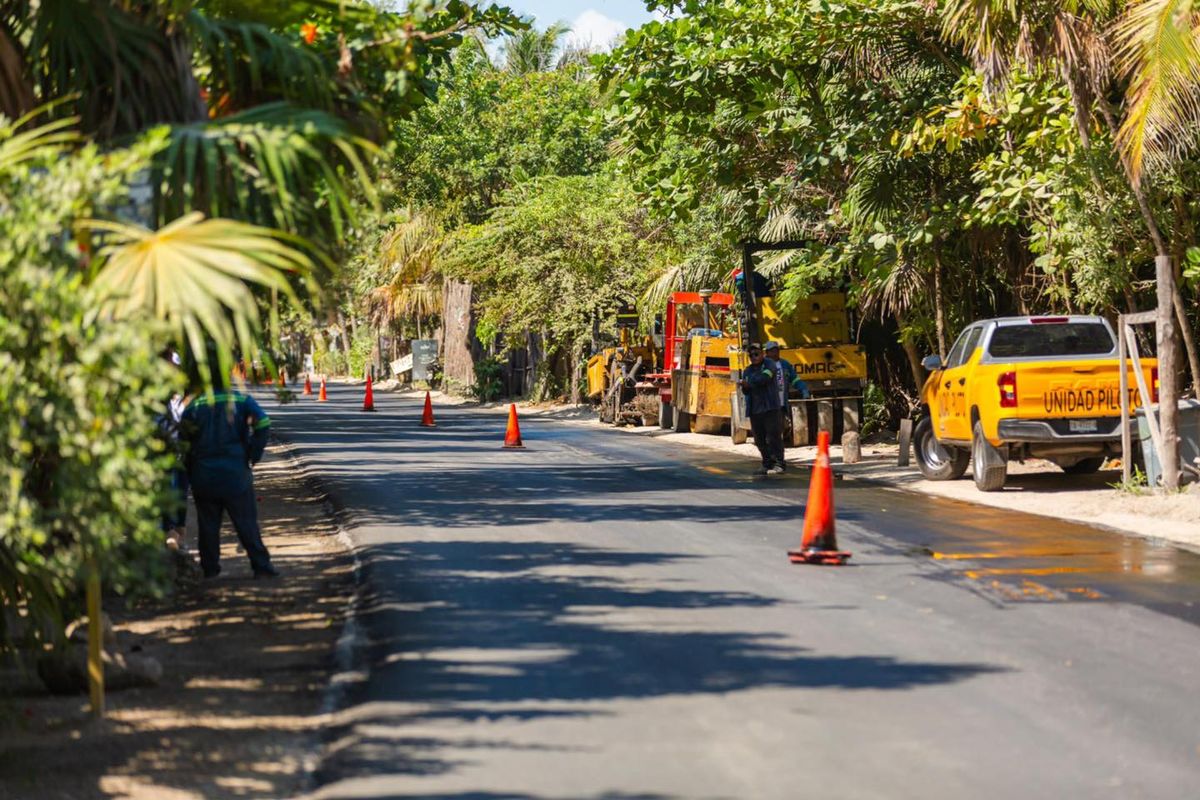
Tulum’s coastal corridor is undergoing a significant transformation as resurfacing work moves forward with visible progress, bringing relief and new questions to one of the town’s most heavily trafficked routes. With the pavement steadily replacing the previously deteriorated road, residents and visitors alike are watching the evolution of a space that is essential not just to traffic flow, but to the identity of Tulum itself.
A Project Years in the Making
This ongoing coastal road improvement, stretching 1.5 kilometers from the Kore Hotel to the Punta Piedra area, represents a broader infrastructure investment of 168 million pesos. Nearly 10 million pesos are allocated to this segment alone, according to Mayor Diego Castañón Trejo, who announced that work is now proceeding overnight to minimize daytime disruption.

“This isn’t just about fixing a road,” Castañón Trejo said. “It’s about restoring mobility to an area central to our tourism and local economy.”
Paving efforts are underway in La Veleta, with nearly 21 million pesos invested in improving neighborhood roadways. The administration has labeled these works a priority for residents and long-term development planning.
Rising Concerns for Non-Motorized Transit
As asphalt spreads and roadwork continues, a pressing issue is surfacing among the public: safety for those who walk or cycle along the coast.
Thousands of pedestrians and cyclists navigate the coastal road daily. Tourists on rental bikes, hospitality staff, and local families frequently share space with cars, often without any buffer or protection. In many sections, sidewalks or bike paths are nonexistent.

“The new pavement is welcome,” said one resident, “but we really need space to walk or cycle safely. Otherwise, accidents are just waiting to happen.”
The concern isn’t unfounded. Rising tourism and a growing local population have intensified traffic on the coastal corridor. While the improved road surface may enhance vehicle flow, the lack of pedestrian infrastructure remains a critical blind spot.

Broader Mobility Plans in Progress
To manage the impact of construction and traffic, the municipal government has coordinated with the Department of Transit to implement alternate routes, particularly during peak hours. Additional roadwork is scheduled to begin soon on Oko’ok Street, a temporary bypass for heavy vehicles, marking another step in the city’s evolving transit framework.

The resurfacing of Tulum’s coastal road may be the most visible sign of change. Still, it’s part of a larger movement toward reshaping how the city manages growth, accessibility, and quality of life. Questions about inclusivity, urban safety, and shared public space are emerging alongside the hum of construction equipment.
As pavement is laid down, so too is an opportunity to design a Tulum that supports movement and well, being for drivers, cyclists, and walkers alike.
We welcome your thoughts. Join the conversation on our social media channels and share your perspective on the future of Tulum’s roads.