
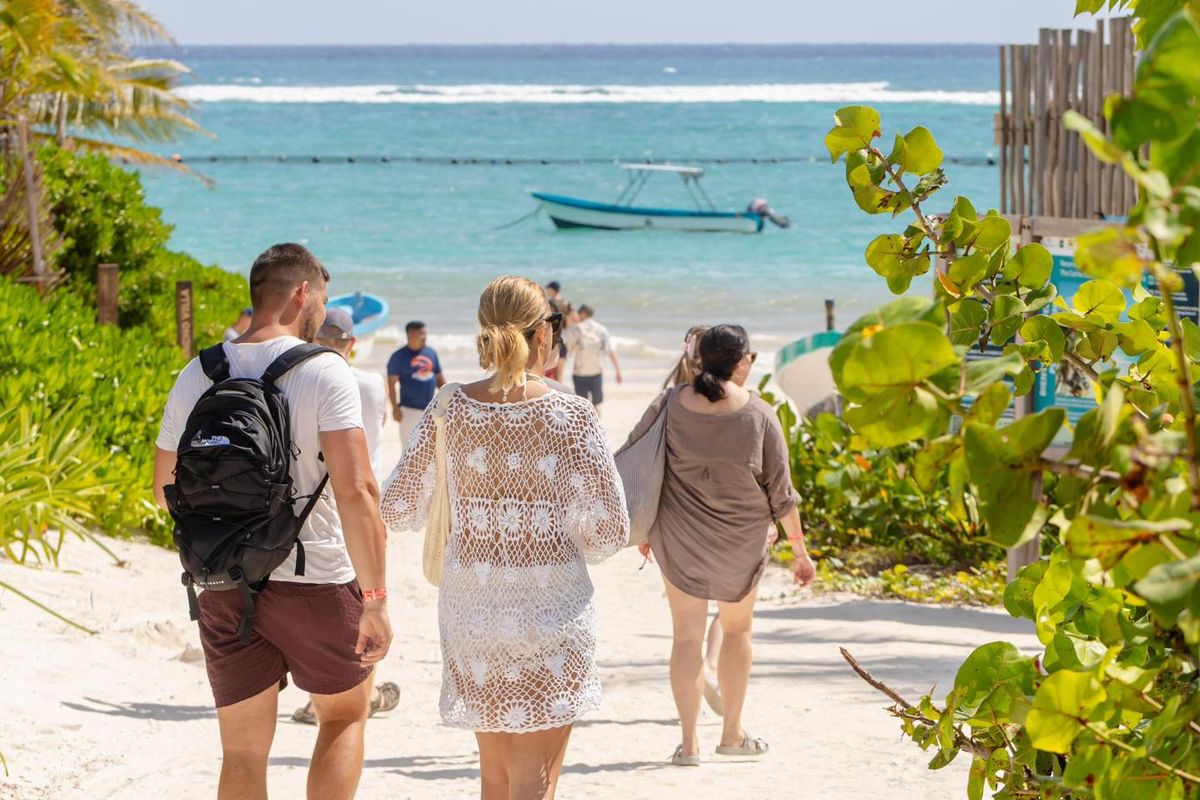
In November 2025, Tulum entered a new stage in its management of public spaces along the coastline. After months of citizen pressure, legal debate, and a gradual decline in tourism indicators, authorities from all levels of government announced the opening of free access points to the beaches located inside Parque del Jaguar, along with two additional public entry points along the coastal corridor. The measure was described as a response to longstanding demands from local residents who had repeatedly called for clear, free, and permanent access to the shoreline.
The announcement was made from the traditional entrance to Parque del Jaguar, a symbolic location for the community and one of the most requested points of access. According to state and federal officials, the action reflects the national well-being policy promoted by President Claudia Sheinbaum Pardo. This policy seeks to guarantee equitable enjoyment of natural spaces and strengthen a tourism model that prioritizes sustainability, social inclusion, and public benefit.
“Today, the traditional access, the one that residents had been asking for, is open. It is a right, not a privilege, and it will remain completely free,” said Governor Mara Lezama during a public visit. She was joined by Mayor Diego Castañón Trejo and representatives from federal, state, and municipal institutions.

Background of Conflict and Public Concern
A turning point after months of tension
The decision arrives after a period of increased frustration among residents and local organizations. During the year, several concerns emerged regarding access restrictions inside Parque del Jaguar, higher fees for visiting the archaeological zone, and the perception that the coastline was becoming increasingly difficult to reach without paying. These concerns were compounded by other challenges. Tulum experienced a drop in hotel occupancy, reductions in tourist arrivals, and growing worries about the long-term sustainability of the destination.
Local residents argued that the combined park and archaeological entrance fees limited the possibility of reaching the beach. Others pointed to inconsistent information, lack of signage, and the growing influence of private interests in the management of the coastal corridor. At the same time, federal authorities clarified that beaches in Mexico are public goods, and access to them must be guaranteed without financial barriers.
The announcement of new access points was framed as a correction to these issues. Officials emphasized that the coast belongs to everyone and that public entry should not depend on consumption in beach clubs or the purchase of additional tickets.

New Public Access Inside Parque del Jaguar
Two official free entry points for year-round use
Tourism secretary Josefina Rodríguez confirmed that two free public access points have been officially opened inside Parque del Jaguar. These entry points will operate every day of the year and are available for residents of Quintana Roo, national visitors, and international tourists.
Inside the park, visitors will now be able to reach five public beaches: Santa Fe, Pescadores, Maya, Mangle, and one additional shoreline area. All five are fully accessible through the internal paths.
Rodríguez explained that this implementation aims to respect the character of the park as a cultural and natural preservation area while ensuring that the coastline remains accessible. She highlighted the importance of these zones as shared spaces for recreation and local identity.

Two Additional Access Points on the Coastal Road
Playa Conchita and Playa del Pueblo
Mayor Diego Castañón announced the creation of two new public access points along the coastal road. These are located at Playa Conchita at kilometer 5.5 and Playa del Pueblo, both designed for family use. The sites include cleaning services, waste separation infrastructure, and official surveillance.
This development responds to long-standing community requests. Residents have repeatedly stated that public access should not depend on private businesses and must be clearly marked, clean, and safe.

Upgrades to the Traditional Park Entrance
Clear signage, wider paths, and improved visitor experience
Authorities confirmed that the traditional access to Parque del Jaguar underwent significant improvements. These include:
• Wider pedestrian paths
• Continuous cleaning
• Rest areas
• Signage that is visible from the highway
• Clear indicators guiding visitors from Federal Highway 307 to the beach trails
Governor Mara Lezama stated that twenty new signs will be installed along the route. Four signs will be placed along Highway 307, and sixteen totem-style markers will guide visitors inside the park. The goal is to ensure that both residents and tourists can easily identify free public access points without confusion or intermediaries.

Structure and Features of Parque del Jaguar
A public space with ecological and cultural components
General Adolfo Héctor Tonatiuh Velasco Bernal, director of Grupo Mundo Maya, outlined the broader context of Parque del Jaguar. According to the official description, the park includes:
• A museum
• A viewing tower
• More than four kilometers of pedestrian and bicycle trails
• Five public beaches
• Areas for educational and environmental activities
Visitors can walk, run, or cycle across internal routes that connect the archaeological zone with the coastal areas. This integrated approach aims to balance tourism, environmental protection, cultural interpretation, and community use.
Federal and State Coordination
Institutional presence during the announcement
The presentation of the new public access points included participation by several institutions. Public officials present included:
• Omar Vázquez Herrera, general director of INAH
• Bernardo Cueto Riestra, Quintana Roo’s tourism secretary
• Juan Carlos Romero Gil, regional director of Conanp
• Margarito Molina Rendón, director of the INAH Quintana Roo Center
Tourism secretary Rodríguez highlighted the importance of interagency collaboration. She noted that Tulum’s infrastructure, including the airport, the Tren Maya, and the park, forms part of a national strategy to support tourism with a human-centered focus.

Social Significance and Public Expectations
Community impact and ongoing concerns
For Tulum’s residents, the announcement marks the resolution of a longstanding request. The traditional access point in particular had become a symbol of public frustration as people asked for a simple, direct route to the shoreline without financial or operational barriers.
However, residents also expressed that the true test will be consistency. Many pointed to past experiences where public access points were announced but later obstructed by informal vendors, unauthorized charges, or unclear management.
Community groups emphasized three priorities for the coming months:
• Effective supervision to prevent misuse
• Clear communication to residents and tourists
• Accountability among authorities and operators

Implications for Tourism
A step that could help restore visitor confidence
Tulum has faced a weakening tourism cycle during the year, with lower occupancy rates and decreased spending. Local businesses and analysts noted that the perception of restricted access contributed to visitor dissatisfaction.
By opening clear and free access points, authorities aim to rebuild trust and recover the destination’s reputation as an accessible and enjoyable coastal area. Tourism specialists have described this measure as an important corrective step that can help reposition Tulum as a destination aligned with public interest.
Environmental Considerations
Balancing conservation with public access
Parque del Jaguar was designed as a protected ecological zone. With the new access points, environmental authorities emphasized the importance of:
• Waste reduction
• Controlled tourist flow
• Environmental education
• Preservation of vegetation and wildlife
Officials stated that the combination of new facilities, clear rules, and onsite supervision will help reduce the impact on sensitive areas.

A Policy That Redefines Coastal Access in Tulum
The long-term outlook
The opening of public access points is seen as a structural change in Tulum’s coastal management. The Government of Quintana Roo and the Government of Mexico framed the measure as part of a broader shift toward inclusive and responsible tourism.
The effectiveness of this policy will depend on long-term coordination, transparency, and enforcement. If the access points remain operational, clean, and free of barriers, Tulum may establish a reference model for public coastal access across the region.
For now, residents and visitors can enter the beaches of Parque del Jaguar and the newly opened coastal access points without cost, reinforcing the principle that beaches are a public right and a shared space for all.