
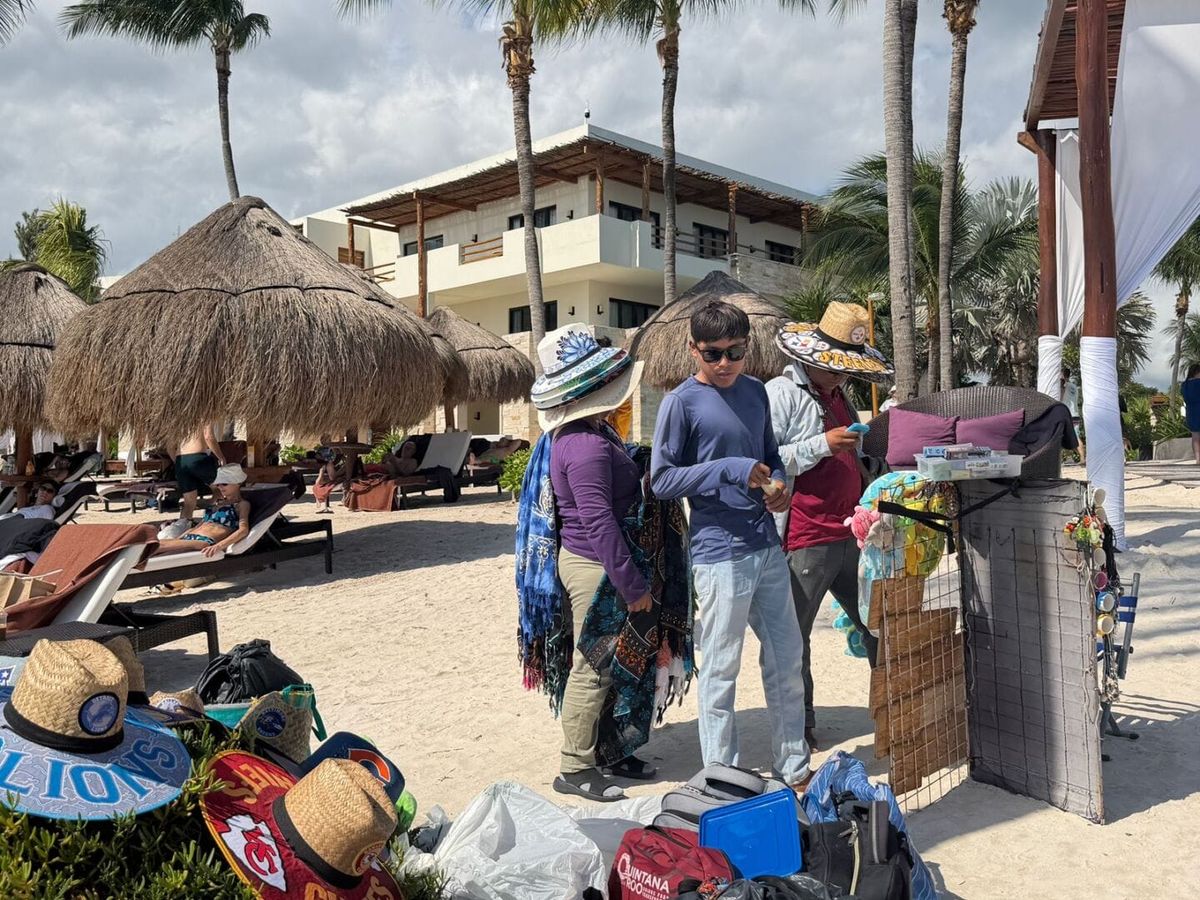
The growth of illegal beach vending in Tulum has resurfaced as a flashpoint in the struggle to restore order and credibility in one of Mexico’s most visible tourist destinations. This week, David Ortiz Mena, president of the Tulum Hotel Association, publicly urged authorities and residents to prioritize legality, warning that the unchecked spread of ambulantaje on local beaches risks undermining efforts to stabilize the destination’s image.
His message was direct and unusually forceful for a sector that often avoids public confrontation. At a moment when officials and business leaders say they are working to reverse perceptions of disorder in Tulum, allowing illegal commerce to expand along the shoreline sends the opposite signal.
A call to defend legality as tourism recovers
Ortiz Mena delivered his warning through a press statement that framed the issue not as a minor nuisance but as a structural problem. In his view, the presence of unregulated vendors on the beaches contradicts public campaigns aimed at projecting safety, organization, and rule of law in the Riviera Maya.
“Some say the sun rises for everyone to justify street vending,” he said, using a phrase common in Mexico to defend informal work. “But they forget that this is a prohibited activity. No one has permits to sell on the beach.”
That statement resonated beyond Tulum. Ortiz Mena also serves as president of the Mexican Caribbean Hotel Council, giving his remarks weight across Quintana Roo, where tourism is both the main economic engine and a politically sensitive sector.
Tourism operators argue that beach vending, once sporadic, has grown in scale and visibility. And with international arrivals slowly recovering from past shocks ranging from the pandemic to security scares, the optics matter.
The beaches as a mirror of governance
In Tulum, beaches are more than leisure spaces. They function as a public showcase of how authorities manage land use, security, and commerce. When visitors see dozens of unauthorized vendors offering food, massages, souvenirs, or tours, the impression can be confusion rather than charm.
Ortiz Mena emphasized that containing beach vending would be a straightforward way for authorities to demonstrate order. Federal, state, and municipal governments all have jurisdiction over different aspects of coastal management, from maritime zones to public security. Coordinated enforcement, he suggested, would send a clear message that rules exist and are enforced.
The main keyword here is illegal beach vendors, and in Tulum, that phrase carries broader implications. It touches on governance gaps, social inequality, and the tension between informal survival economies and a tourism model built on regulation and exclusivity.
Security concerns beyond the tourist postcard
The most serious part of Ortiz Mena’s warning went beyond aesthetics or brand image. He argued that illegal vending can act as a cover for more serious crimes, including human trafficking.
According to his statement, authorities have identified cases in which individuals detained as beach vendors were later linked to criminal activity. Some vendors are foreign nationals. Others are minors. In certain instances, people selling goods or services were found to be operating under coercion or as part of organized networks.
This is not the image tourism officials want associated with the white-sand beaches of the Riviera Maya. And it reframes the debate. The issue is no longer just about informal commerce versus regulation, but about public safety and human rights.
“One cannot separate illegal beach vending from the risks it hides,” is the kind of line that travels well on social media, and it reflects the tone Ortiz Mena adopted.
A familiar problem with new urgency
Beach vending has long existed across Mexico’s tourist corridors, from Cancún to Playa del Carmen. What appears to worry hotel leaders now is scale and tolerance. As Tulum grew rapidly over the past decade, enforcement lagged behind development. The result has been a patchwork of informal practices filling regulatory voids.
In recent years, Tulum has faced international headlines about crime, infrastructure strain, and environmental degradation. Federal and state authorities have responded with high-profile projects like the Maya Train and Jaguar National Park, alongside promises of improved security and urban planning.
Against that backdrop, visible disorder on beaches undermines official narratives. For visitors, the beach is often their primary interface with the destination. If that space appears unregulated, broader assurances about safety and governance ring hollow.

Authorities caught between enforcement and social reality
Cracking down on illegal beach vendors is politically delicate. Many vendors are migrants or low-income residents with limited economic alternatives. Aggressive enforcement risks images of repression and social conflict, particularly if it targets women or minors.
Yet allowing the practice to continue unchecked creates another set of problems. Hotel operators complain of unfair competition. Environmentalists warn about waste and damage to fragile coastal ecosystems. Security experts point to the potential for criminal infiltration.
Ortiz Mena did not outline a detailed enforcement plan. Instead, he placed responsibility squarely on authorities at all three levels of government, arguing that the tools already exist. What is lacking, he implied, is political will and coordination.
The business sector raises its voice
The intervention by the Tulum Hotel Association signals growing frustration within the private sector. Hoteliers have invested heavily in promoting Tulum as a premium destination, distinct from mass tourism hubs elsewhere in Mexico. That strategy depends on perceptions of exclusivity, safety, and order.
When those perceptions erode, the business model is threatened. Investors watch signals closely. Tour operators adjust recommendations. Travelers, especially from the United States and Europe, may choose alternatives in the Caribbean or Central America.
This is where the local debate becomes global. Tulum’s reputation no longer belongs only to Quintana Roo. It circulates internationally through reviews, social media, and travel advisories.
Informality, inequality, and the limits of tourism growth
There is an uncomfortable subtext to the debate. Tulum’s rapid growth has produced winners and losers. While luxury hotels and restaurants thrive, many residents struggle with rising rents and limited job security. Informal vending becomes, for some, a survival strategy.
Critics of strict enforcement argue that removing vendors without offering alternatives simply displaces the problem. They call for regulated zones, permits, or social programs that integrate informal workers into the formal economy.
Ortiz Mena did not engage deeply with that argument, focusing instead on legality and security. But his comments reopen a broader question: can Tulum continue to grow as a global destination without addressing the social pressures that growth creates?
A test of credibility for local governance
For authorities, the issue of illegal beach vendors in Tulum is a test case. If they cannot enforce clear rules in highly visible areas, skepticism grows about their ability to manage more complex challenges, from environmental protection to organized crime.
Containing beach vending would not solve all of Tulum’s problems. But it would signal that laws matter. That coordination is possible. That public spaces are governed, not abandoned to improvisation.
As The Tulum Times has reported in other contexts, credibility in tourism destinations is built as much on what visitors see as on what officials say.
What is at stake for Tulum and the Riviera Maya
At stake is more than a clean beach. It is trust. Trust from visitors deciding where to spend their money. Trust from investors weighing risk. Trust from residents who want both opportunity and order.
The debate over illegal beach vendors exposes the fragile balance between inclusion and enforcement in Mexico’s tourism economy. How authorities respond in Tulum could set a precedent for the wider Riviera Maya.
In the end, Ortiz Mena’s message was not subtle. Protect the destination’s image by upholding the law. Or accept that disorder becomes part of the brand.
We’d love to hear your thoughts. Join the conversation on The Tulum Times’ social media.
Should Tulum prioritize strict enforcement on its beaches, or seek regulated solutions for informal workers?