

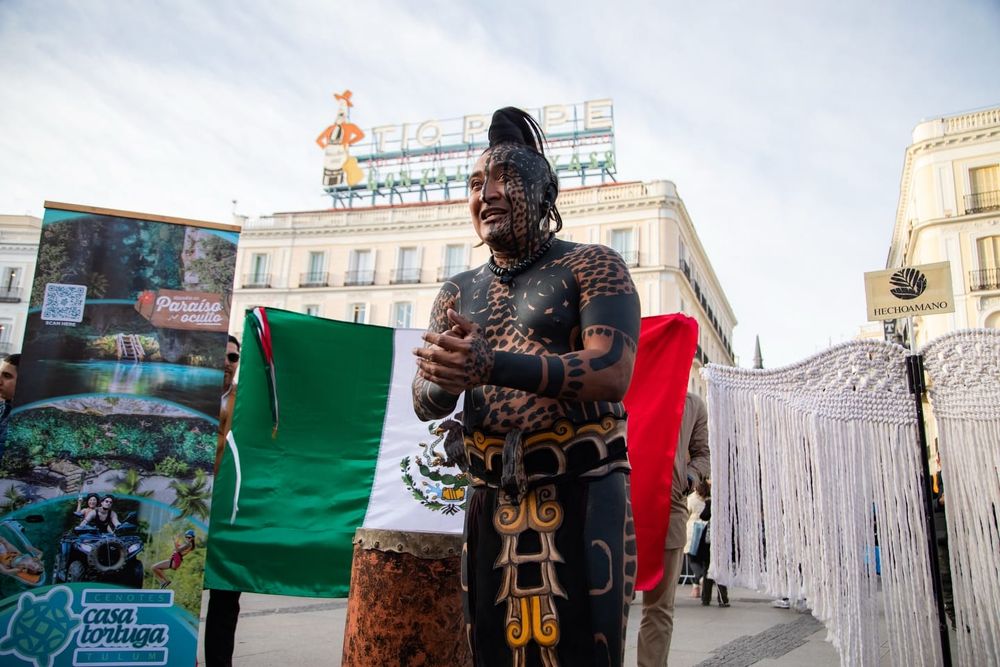
A symbolic representation of Mayan culture from Tulum was presented publicly in Madrid as part of a cultural and tourism promotion initiative linked to the Mexican Caribbean. The character known as El Último Maya (The last Mayan) appeared at Puerta del Sol, one of the most recognized public spaces in Spain’s capital, engaging passersby with visual and narrative elements rooted in Mayan heritage.
The activity took place in Madrid in recent days and was shared publicly by the character itself through informational materials. According to those communications, the appearance was coordinated with Cenotes Casa Tortuga and Mario Cruz Rodríguez, a tourism promoter from Tulum, who participated in the initiative aimed at projecting Mayan identity to an international audience.
The presentation centered on ceremonial attire, symbolic elements, and an ancestral narrative intended to evoke the continuity of Mayan civilization and its presence in the contemporary identity of the destination. The initiative aligns with broader strategies that place culture at the core of tourism promotion efforts for Quintana Roo in international markets.

A cultural message in a high-visibility public space
The selection of Puerta del Sol as the setting was driven by its role as a major gathering point for residents and visitors. The square is known for its constant foot traffic and its function as a cultural crossroads within Madrid, providing visibility among people from a wide range of nationalities.
During the appearance, messages focused on the preservation of cultural and natural heritage were shared alongside references to what distinguishes Tulum and the Mexican Caribbean. These included cenotes, surrounding jungle landscapes, and the ancestral legacy that continues to shape the region’s identity.
The activity did not involve staged performances or commercial transactions. Instead, it relied on visual symbolism and direct interaction with the public to convey its message. The approach reflects a growing emphasis on experiential and identity-driven promotion rather than conventional advertising.

Positioning Mayan heritage within tourism promotion
El Último Maya is presented as a character that emulates an ancient Mayan figure through ceremonial clothing, symbols, and storytelling. The narrative seeks to highlight the historical depth and spiritual dimensions of the Mayan civilization, while also suggesting its relevance within present-day communities.
This type of representation is increasingly used within tourism promotion as destinations attempt to differentiate themselves beyond standardized images. In the case of Tulum, cultural identity has become a central element in how the destination is communicated abroad, complementing its established reputation for beaches and natural attractions.
The participation of Cenotes Casa Tortuga, a well-known attraction in the Tulum area, links the cultural message to specific experiences available in the region. While no commercial offers were promoted during the appearance, the association reinforces the connection between heritage, nature, and tourism infrastructure.
International outreach from a local origin
The character originates from Tulum, a destination that in recent years has expanded its international profile. Promotional efforts increasingly emphasize roots and continuity, responding to traveler interest in culture, history, and local identity.
According to the information released, Mario Cruz Rodríguez participated as a tourism promoter supporting the initiative. His involvement underscores the role of local actors in shaping how destinations are presented internationally, particularly in non-institutional settings such as public squares.
Madrid was chosen as the host city due to its status as a major European capital with strong tourism flows and cultural exchange. Spain remains an important market for Mexican tourism, both as a source of visitors and as a platform for broader European exposure.

Culture as a strategic axis for Quintana Roo
The initiative forms part of a narrative that positions culture as a strategic axis in promoting destinations within Quintana Roo. Rather than focusing exclusively on leisure or resort offerings, this approach seeks to frame the region as a territory with deep historical roots and a living identity.
Such strategies aim to appeal to travelers interested in meaning-driven experiences, while also reinforcing messages about preservation and respect for heritage. During the Madrid appearance, references were made to safeguarding both cultural traditions and natural environments, themes that resonate within global tourism discourse.
This emphasis reflects a broader shift in destination marketing, where cultural authenticity and sustainability are increasingly highlighted as differentiating factors. While the long-term impact of individual actions can be difficult to measure, public appearances in high-traffic international locations are designed to increase visibility and recognition.

A narrative beyond sun-and-beach imagery
Tulum has long been associated with coastal scenery and archaeological sites. In recent promotional narratives, there has been an effort to present the destination as more than a leisure hotspot, emphasizing its historical continuity and contemporary cultural expressions.
The presence of El Último Maya in Madrid aligns with that objective. By placing a symbolic representation of Mayan heritage in an urban European context, the initiative seeks to create dialogue between cultures and to frame Tulum as a place defined by living traditions rather than solely by landscape.
The Tulum Times has previously reported on cultural initiatives that aim to redefine how the destination is perceived abroad, including efforts centered on heritage, community, and environmental awareness. This appearance fits within that evolving framework.

What remains at stake for cultural promotion abroad
Actions like this rely on symbolism and visibility rather than formal campaigns, and their effectiveness depends on sustained coherence with broader destination strategies. As competition among global destinations intensifies, the challenge lies in maintaining authenticity while reaching diverse international audiences.

The appearance of El Último Maya in Madrid highlights an ongoing effort to position Tulum and the Mexican Caribbean through cultural identity, raising questions about how such narratives evolve and how they are received across different contexts.
As destinations continue to seek relevance beyond traditional tourism imagery, the role of cultural representation remains central. What remains relevant is whether these efforts can translate symbolic visibility into deeper understanding and long-term appreciation of heritage.
We’d love to hear your thoughts. Join the conversation on The Tulum Times’ social media.
How should destinations like Tulum balance global promotion with the preservation of their cultural identity?