
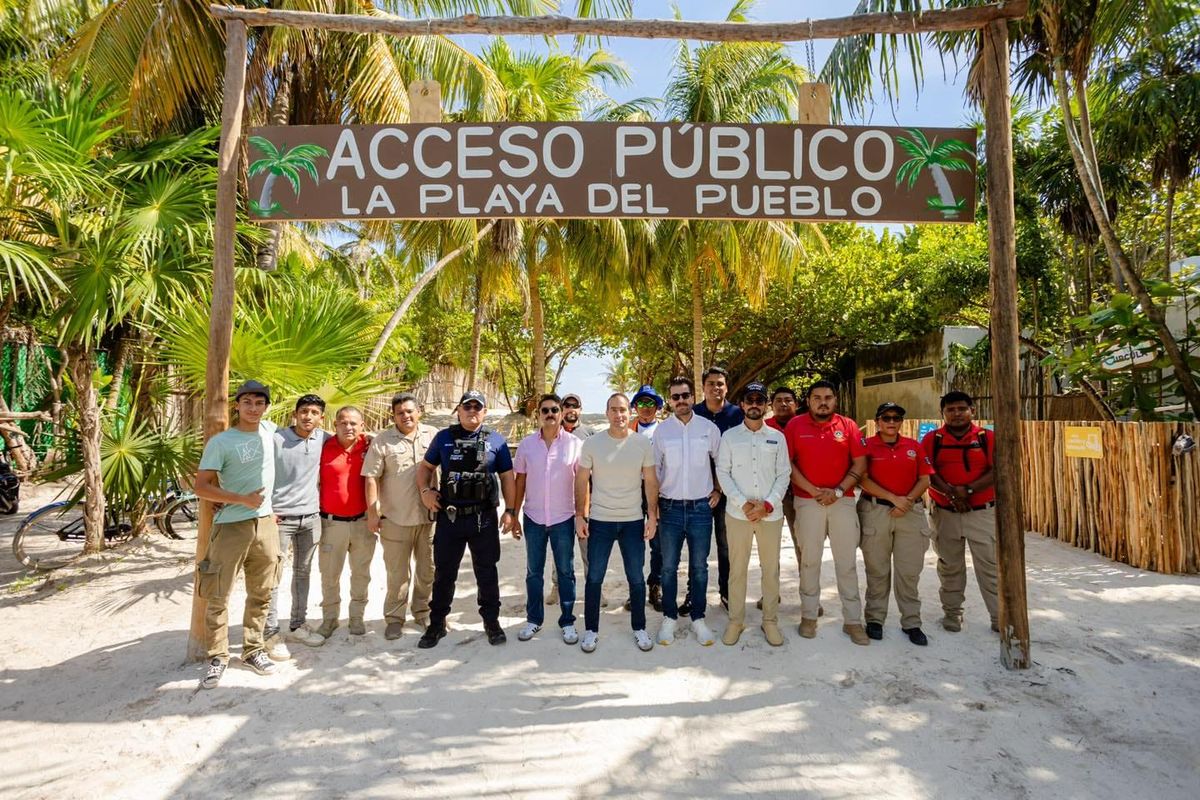
The recent attention around La Playa del Pueblo in Tulum raises more than a practical question about beach access. It reflects how a community in Quintana Roo has lived through years of rapid transformation. By itself, the phrase might seem informal, but it carries the weight of shared experiences, expectations, and unresolved tensions. And even if Mexico’s law states that all beaches are public, the lived reality in much of the Riviera Maya has often suggested something different. This editorial from The Tulum Times examines why this term appears now, what it represents emotionally and socially, and how it could guide a more balanced future.
A name that draws a line between access on paper and access in practice
When residents begin to refer to a space as la playa del pueblo, they are not creating a new legal category. They are responding to a gap between rights and everyday experience. The name marks a boundary that the population has tried to hold. It communicates that there is still a place where people feel they can arrive, settle, share food, sit on the sand, and be present without conditions linked to consumption.
For many who live in Tulum, access to the coast gradually stopped feeling natural. Not because the law changed, but because the environment around the beach became more restrictive. Guards at entrances asked extra questions. Paths once known by neighbors became corridors managed by private businesses. The idea that belonging required paying for a bed, a table, or a minimum consumption took hold. In that context, the name La Playa del Pueblo acts as a reminder that community presence still matters. A resident told us in a local forum, in a phrase that could circulate on social media, “public access is a right, but feeling welcome is another story”.

The contradiction between legal public access and emotional exclusion
Mexico’s legal framework is clear: beaches are federal property and therefore open to all. Yet many families in Tulum describe something different. They speak of long routes to reach the shore, signs that seem to discourage entry, prices aimed at international tourists, and looks that imply that certain spaces are not meant for those who live here.
This contradiction generates frustration. People understand that the coast is public, but the experience often does not reflect that principle. Over time, this gap becomes a source of emotional exhaustion. Individuals adapt to a system that pushes them to consume to justify their presence. And while no one explicitly states that some beaches are for tourists and others for the community, the pattern of indirect barriers creates that impression.
The beach that ends up being known as la playa del pueblo feels like an exception where rights and experience finally align. It is not a romantic ideal. It is a response to a long period in which access felt narrowed by economic, physical, and symbolic filters.

Rapid growth and internal displacement in a changing Tulum
Tulum shifted from a small coastal town to a global destination in a short period of time. Hotels multiplied. Influencers and events rebranded the area. Real estate projects expanded. International tourism brought opportunities for many workers, but also created pressure points that reshaped everyday life.
Prices rose faster than wages. Streets, services, and public investment prioritized visitor mobility. The local identity started to compete with an international narrative built for marketing and high-spending travelers. None of this happened by explicit design. It unfolded gradually, driven by global demand and limited long-term planning.
The community did not face sudden physical displacement, but a slow and persistent shift in priorities. What used to be a shared public environment became part of a commercial circuit. The message that emerged for many was subtle but firm: to belong fully, one must consume. That shift created a fracture between two images of Tulum. One as a home for people who live and work here. Another as a polished product for the global tourism industry.
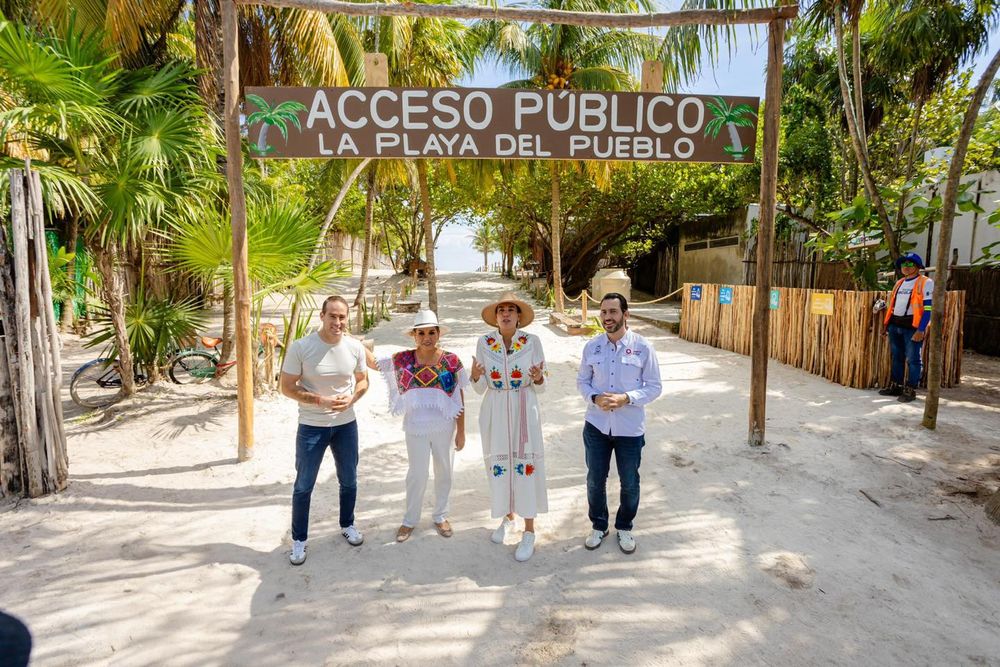
Indirect barriers that shape who feels welcome at the coast
Modern exclusion rarely operates through direct prohibition. It works through filters that influence who enters and who steps back. Some are physical, such as closed access points or walkways hidden behind private structures. Others are financial, like prices that far exceed the average income in Quintana Roo. There are also symbolic cues, such as design choices aimed at an upscale market or interactions that imply that certain visitors are valued more than others.
These elements produce an atmosphere where access depends less on rights and more on perceived status. People adapt to these signs. Some avoid particular areas because they do not want to feel out of place. Others assume that the coast near certain hotels is not meant for them, even when the law says otherwise. In that environment, the existence of la playa del pueblo stands out as a rare moment where the experience feels straightforward again.

Why does the community celebrate something that technically already existed
From an outside perspective, celebrating access to a public beach might seem unnecessary. But for those who have lived years of indirect restrictions, the celebration is understandable. It signals a moment in which a public decision aligns with community needs. It lowers the feeling of neglect. It restores, even in small measure, the sense that residents matter.
It also challenges the idea that tourism should always take precedence. Not by attacking the industry, but by reminding everyone that Tulum is not only a destination. It is also a home shared by workers, families, business owners, internal migrants, public employees, and long-time residents. The gesture does not erase past tensions, but it helps reduce the emotional distance that had expanded between the institution and the population.
Still, there are risks. Celebrating this access might lead to complacency. One beach does not compensate for the unequal distribution of coastal entry points. And it does not resolve deeper challenges such as rising housing costs, pressure on basic services, or the economic divide between tourism revenue and local wages. If the celebration becomes an excuse to halt further improvements, the gesture remains superficial. If it motivates broader conversations, it can become a starting point for long-term change.
The emotional layers behind the term
Behind the excitement around la playa del pueblo, there is also grief. People are grieving a Tulum that no longer exists in the same form. They feel anger about decisions made without consultation. Some express shame when they cannot afford to take a friend to the beach unless they pay for a club. Others feel tired. Tired of the debate. Tired of adapting to changes they did not choose.
Naming a space La Playa del Pueblo offers relief. It gives shape to feelings that have been carried quietly. It signals to the community that their emotions are valid. And it confirms that the social transformation of Tulum has psychological consequences, not just economic ones.

What deeper solutions could look like
No individual can resolve the entire problem, but discussions can happen at different levels.
At a personal level, acknowledging these emotions helps people understand that their discomfort has real causes. Creative projects, dialogue, and participation can transform that energy into action.
At a community level, bringing together residents, workers, small business owners, and authorities can lead to proposals on mobility, cost of living, and access. The narrative should avoid polarizing tourists versus locals. The central debate is not about who is good or bad. It is about which development model benefits both visitors and the population.
At a media level, telling the full story of Tulum matters. The region deserves coverage that shows its internal complexity, not only its appeal to travelers. La playa del pueblo becomes a way to explain why a simple name can express years of exclusion and the hope for a more balanced future.
What Tulum has gone through, and what La Playa del Pueblo reveals
In terms of social psychology, Tulum shifted from being a home to being a product more quickly than the community could absorb. An economic model centered on high-spending tourism created opportunities, but also a loss of control. The beach that carries the name La Playa del Pueblo reflects an attempt to regain a sense of belonging. People are not celebrating that something was given to them. They are celebrating that, for once, the experience resembles what the law has always promised. Access without filters. Space without conditions. A coast that also belongs to those who sustain the region every day.
In this context, la playa del pueblo is more than a location. It is a reminder that Tulum can still balance opportunity with fairness.
We close with the main keyword once more: la playa del pueblo encapsulates the ongoing challenge of building a town where tourism and community can coexist with dignity.
We’d love to hear your thoughts. Join the conversation on The Tulum Times’ social media.
How do you think Tulum can protect access while sustaining its tourism economy?