
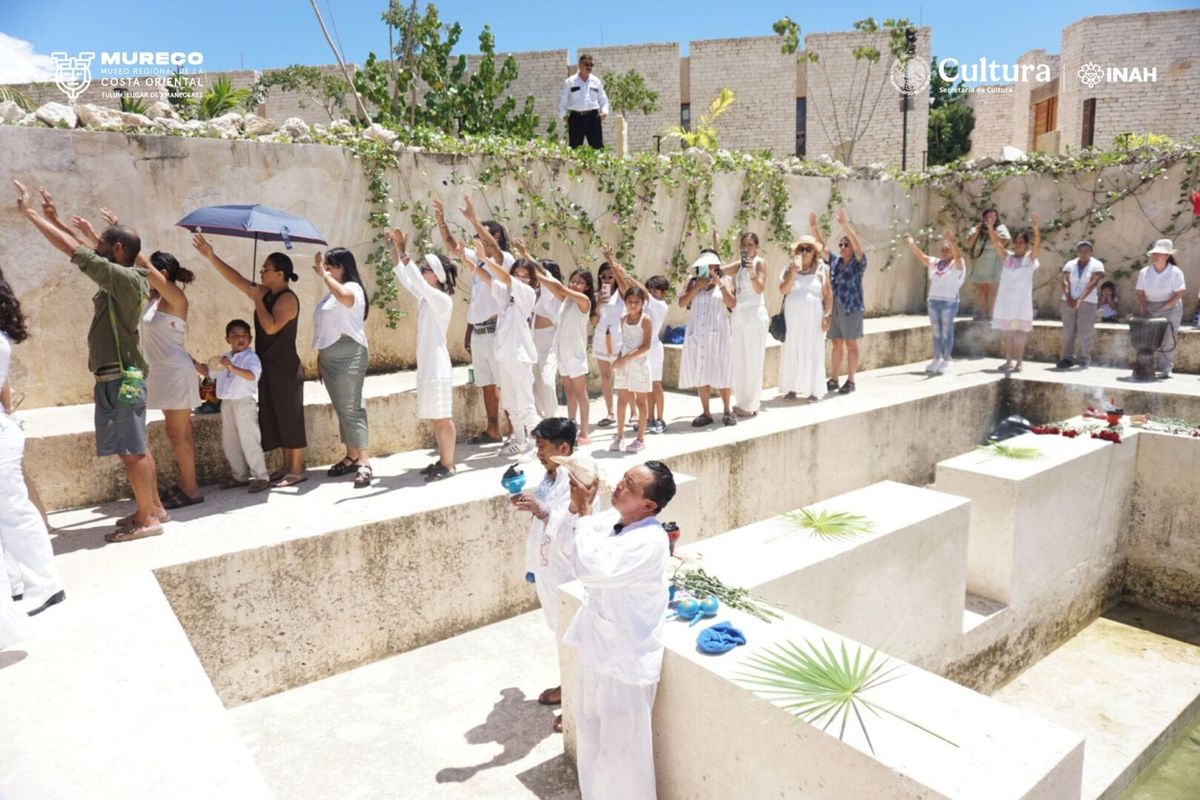
At high noon under the sweltering Tulum sun, a conch shell sounds in four directions. The earth is blessed. Heads bow, incense curls skyward. This isn’t a show for tourists, it’s a Maya ceremony of desagravio, a sacred act of reconciliation with the land. And with that, the Museo Regional de la Costa Oriental (Mureco) marks its first anniversary, not just with celebration, but with intention.
Located inside Parque del Jaguar, Mureco has become far more than a museum in just twelve months. It’s a living space of memory, blending ritual, art, community, and a fierce respect for the Maya heritage that shaped the Yucatán Peninsula long before Tulum appeared on Instagram feeds.

Since opening its doors on September 7, 2024, the museum has received over 98,000 visitors, according to the Instituto Nacional de Antropología e Historia (INAH). But numbers only tell part of the story. As director Carmen Gaitán Rojo put it, “This is no longer just a structure. Now, visitors walk away understanding that those ancient ruins were once homes, filled with life, belief, trade, and deep history.”
A Museum with a Mission
Spread across 1,200 square meters and housing over 300 original pieces, plus 50 carefully crafted reproductions, Mureco is the largest cultural site in the Tren Maya museum network. Its permanent exhibitions trace an arc from the Late Pleistocene to the present day, spotlighting the resilience and evolution of the Maya people.

Curator Karina Romero Blanco designed the exhibits to be more than educational, they’re immersive. One room explores the concept of ice and its absence in the region, another showcases contemporary Maya life, challenging visitors to connect ancient artifacts with living descendants.
For Gaitán Rojo, this human-centered approach is crucial. “We’ve exceeded expectations,” she said. “Many foreigners are amazed when they realize how Tulum connects with Cobá, Chichén Itzá, and Uxmal. This museum stitches the region together in a way that’s rarely been done before.”
A First Birthday Done Right
On Saturday, September 13, the museum celebrated its first anniversary with more than speeches. There were traditional dances, regional cuisine, and a strong presence from local schools and families. The program also featured the Ballet Folclórico DanzArte, the Mariachi Mexicano, and collaborative efforts with EducArte de Tulum.

But the real centerpiece was the Maya ceremony. As Gaitán explained, it wasn’t optional. “We entered this land without asking. Machines, people… we came in. This ceremony to the four cardinal points is a way of asking the Earth, the stars, and nature to bless and protect this space.”
It was an emotional gesture that encapsulates the museum’s essence: humility before history, and hope for continuity.
Bridging the Past and Present
While tourists may admire the collection, Mureco’s true legacy might lie in its work with children and marginalized communities. “Kids are our focus,” said Gaitán. “We want them to understand their roots, to make a mask with their hands, to feel pride in their ancestors.”

This mission isn’t just talk. The museum recently acquired a transport van to bring children from remote areas to the museum, often for the first time. Through guided tours, workshops, and interactive exhibits, these visits aim to reclaim identity and reconnect generations.
In the past year, Mureco also hosted academic lectures, literary presentations, and even a festival centered on biodiversity, proving that it’s not just a repository of the past, it’s a springboard for dialogue about the future.

A Gateway with Conditions
One lingering complication remains: although entry to Mureco is free, it is still located inside the Jaguar National Park, which charges an access fee controlled by Grupo Mundo Maya and Conanp. This gatekeeping has led to confusion and, at times, frustration.
Gaitán clarified the workaround: “Just tell the staff at the gate you’re going only to the museum. That’s enough. You’ll be let through.”
Still, the existence of this hurdle reveals a broader truth, culture may be free, but access often isn’t. For now, Mureco walks a tightrope between inclusion and restriction.

Mureco’s Vision for Year Two
The museum isn’t slowing down. New exhibitions are on the horizon, including two rotating galleries that will explore Maya cosmology, architecture, and ecological thought. More book launches, artist talks, and student collaborations are in the pipeline.
Long-term, the vision is bolder. “We want to become a research center for southeast Mexico,” Gaitán revealed. “And we want this to be a museum for everyone, especially those in the most underserved areas.”

If the first year was about foundation, the second seems poised to be about expansion, not just in physical programs, but in social relevance.
A Micro-Story, A Macro Message
During one school visit, a six-year-old asked a guide what the symbols on a vase meant. She wasn’t just curious, she was asking in Yucatec Maya. That moment, shared later by a museum worker, brought tears to her teacher’s eyes.
That’s the power of place. Of seeing yourself in the story being told. Of realizing your ancestors didn’t just live in ruins, they lived full, dynamic lives that still echo today.

Closing Reflections
Mureco’s first anniversary isn’t just a milestone. It’s a reminder that heritage lives and breathes, especially when given a home that respects its complexity.
As the Riviera Maya wrestles with mass tourism and cultural dilution, Mureco stands as a model of what rooted, community-driven preservation can look like.
We’d love to hear your thoughts. Join the conversation on The Tulum Times’ social media.
What should be the role of museums like Mureco in reshaping the national narrative?