

Tulum’s beaches are more than picturesque, they’re magnetic. The sunrises feel sacred, the breeze feels ancient, and the Caribbean rolls in with a rhythm that echoes through your soul. But even in paradise, the question remains: who really gets to enjoy the coast? While public beach access in Tulum is a right protected by Mexican law, the reality of accessing that shoreline, freely, legally, and comfortably, can be far more complicated. This guide offers everything you need to know about public beach access in Tulum, including how to navigate the current regulations, fees, and local efforts that are reshaping who gets to stand where land meets sea.

Know Your Rights: The Legal Framework
In Mexico, all beaches are public by law. The first 20 meters from the high tide line are part of the federal maritime zone and must remain free and open to all. A 2020 reform further reinforced this right, establishing legal consequences, including steep fines and even demolition, for anyone attempting to privatize or block access to public beaches. But while this framework is clear in principle, implementation varies widely, particularly in tourist-heavy areas like Tulum.
The core issue is not whether you’re allowed on the beach, but how you’re supposed to get there. In Tulum, luxury hotels and high-end developments dominate the beachfront. While they cannot legally restrict access to the sand itself, the surrounding infrastructure often makes it hard for non-guests to find a public path.

Jaguar Park Beaches vs. The Rest of Tulum’s Coastline
One of the most defining changes in Tulum’s coastal access is the creation of Parque Nacional del Jaguar, a federally protected natural reserve that covers a significant stretch of shoreline. Unlike the more rustic and loosely governed public beaches throughout the region, the Jaguar Park operates under a highly regulated structure with official entry points, controlled capacities, and, most notably, entry fees.
Visitors to the park are required to pay to access its beaches, even though they remain legally public. In 2025, foreigners are charged $415.37 MXN, Mexican nationals $255.00 MXN, and Quintana Roo residents $105.00 MXN. Armed Forces members and GAFSC officers also pay $105.00 MXN, while students and teachers from accredited Mexican schools enter for $31.00 MXN. Certain groups, such as children under 12, senior citizens with INAPAM cards, pensioners, people with disabilities, and verified Tulum residents, are fully exempt from payment.

The difference in experience between Jaguar Park and other public beaches is substantial. Inside the park, visitors encounter clean, well-maintained facilities, including restrooms, walking paths, shaded areas, and security personnel. The access is clearly marked and orderly. Environmental protections are enforced, and the atmosphere feels tranquil, respectful, and safe.
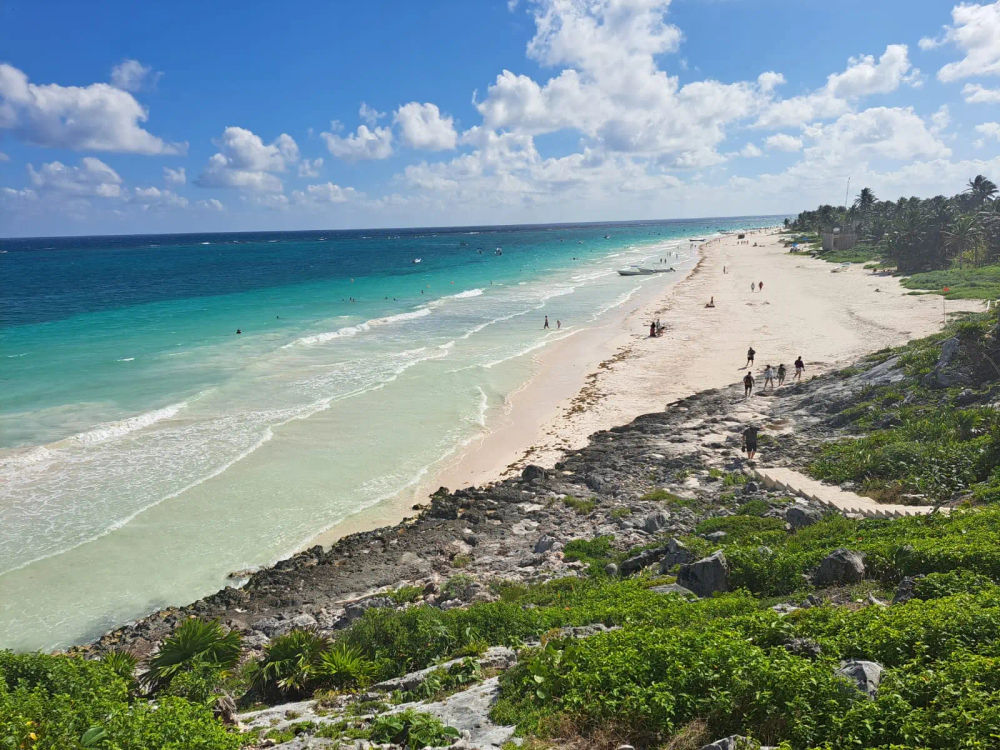
Contrast that with the rest of Tulum’s coast, where access points are often hidden, unmarked, or squeezed between private developments. Infrastructure is minimal or nonexistent. Parking is limited. Safety services, such as lifeguards or medical attention, are rare. And while these areas are open to entry, they require a greater degree of self-reliance and local knowledge.

The Role of Community in Defending Access
Over the past several years, Tulum’s residents, both locals and foreign nationals, have become increasingly vocal in defending public access to the coast. Protests erupted when Jaguar Park introduced entrance fees for foreigners, prompting debates about what constitutes fair and inclusive public access. The phrase “La playa es de todos” echoed across social media, local meetings, and city streets.
Thanks to consistent civic pressure, Tulum authorities responded by granting free access to residents who could show proof of address. Activists also pushed for the removal of illegally placed fences, clearer signage for existing access paths, and greater investment in infrastructure. In 2025, the local government opened a new public beach entrance complete with ramps, bathrooms, security, and shade, an unprecedented move toward equitable access.

These efforts reflect a more profound truth: in Tulum, the right to the beach is not just a legal matter, it’s a cultural one. The beach is where families gather, where children learn to swim, where generations meet the sea. It’s not just a destination, it’s a way of life.
Responsible Enjoyment: How to Access and Preserve Tulum’s Beaches
Whether you’re entering a beach inside Jaguar Park or navigating toward a less-developed stretch of sand, it’s essential to approach your visit with respect and awareness. In protected areas, follow all posted rules, use reef-safe sunscreen, and take full advantage of the park’s organized amenities. If you’re heading to a wild beach, bring your water, snacks, and shade, and pack out everything you bring in.
Respect locals and property boundaries. Never cut through private resorts, and avoid blocking narrow paths with vehicles or bikes. Heed any posted swimming flags, green for safe, yellow for caution, and red for dangerous conditions.

Remember that your presence has an impact. Whether it’s sand between your toes or trash in your bag, every action matters. Conservation and access are not opposing ideas, they are interdependent.
Quick Answers: What Most Visitors Want to Know
Do I need to pay to visit the beach in Tulum?
No, all beaches are public by law. However, access to beaches inside Jaguar Park requires an entry fee unless you qualify for an exemption.
Which beaches are free?
Most beaches outside Jaguar Park, such as Playa Paraíso and Playa Pescadores, are free to access, though public paths may be hard to find.
How can I prove I’m a Tulum resident?
Bring an official ID or a recent utility bill with your name and a Tulum address to qualify for free entry to Jaguar Park.
Where can I find safe, family-friendly beaches?
Jaguar Park offers the most secure and well-maintained experience. For a more local vibe, Playa Santa Fe is a popular and scenic, yet rustic, destination.
Are there restrooms or services at public beaches?
Services are scarce outside the park. Inside Jaguar Park, you’ll find facilities designed for comfort and accessibility.
A Shared Shoreline, A Shared Responsibility
Public beach access in Tulum is more than a legal entitlement, it’s a social agreement. Whether you pay for a protected experience at Jaguar Park or wander down a dirt path to a wild, open stretch of sand, the coastline belongs to all. The ocean doesn’t ask where you’re from, it just welcomes you. May we all do the same.
So pack your bag, learn the rules, and explore with intention. There’s room for everyone in Tulum’s paradise, but only if we protect it together.
We’d love to hear your thoughts, join the conversation on The Tulum Times’ social media.