

On a bright Caribbean morning in Tulum, Mexico, the beaches glisten invitingly under the tropical sun. In theory, every grain of that white sand is public domain, protected by law for the enjoyment of all. Yet for many residents and visitors alike, gaining Tulum beach access has become anything but straightforward. A local family arriving for a weekend picnic might find their usual path to the shore blocked by a rope and a sign reading “Private Beach Club – Guests Only.” Nearby, a security guard with a clipboard stands by an improvised gate, politely, but firmly, explaining that access now comes with a fee. What was once a simple stroll to the water’s edge can feel like negotiating entry into an exclusive paradise.
This growing tension between public beach rights and the rise of private beach clubs is more than just a local inconvenience – it strikes at the heart of what Tulum’s paradise is and who gets to enjoy it. As tourism in Tulum booms and upscale development sprawls along the coast, a complex battle has emerged over the soul of the shoreline. The question lingers in the salty air: Will Tulum’s beaches remain a shared treasure, or become a privilege for the few?
Public by Law, Private in Practice
By Mexican law, there are no private beaches. The nation’s constitution and federal regulations declare the entire seashore a public good, “inalienable and imprescriptible.” In plain terms, the beach belongs to everyone – public beach access is a right. In Tulum and across the country, property owners are prohibited from blocking access or claiming any stretch of sand as their exclusive property. Walk any beach in theory, and you should never hit a dead end.

But on the ground in Tulum, the reality tells a different story. Decades of tourism-driven development have seen luxury resorts, trendy clubs, and gated villas dominate the prime coastline. Technically, these businesses lease the beachfront (via federal concessions) but cannot own it outright. In practice, however, many behave as if the panoramic turquoise views out front are theirs and theirs alone. Public entry points have mysteriously vanished or dwindled. Tall wooden fences and dense palm hedges have sprung up, erected to “protect” high-end properties but conveniently keeping outsiders out. Even when officials tear down unauthorized barriers – more than a kilometer’s worth of fencing was dismantled along the Riviera Maya in the past year – new obstacles often appear in more subtle forms. It becomes a never-ending shell game: for every illegal fence removed, another barrier materializes in disguise. One day, it’s a “No Trespassing” sign in English planted in the sand; the next, it’s a guard station asking to see a room key or a “reservation receipt” for a beach bed.
These tactics create an open secret, privatizing what is meant to be common ground. The letter of the law says the coastline is public, but if you can’t find a path to get there, it might as well be private. The vast majority of Quintana Roo’s shoreline – over 80% by some estimates – is now under private concession management. That means a handful of hotel and club operators control how most of Tulum’s beach is accessed and used, even though they are supposed to keep it open to the public. The discrepancy between rights on paper and reality on the sand is stark. Free access, especially in a high-tourism hotspot like Tulum, often exists more in theory than in fact.
Local authorities, to their credit, are aware of the issue. In recent months, the Tulum government has trumpeted campaigns to reclaim public beach paths and enforce the laws that guarantee open access. There have been well-publicized operations to tear down illegal walls and clear blocked trails. New regulations even threaten hefty fines – up to tens of thousands of dollars – for hotels or restaurants caught denying entry unlawfully. On paper, the frameworks are in place to defend the public’s right to the beach. Yet enforcement on the glittering shoreline remains an ongoing battle. It’s one thing to declare a beach open; it’s another to ensure that, in practice, anyone can actually walk freely from the road to the surf. As one frustrated resident quipped, “They can remove a fence today, but who will be watching tomorrow to make sure it doesn’t go back up?” Vigilance has become the name of the game.

Fences, Fees, and Frustration
For Tulum’s beachgoers, the hurdles to access aren’t always as apparent as a padlocked gate across a path. More often, they come in the form of subtle discouragements and veiled threats. “Public welcome” might be the official stance, but the experience can feel far from welcoming. Countless reports describe what many have dubbed a “two-tiered” beach system emerging. Those with means – typically tourists on holiday – can slide right into a cushioned lounge under a swaying palm, provided they’re willing to spend lavishly on food and cocktails. Those without that buying power – including many locals – find only complications.
One common obstacle is the so-called “access fee.” Arrive at specific Tulum beach entrances with no hotel reservation or day-club pass, and you could be asked to pay a fee to step onto the sand. Sometimes this is thinly disguised as an “environmental impact fee” or a parking ticket; other times it’s an outright cover charge with no explanation. In theory, these fees are illegitimate – the beach itself cannot be sold – yet they persist in a gray zone. Unregulated and arbitrary, such charges exploit visitors who are unaware of the consequences and intimidate locals who refuse to pay on principle. They also fly in the face of the very idea of public ownership. Pay-to-play beach access creates exactly what the law was written to prevent: a beach that exists in name as public, but in practice only for paying customers.

Then there are the “soft” barriers: social pressures and minor hassles that accumulate to create exclusion. A family from town might be told they can walk through a resort’s property to reach the open beach beyond, but only at certain hours – say, before the day’s paying guests arrive. Or they’re permitted to pass, but get stern looks if they linger near the loungers. Some beach clubs strictly forbid outside food and drinks, so the cooler of homemade lunch a local family brings is suddenly not allowed past the entrance. The message is clear: this space is curated for tourists spending money, not for residents seeking a free afternoon by the sea. Such encounters breed frustration and humiliation. Many long-time Tulum residents remember when a day at the beach meant packing some ceviche and sodas and simply walking to a favorite spot. Now, they feel like interlopers in their backyard, having to navigate a maze of rules and fees to enjoy what used to be freely theirs.
The frustration isn’t just anecdotal – it’s widespread. In community meetings and on local social media, Tulum locals share stories of being turned away or made to feel unwelcome on beaches they’ve loved since childhood. There’s anger, but also sadness. “I used to watch sunrise every week on that beach,” one elderly resident recounts, “until a hotel put up guards who said I was trespassing.” Others describe the awkwardness of trying to explain the situation to visitors. As one street vendor put it, “Tourists ask me why they can’t walk past certain resorts. I have no answer – it’s embarrassing.” The sense in town is that something precious has been lost: not just convenient access to sand and surf, but a piece of Tulum’s open, bohemian identity.

The Local Cost to Community
When beaches become exclusive enclaves, the social impact on local communities runs deep. Tulum is no longer the sleepy fishing village it once was – it has evolved into an international destination – but many families here have roots that stretch back generations. For them, the beach isn’t just a selling point for tourism; it’s part of daily life and cultural heritage. Weddings, birthday gatherings, simple Sunday afternoons – these personal and communal rituals have always played out on the shore. Losing easy access to the beach means losing a communal space, a kind of natural town square where everyone, regardless of income, can relax and connect.
Residents in Tulum often feel like second-class citizens on their own coast. It’s a bitter irony: they welcome millions of travelers to enjoy Tulum’s natural beauty each year, yet they often struggle to find a free patch of that famous sand. For a Maya-descended community member whose family has lived off these coastal lands long before “Tulum” was a hashtag, being asked to leave a beach because he’s not a paying guest is more than just an inconvenience – it’s a personal affront. It symbolizes a broader exclusion. The implicit message is that the enjoyment of Tulum’s nature is now a luxury commodity, not a fundamental right. This erosion of inclusivity chips away at community pride and belonging. “When beaches become exclusive, we lose a piece of our identity,” one local activist lamented, capturing the mood of many.
There is also an intergenerational strain: elders recall a free-spirited Tulum where every child learned to swim in the open sea, while younger locals come of age under a new norm of paywalls and prohibitions. Parents find themselves having to explain to their kids why they can’t kick a soccer ball on the sand in front of a particular hotel, or why a once-familiar beach path now ends in a guarded gate, the social fabric frays when public spaces shrink. A beach, after all, is more than a stretch of land – it is a shared experience. In Tulum, that experience has increasingly been split by class and status, and the community feels the loss.
Economically, too, exclusivity carries a price for locals. Yes, tourism has brought jobs and income to Tulum – many residents work in the hotels, restaurants, and tour companies that thrive because of the beaches. However, when access is restricted, the benefits of tourism can be bypassed by the broader community. Local small businesses, from taco vendors to craft sellers, rely on a steady flow of people coming and going freely. If only those staying at high-end resorts can reach certain areas, local vendors lose customers who might wander in from a public beach. Opportunities for the community to share in tourism profits diminish. In extreme cases, traditional livelihoods are disrupted. Fishermen have found it increasingly difficult to reach certain fishing spots because new developments have cut off boat access or appropriated old docking beaches. “My father taught me to cast nets where those luxury cabanas now stand,” one veteran fisherman noted ruefully. The encroachment of private ventures doesn’t just inconvenience him – it represents a severing of a historic connection to the sea.

In short, Tulum’s local community bears multiple burdens from the privatization of paradise. Socially, they feel alienated; economically, they risk being marginalized. And while tourism dollars enrich the big resorts and beach clubs, the everyday residents see comparatively little of that wealth, especially if fewer tourists venture outside those enclaves to support local enterprises. A paradise that shuts out its people is indeed poorer.
Two Beach Realities: Locals vs. Tourists
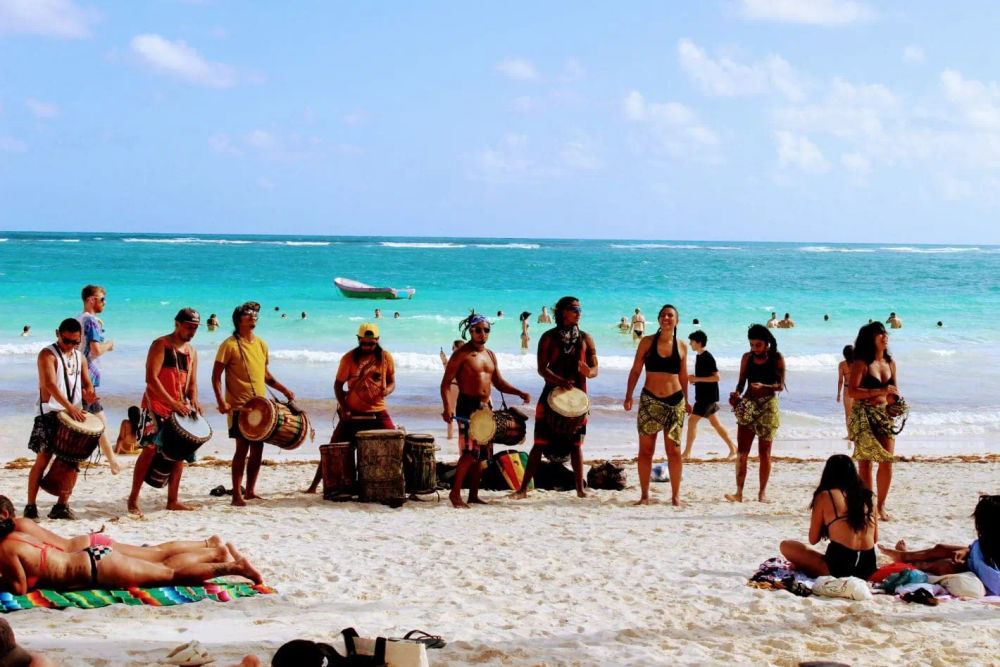
On the very same Tulum shoreline, one can witness two starkly different beach realities playing out side by side. For tourists, Tulum’s beaches often remain the idyllic playground advertised in travel magazines. If you’re a guest at an upscale beachfront hotel or you’ve paid for a day pass at a chic beach club, the experience is seamless. You are greeted with a cold towel and a cocktail, you recline on a plush sunbed steps from gentle waves, and a DJ curates the perfect soundtrack. From this vantage, the beach is a carefree zone of comfort and indulgence – precisely what a dream vacation promises. The private beach clubs that dot Tulum’s coast specialize in delivering this curated experience, and for those who can afford it, it can indeed feel like a slice of heaven.
Meanwhile, just beyond the roped-off VIP section, a different scene unfolds. A group of local teenagers kicks around a soccer ball on one of the few remaining stretches of truly public sand, careful not to stray into the “club” territory where they might be admonished. A couple of backpackers who balked at the steep cover charges find a spot on the public side, laying their towels on the sand with no loungers in sight. A local mother watches her two small children splash in the surf, but keeps an eye on the time – she knows that after noon, the place they’re sitting tends to be “claimed” by a nearby hotel setting up its beach furniture. These folks are enjoying the same sun and sea as the resort guests a few yards away, but they experience it on very different terms.

The divide is not absolute – there are public beaches in Tulum, and not every tourist indulges in luxury, of course. But by and large, tourists have more privileges to enjoy Tulum’s coast than the people who live there year-round. Many tourists are blissfully unaware of the access issue; they follow the directions of their Airbnb host or concierge. If that path happens to circumvent any local conflict, they might never notice anything amiss. The local residents of Tulum, however, are acutely aware that much of their beloved shore has been commercialized around them. Some express understanding – tourism, after all, is the lifeblood of the local economy, and they take pride in hosting visitors. Yet they can’t help but feel the imbalance when a visitor from thousands of miles away can walk into a beach club that a lifelong Tulum resident would feel uncomfortable entering because they can’t afford the menu.
This dynamic can foster a quiet resentment. Imagine working at a beachfront hotel – cleaning rooms or waiting tables – where each day you help tourists enjoy their holiday. The guests rave about the beautiful beach you’ve known since you were a child. Yet on your day off, you might not even be allowed to sit on that same beach unless you pay a fee nearly as high as your day’s wages. It’s a painful paradox for many locals: their livelihoods depend on tourism, but the fruits of Tulum’s popularity seem reserved for outsiders. One might say tourists get the postcard version of Tulum, while locals are left peering over the fence (sometimes literally) at a paradise that used to be theirs to share.
For the tourists who do pay attention, this disparity can be jarring. Some arrive expecting an open, bohemian paradise, only to find that the entire coast is an expensive, members-only club. Others don’t notice until they venture beyond the hotel zone and hear stories from residents. Increasingly, conscientious travelers are asking pointed questions: Why can’t a local family easily enjoy the same beach I enjoyed? Who benefits from the cover charges and the exclusivity? These questions are adding a new layer to Tulum’s story – one that goes beyond sun and fun, and straight into issues of justice and fairness.

Paradise for Sale: The High Price of Enjoying Tulum’s Coast
Underlying much of this divide is a simple factor: money. Over the past decade, Tulum’s once laid-back beach scene has undergone a high-end transformation. What was once a cluster of humble palapas and free public sand has turned into a string of stylish clubs, boutique hotels, and trendy bars – in short, a lucrative business coastline. The commercialization of the beach experience means that nearly everything has a price tag. Want a shaded daybed and umbrella on a prime patch of sand? That’ll require a minimum spend on food and drinks, often ranging from $50 to $100 per person at the more upscale clubs, and craving a dip in a picturesque cenote by the beach? There’s likely an entrance fee and maybe a pricey smoothie stand inside. Even the simple pleasure of walking along specific scenic stretches now sometimes funnels you through a “payment checkpoint” in the form of a beach club entrance. Paradise can still be yours in Tulum – if you can pay for it.
For many visitors, especially those from wealthier countries, these prices, while high, are begrudgingly accepted as part of the Tulum package. After all, Tulum has marketed itself as a boutique destination – a place of eco-chic luxury and once-in-a-lifetime experiences. The beach clubs justify their costs by offering comfortable amenities, security, curated music, and the cachet of exclusivity. In their view, they’re not charging for the beach itself (which would be illegal) – they’re charging for the services and the vibe. Over time, this model has turned large portions of Tulum’s coastline into an upscale playground. The natural beauty remains, but it’s presented in a refined manner, complete with craft cocktails, designer hammocks, and Instagram-worthy decor. Beachgoing, in many areas, has been commodified into a full-fledged consumer experience.

However, the “pay-to-play” model has unintended consequences. It not only edges out those who can’t afford it, but it also alters the character of Tulum’s tourism. As prices soar and the atmosphere grows more exclusive, some travelers are starting to wonder if Tulum has lost some of the very charm that made it famous. The rustic, everyone-welcome ethos has given way to velvet ropes on the sand. This shift can make the destination feel less authentic. A beach is fundamentally a simple pleasure – sun, sea, sand. When every aspect of it is monetized or curated, some of that simple joy is inevitably lost.
There is also the specter of sustainability – not just environmental (though that’s a concern with overdevelopment) – but also economic and cultural sustainability. How much commercialization can a destination withstand before it loses its soul? Tulum may be approaching that threshold. Longtime visitors reminisce about the “old Tulum,” when budget travelers, backpackers, and locals mingled freely on the beach, and you didn’t have to be a celebrity or a social media influencer to feel at home. Today, a casual traveler of modest means might feel out of place or financially stressed trying to keep up with Tulum’s high-priced beach scene. If paradise becomes too exclusive, fewer people will be drawn to experience it. In chasing a luxury market, there’s a risk of alienating the very diversity of travelers (and locals) that keep a destination lively and resilient.
In essence, the commercialization of Tulum’s beaches has been a double-edged sword. It has certainly generated revenue and put Tulum on the global map of must-see places. But it has also turned what should be a public commons into a collection of storefronts. The beach has become both a stage and a commodity. As with any commodity, there are winners – typically investors and businesses – and losers, often the local public and budget-conscious visitors. The question now facing Tulum is whether this is a sustainable path or if a course correction is needed to ensure that the beach remains, in spirit and reality, a treasure open to all.
Turning the Tide: Fighting Back for Fair Access
Despite the challenges, there are signs that Tulum’s community and even some authorities are pushing back, determined to turn the tide and restore some balance to beach access. Over the past year, local activists, residents, and allies have mobilized under slogans like “Playas Para Todos” (“Beaches for All”), insisting that public rights be more than just words on paper. This movement spans a broad spectrum of Tulum society, from fishermen and Maya elders to young environmentalists, small business owners, and foreign expatriates who have made Tulum their home. What unites them is a conviction that the beach should not be for sale and that preserving Tulum’s future means keeping its shores open and healthy for the next generation.
These advocates have staged peaceful protests and awareness campaigns to highlight irregularities and abuses. In one notable incident, a group of residents, including both Mexican and international nationals, came together to briefly block the main highway in protest after learning that a new “exclusive” access scheme was being imposed at a national park beach. With handmade signs declaring “Acceso Libre” (Free Access) and “No a las Playas Privadas,” they forced a conversation with local officials. Such demonstrations underscore the deep local frustration, but they have also yielded results. In the case of Tulum’s Jaguar National Park – a vast protected area that includes coastal zones – public outcry led to an agreement ensuring free entry for residents with valid ID and the reopening of a long-closed beach path. What was once the guarded entrance to a private club is now open to the public again. The cheers of families returning to that cove after years of closure speak volumes about what was at stake.
Local civil groups have also taken a more formal route, petitioning lawmakers to tighten and enforce beach access laws. Citing the constitutional guarantees and numerous stories of residents being turned away, they have demanded concrete measures: clear signage for public entry points every few hundred meters along the coast, penalties for any business that puts up unofficial “private” signs or barriers, and community oversight committees to monitor compliance. Activists point to success stories elsewhere in Mexico – for example, a grassroots campaign in Nayarit recently reclaimed kilometers of beachfront for public use, setting an inspiring precedent. Why not Tulum as well?
In response, there are hints of change. Government authorities, from the municipal level up to federal environmental agencies, have stepped up patrols to detect and remove illegal obstructions. They’ve involved organizations like the Mexican Center for Environmental Law and local ecological groups to help watch over the coastline. Technology is playing a part too – drone surveillance and GPS mapping are being used to spot new fences or constructions creeping onto public dunes. Importantly, local voices are being included in these efforts more than before. There’s talk of appointing local beach guardians and incorporating community feedback when reviewing permits for coastal development. These moves show an understanding that enforcement must be constant and collaborative. Removing a fence once isn’t enough – keeping the beach truly open will require ongoing vigilance and the will to stand up even to powerful interests.
Even some in the business community have acknowledged the need for a course correction. A few hotel owners have begun voluntarily allowing time windows for public access across their properties, such as letting locals use certain beach areas in the early mornings or at sunset, when paying guests are few. These gestures are small and not yet widespread, but they signal that compromise is possible. The more forward-thinking resort managers recognize that a reputation for blocking beaches is detrimental to everyone – it fosters local resentment. It could ultimately deter tourists who don’t want to feel they’re part of an unjust system. A shared beach, they figure, can still be good for business if managed respectfully.
Perhaps most heartening is the sense of community pride and stewardship re-emerging. Through beach clean-ups open to all, educational workshops on coastal ecology, and social media campaigns celebrating Tulum’s natural heritage, residents are reclaiming the narrative about their beaches. The idea is not just to demand rights, but to demonstrate responsibility – to show that locals and visitors alike can be partners in caring for the coastline. After all, ensuring free access and maintaining pristine beaches go hand in hand. When people feel a sense of ownership, whether it’s shared or not, they are more likely to protect what is theirs. In Tulum, that means treating the beach not as a commodity to be exploited, but as a commons to be safeguarded.

A Shore for All: The Path Forward
As Tulum grapples with the push and pull between exclusivity and equality on its shores, one thing is clear: the beaches are the heart of this community and its economy, and they must remain open to everyone. Achieving this will require continued effort on multiple fronts. Laws and official policies will need real teeth – consistent enforcement, clear consequences for violations, and transparency that rebuilds public trust. Businesses will need to be part of the solution, not the problem, by respecting the spirit of the law and understanding that long-term prosperity comes from inclusion, not exclusion. And the community, buoyed by recent wins, will need to stay vocal and united, keeping a watchful eye on the coastline.
There is reason for optimism. Tulum is not the first place to face this challenge, and it can learn from others and its residents. The very fact that these conversations are happening – in town halls, on social media, and in the pages of outlets like The Tulum Times – is a sign of progress. It means the issue is out in the open, where it belongs. Public awareness is often the first step toward lasting change.
In the end, preserving open beach access in Tulum isn’t just about tourists or locals, dollars or pesos – it’s about what kind of community Tulum wants to be. Is it a place where nature’s gifts are shared widely, fostering a sense of togetherness and equality? Or will it be a gated playground, beautiful but inaccessible, generating profit at the cost of principle? The answer may well define Tulum’s identity in the years to come.
As an editorial voice and a member of this community, I believe that the magic of Tulum has always lived in its harmonious balance – the turquoise sea enjoyed by a mix of people, the beachfront where a traveler and a local family could watch the same sunset. That magic wilts behind walls and VIP wristbands. It thrives in openness.
What do you think? Have you felt the pull of a “private” beach in a place that’s meant to be for all? Tulum’s story is still being written, and every resident and visitor has a stake in its unfolding narrative. Join the conversation with The Tulum Times on our social media platforms, whether you’re a local with lifelong memories or a traveler who has just discovered this coast, your perspective matters. Let’s ensure that Tulum’s beaches remain not just postcard-perfect, but genuinely open and welcoming – a shore for all to share. We invite you to share your thoughts and experiences on The Tulum Times’ social channels and join the discussion. Together, let’s keep the dialogue going and help shape a Tulum where paradise belongs to everyone.
Cover image generated using artificial intelligence.