

Who guards paradise when paradise feels unsafe? That’s the question echoing across Quintana Roo as the state prepares to launch a unified Tourism Police force this November. Ninety-eight officers will mark the beginning of a model meant to bring order, accountability, and a new sense of dignity to security in Mexico’s most-visited corner.
This is not just another bureaucratic shuffle. For years, visitors arriving in Cancún, Playa del Carmen, and Tulum have brought with them two things: dreams of turquoise waters and nagging concerns about safety. And when safety falters, so too does trust. That tension is what gave birth to the new force.
A Statewide Shift
The plan is deceptively simple. Municipal police units, long fragmented and uneven in quality, will be woven into a single framework. The state will take charge of uniforms and training. Salaries will remain local, still covered by each municipality. At first glance, it sounds technical. But beneath the logistics lies a question of image and credibility.
James Tobin, the state coordinator of the Citizen Security Council, insists this is about projecting reliability at a moment when global eyes are turning to Mexico. “We need police officers who guide tourists, not mistreat them,” he said. His words point to the heart of the project: reimagining the face of law enforcement in the land where tourism is both lifeblood and vulnerability.

Training with Global Eyes
To strengthen that face, the state has turned to Peter Tarlow, an international figure in tourist security. His involvement signals more than just tactical lessons. It’s about optics. Training by a recognized foreign specialist lends legitimacy that homegrown promises sometimes lack.
The timing is no accident. With the World Cup approaching in 2026, Quintana Roo wants to stand out not as a cautionary tale but as a showcase. Security, in this sense, becomes part of the tourist offering, as essential as pristine beaches or Mayan ruins. “Training and dignified treatment will be key to improving the image of Quintana Roo,” Tobin added.
The Eye That Never Blinks
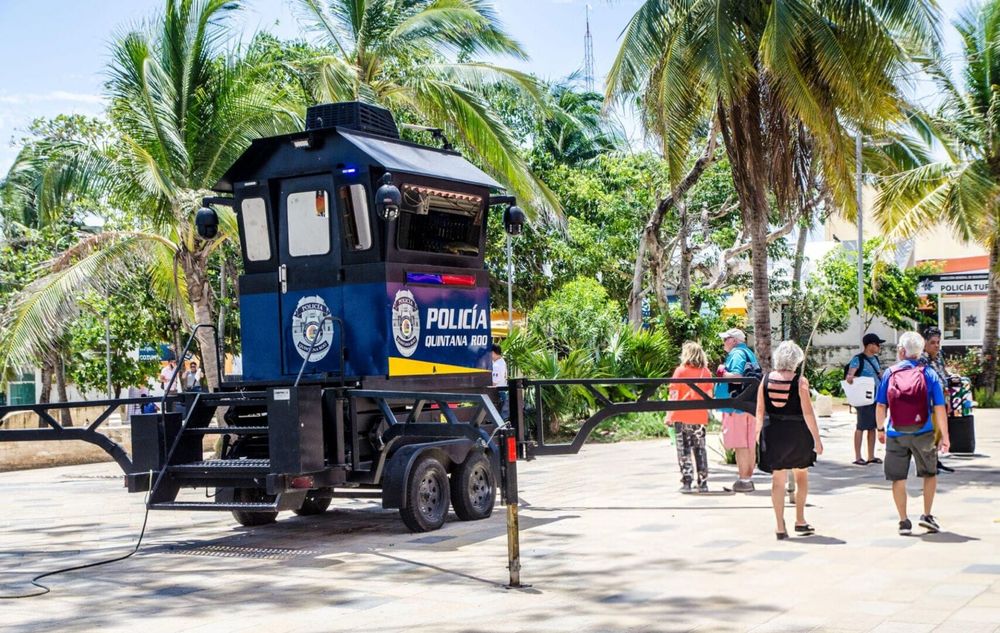
Change will also be visible, quite literally. Starting September 1, officers in Cancún and Playa del Carmen will patrol with lapel cameras. These small devices, impossible to switch off or tamper with, are meant to ensure transparency and clamp down on corruption.
The cameras act like mirrors turned outward, reflecting not just what police see but how they act. For locals weary of misconduct and visitors wary of scams, this might bring a measure of reassurance. Or it might raise new questions about surveillance and trust. Still, for a region where reputation is currency, the gamble seems worth it.
A Human Angle
On a hot August afternoon in Playa, a Canadian tourist recounted how she once felt pressured to pay an “informal fee” after a minor traffic misunderstanding. Stories like hers travel fast, faster than official press releases. They appear in forums, WhatsApp chats, and travel blogs, shaping impressions of Quintana Roo more effectively than glossy brochures ever could. That’s why reforms like the Tourism Police matter. They speak to the micro-experiences that ripple outward into global perception.
And locals, too, live with the consequences. A taxi driver in Tulum put it bluntly: “If tourists stop coming, I stop eating.” For him, police reform isn’t abstract policy. It’s survival.

International Scrutiny
Interest from abroad underscores the stakes. Consuls from the United States and the United Kingdom have already inquired about the new model. Their questions carry weight, reflecting not just concern for citizens but for the economic pulse of the region. If Cancún or Tulum are deemed unsafe, families reroute to safer havens. Places like Costa Rica or the Dominican Republic wait in the wings.
And here lies the quiet editorial reflection: in Mexico’s tourism economy, image is half the product. Security doesn’t just protect it, it sells it.
Lessons from Neighbors
Other destinations in the Riviera Maya provide both warnings and comparisons. Cancún, with its high-volume arrivals, has long battled headlines about violence. Playa del Carmen has oscillated between a relaxed beach town and a security hotspot. Tulum, once bohemian and detached, is now caught in the same crosshairs. Each city mirrors the others’ struggles, yet each also reveals the same truth: safety is indivisible. A tourist landing in Cancún will likely visit Tulum. A failure in one city can’t taint them all.
The unified police force is, in essence, an attempt to break the cycle of fragmented responsibility.

What’s at Stake
The Tulum Times has followed how security debates shape not only government policy but daily life. The creation of the Tourism Police appears less like a choice and more like an inevitability. The world is coming, and Quintana Roo cannot afford missteps.
Still, doubts linger. Can ninety-eight officers, even well-trained ones, truly shift perception? Will lapel cameras curb abuses or simply record them? These questions don’t fade easily.
Yet the experiment could mark a turning point. A cleaner uniform, a respectful interaction, a recorded assurance, small gestures that, together, might alter the narrative.
Because in the end, what’s at stake is not just security, but the fragile confidence that sustains the Riviera Maya’s global allure.
We’d love to hear your thoughts. Join the conversation on The Tulum Times’ social media. What do you believe, will this unified Tourism Police restore trust in Quintana Roo, or is it just another promise waiting to be broken?