

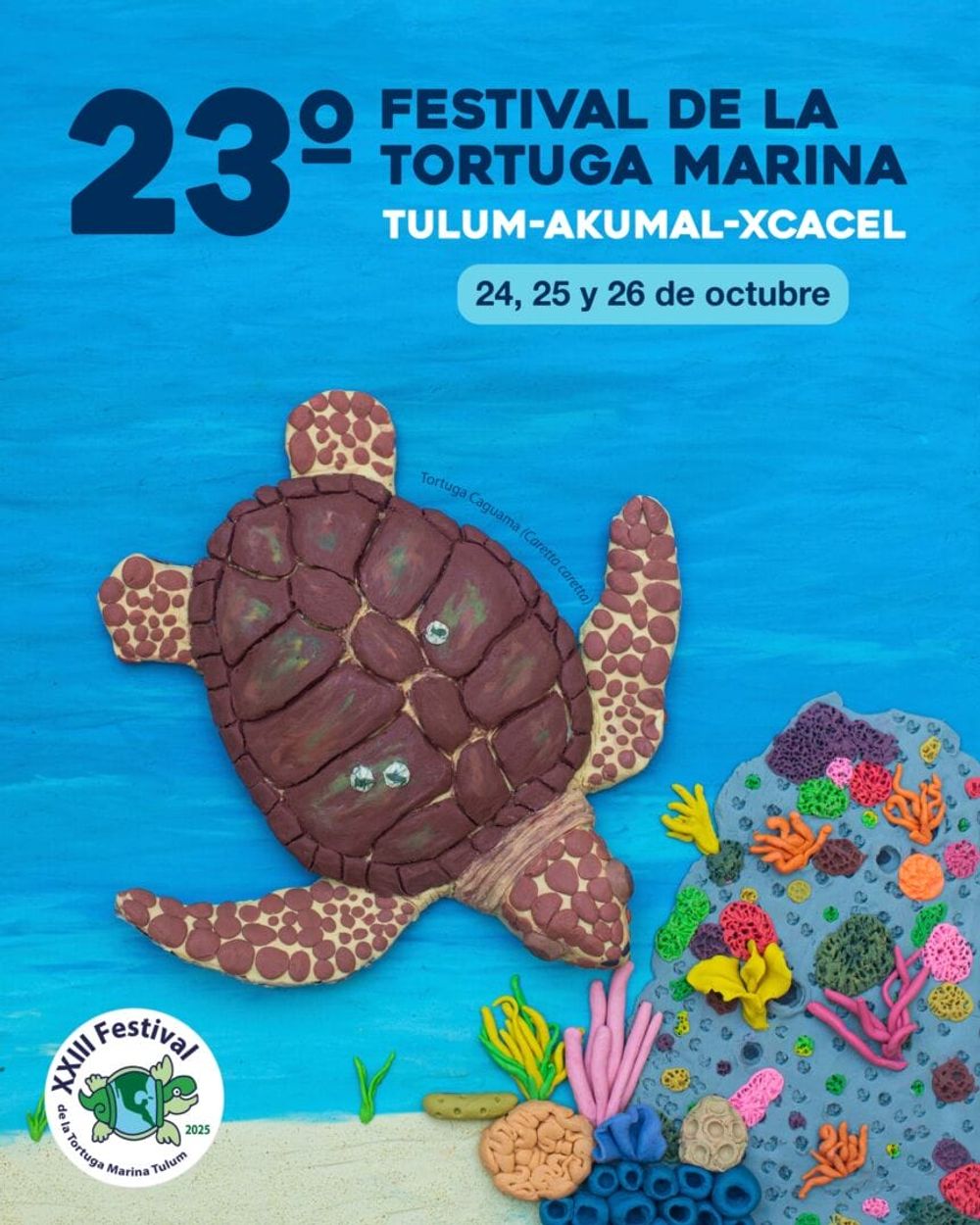
Under the October sun, where turquoise waves kiss the sand, the Riviera Maya will once again become a stage for one of its most meaningful gatherings. From October 24 to 26, the 23rd Sea Turtle Festival will take place across Tulum, Akumal, and Xcacel, inviting locals and tourists alike to reconnect with one of the region’s most iconic species, the sea turtle.
This year, the spotlight is on the loggerhead turtle (Caretta caretta), a resilient mariner that has swum across the oceans for millions of years, only to return, time after time, to the same shores where it was born. That’s not poetry, it’s biology. Specialists explain that this species typically nests four times per season, with cycles that occur every two to three years. And when they come back, they come home.
Ancient ritual meets modern awareness
The nesting season peaks between May and September, with June and July seeing the highest density of nests. But the real story doesn’t begin or end with a hatchling’s dash to the sea, it’s in the community effort to protect these fragile cycles. That’s what the festival is all about.
Organized across three emblematic locations, the Sea Turtle Festival offers a mix of free cultural events, workshops, talks, children’s activities, and even live turtle releases. It’s not just a celebration, it’s a classroom on the beach, a reminder of what’s at stake when concrete threatens coastlines and artificial light outshines the stars.
“The loggerhead doesn’t forget where it came from,” a local conservationist said during last year’s event. “So neither should we.”

Where conservation meets culture
Each host town brings its own rhythm. In Tulum, expect beachside art installations and youth-driven performances. Akumal, already known for its turtle-friendly tourism, will feature hands-on science stations. And Xcacel, a protected sanctuary and national treasure, will offer rare glimpses into the quiet work of conservationists.
While the festival emphasizes environmental education, it also underscores a deeper, more personal theme: the connection between people and place. Many residents of Tulum have grown up watching turtles nest, helping with releases, or attending these annual gatherings. For some, it’s a tradition that ties generations. For others, it’s their first taste of ecological activism.
The Tulum Times, which has long covered the intersection of tourism and environmental stewardship, sees this festival as more than an event. It’s a reminder that eco-tourism doesn’t work unless the “eco” comes first.

A shared responsibility
In recent years, the Riviera Maya has experienced rapid development, and with it, growing pressure on its fragile ecosystems. The loggerhead turtle, like its cousins the green and hawksbill species, is increasingly affected by habitat loss, pollution, and noise. Festivals like this one may seem small in scale, but they echo louder than you’d think.
Behind every child painting a turtle mask or every tourist releasing a hatchling into the surf, there’s a larger movement taking shape, one that blends tradition, science, and community action.
And maybe that’s the quiet genius of this festival: it teaches without preaching. It invites without overwhelming. It reminds you that the beach belongs not just to sunbathers, but to ancient mariners who return, against all odds, to lay the future in the sand.
What’s next?
The detailed program will be posted on the official page of the Festival de la Tortuga Marina Tulum-Akumal-Xcacel, offering a full schedule of events tailored to each location. While the festival ends after three days, its ripple effect could last all year, especially if it plants the seed of care in the hearts of attendees.
As climate pressures mount and development continues along the coast, the question lingers: Will Tulum choose to grow with nature, or despite it?
We’d love to hear your thoughts. Join the conversation on The Tulum Times’ social media.