
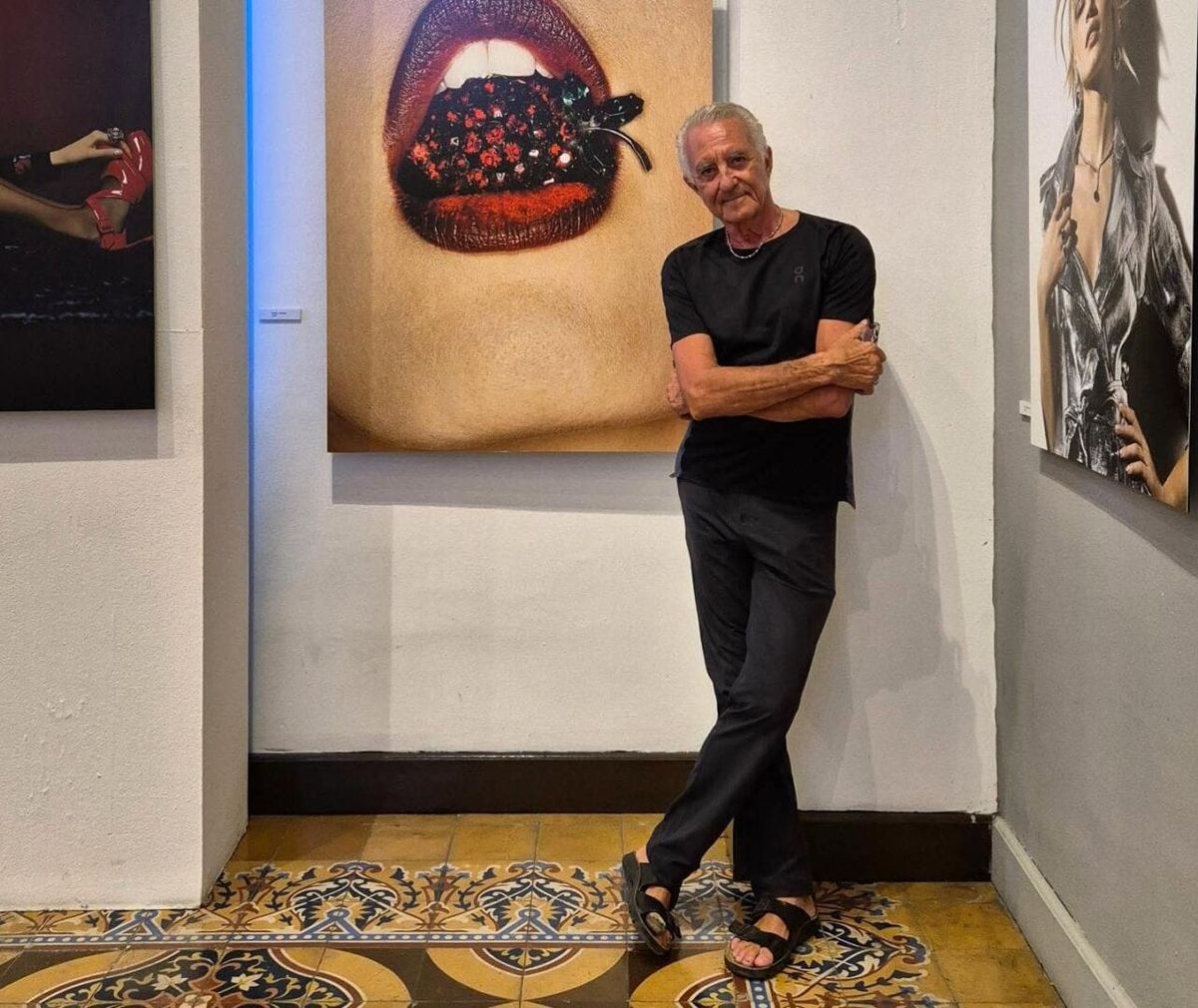
Once upon a catwalk, Serge Barbeau chased a very different kind of light. It sparkled off the cheekbones of runway models, bounced from chrome-plated studio rigs, and evaporated by morning. The Montreal-born fashion photographer made his name in the world of high gloss, Milan, Paris, New York, cities that celebrate beauty as long as it doesn’t linger. His art was precision, his subjects ephemeral, and his timing impeccable. Glamour, after all, waits for no one.
But now, in a Maya village nestled between the ghost-stones of Cobá and the tourist crush of Tulum, Barbeau waits. He waits for old men to find their words, for women to recall dreams their grandmothers once told them, for the breeze to settle just enough so a face, lined, proud, soft with memory, can meet the light. The light here is not diffused or flattering. It is flat, relentless, and true. And that is precisely the point.
Welcome to Últimos Testigos, The Last Witnesses, Barbeau’s haunting portrait series that trades stilettos for huaraches, chiffon for cotton, and the ephemeral for the eternal. Here, the subject is not fashion. It is history, or rather, what remains of it when everyone else has looked away.

The War Everyone Forgot
The Caste War of Yucatán (1847–1901) is not really a war. Or at least not in the way we like to imagine them, flags, heroes, treaties, monuments. It was, more precisely, a drawn-out act of indigenous resistance, a rebellion against colonizers who had outlived colonialism, and a last desperate attempt by the Maya to defend not just their land but their cosmology, their language, their soul.
For over half a century, Maya communities fought against the Mexican state and its colonial successors with an almost mythic tenacity. They founded sacred towns like Chan Santa Cruz (today Felipe Carrillo Puerto), where spiritual leaders wielded crosses that bled and spoke, and where faith became a weapon more enduring than gunpowder. It was a war of machetes and prayers, of visions and hunger.
And yet, ask most Mexicans today, even well-educated ones, and you’ll get little more than a shrug. The War of the Castes has been so thoroughly buried under the narratives of mestizaje and modernity that it might as well have never happened. It’s a silence loud enough to echo. As Carmen Tostado, director of the Museo Archivo de la Fotografía, puts it: “Most Mexicans know little about the Caste War, yet it shaped generations of Maya people.”
Barbeau’s lens isn’t just capturing faces. It’s excavating that silence.

From Runways to Dirt Roads
It would be easy to reduce Barbeau’s transformation to a trope: the artist who finds meaning in simplicity after the hollowness of fame. But life, like light, is rarely so linear.
Born in Montreal in 1951, Barbeau studied Communication Arts at Loyola College and quickly rose through the fashion ranks, Vogue, Elle, Harper’s. His subjects were impossibly beautiful, often impossibly thin, and always vanishing into the next trend. He lived between Paris and Milan, surrounded by the kind of luxury that can only be sustained by looking away from its cost.
Then, a commercial assignment brought him to Playa del Carmen. The job was forgettable. The light was not.
“There was something about it, harsh, honest. It cut through everything,” he says. That light, and the quiet dignity of the people he met, stayed with him. He didn’t just change locations. He changed direction. He settled in Francisco Uh May, a Maya village where the internet is spotty, and stories are not.
It was there that he met anthropologist Bernardo Pérez Soler, who was working on a documentary about the descendants of Caste War rebels. Barbeau joined the project as a photographer. He emerged with a mission.

Portraits that Refuse to Look Away
In towns like Tihosuco, Señor, and Felipe Carrillo Puerto, Barbeau began photographing Maya elders, many in their 80s and 90s, one over 107, people who carry memory not in books, but in bone and breath. He partnered with Marcos Canté, a local cultural activist and founder of the cooperative Xyaat. Canté gathered oral histories; Barbeau captured the faces that held them.
The resulting portraits are almost confrontational in their stillness. No studio backdrops, no retouching, no makeup. Just a body, a gaze, and the weight of everything unsaid.
One man recalls his grandfather hiding in the forest to speak Maya. Another speaks of trains he never rode, of rituals that blend history with myth. Some stories contradict each other. Some blur into dreams. “Maybe they forget. Maybe they exaggerate,” Barbeau says. “But the feeling, that’s real. And that’s what I photograph.”
Each face is a landscape. Each wrinkle is a ravine carved by time. These are not pictures to be consumed; they are testimonies to be witnessed. You do not scroll past them. You stop.

The Last Witnesses Come to Tulum
On July 30, the Últimos Testigos exhibition will open at the Museo Regional de la Costa Oriental in Tulum, marking the 178th anniversary of the Caste War. It’s a strange, fitting place, Tulum, the Instagram darling, the eco-luxury Eden built atop ancient ruins and selective amnesia.
But this exhibition isn’t here to sell you a story. It’s here to ask why you never heard it.
Alongside Barbeau’s portraits, textile artist Marcela Díaz will exhibit a series of sculptural works, adding tactile memory to visual testimony. The day will also include regional music and academic talks, not as a performance, but as resistance. Memory, here, is not passive. It is participatory.
And yes, it’s open to everyone. No velvet ropes. No VIP sections.
Tuesday, July 30
12:00 p.m.
Museo Regional de la Costa Oriental, Tulum
Free entry
Witnessing as a Way of Life
What Barbeau has created is not an exhibition. It is an act of witnessing. A form of penance, perhaps, for all the years he spent freezing beauty that evaporated the moment it was printed.
“In fashion, everything dies quickly,” he reflects. “Here, people live long, slow lives. They have little, and yet they’re so rooted. That stillness… it stays with you.”
Barbeau no longer clicks the shutter as an assertion of control. He waits. He listens. Sometimes, he sits for hours before even lifting the camera. “You have to ask permission,” he says. “Not just with words. With presence.”
These are not ethnographic curiosities. These are human beings whose memories have survived erasure not through preservation, but through quiet defiance. Like a candle in a storm, they flicker, but they do not go out.
As Carmen Tostado said, “These portraits are living archives. They carry what books can’t: the scent of the milpa, the cadence of spoken Maya, the echo of a war that still hasn’t ended.”
And perhaps that’s what Barbeau’s work ultimately reveals, that history is not behind us. It is inside us, in the stories we choose to tell, and the silences we refuse to break.
So go. Look into those eyes. Linger. Let yourself be seen by the people no one thought to remember.