

The Tulum Times has introduced a new daily word game designed to bring readers together around a shared, simple ritual that resets every night in Cancun time. The game, now called Temple of Words, is built around one idea: wherever you are, and however your day unfolds, there is a new puzzle waiting for you every morning.
Temple of Words is available to registered users and can be played from anywhere, whether that is a phone on the beach, a laptop at home, or a quick break between activities. Each day offers a fresh combination of letters and a clean start, inviting players to return regularly without pressure or deadlines beyond the natural rhythm of the day itself.
For Tulum, the game represents a different kind of connection with its community, one that is less about consuming information and more about sharing an experience tied to local time and place.
A daily ritual anchored in local time
Every day at exactly 00:00 in the Cancun time zone, Temple of Words resets for everyone. A new set of letters appears, the previous day’s progress disappears, and a new challenge begins.
This timing matters. Cancun time governs daily life across the region, from work schedules to school days to business hours. By anchoring the game to that same clock, Temple of Words creates a shared starting point for players in Tulum and beyond. No matter where someone is physically located, the challenge changes at the same local moment.
Once the new day begins, players have the full day to play. There is no rush and no limit on attempts. Words found in the morning remain saved in the afternoon, and progress is still there at night. If the page is closed or the app refreshed, the game resumes exactly where it was left off.
A visible countdown gently shows how much time remains before the next reset, reinforcing the sense that this is a daily experience rather than an endless task.
Simple rules, shared challenge
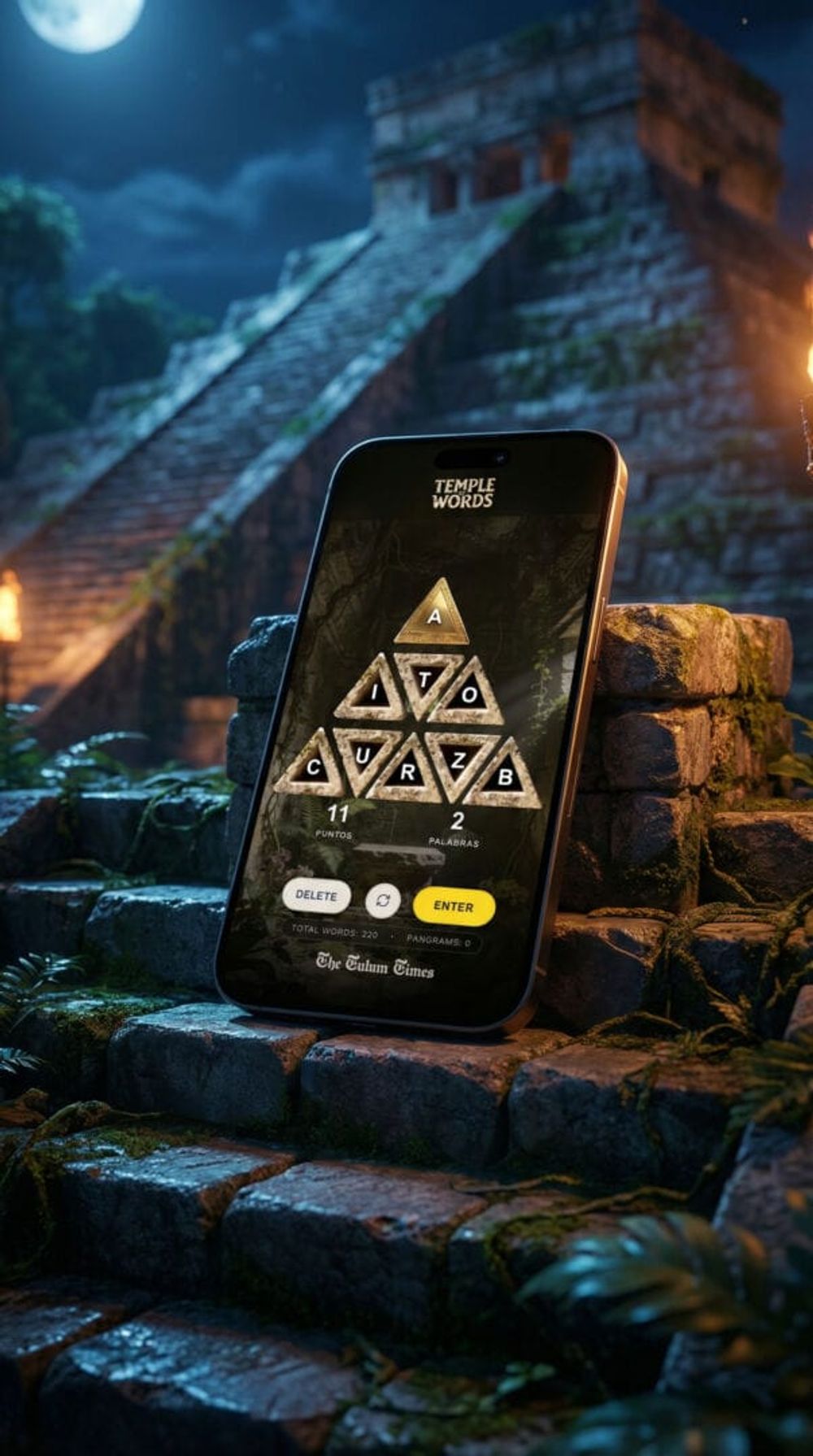
At the center of the Temple of Words is a pyramid of nine letters. One letter sits at the top and must be included in every valid word. The other eight letters can be combined freely, encouraging experimentation and creativity.
The rules are consistent and easy to grasp, even for first-time players. Words must be at least four letters long, written in English, and formed only from the letters provided. Every correct word earns points, and longer words are rewarded more generously.
There is also a special moment built into the game. When a player finds a word that uses all nine letters at least once, the game recognizes it instantly. That achievement is marked visually and remembered as part of the day’s progress.
The goal is not perfection, but discovery. Some players may aim to find every possible word. Others may enjoy uncovering a few surprising combinations during a quiet moment.

Progress you can feel, not chase
Temple of Words tracks progress in a way that feels encouraging rather than demanding. Players see how many words they have found compared with the total possible for that day’s puzzle, along with a percentage that grows as new words are discovered.
As progress increases, the game assigns simple titles that reflect how far the player has gone. These labels shift naturally as the day unfolds, offering a sense of momentum without turning the experience into a test.
Because progress is saved automatically, players can step away and return without losing anything. A few words in the morning, a few more at sunset, and perhaps one last try before midnight all count toward the same daily journey.

A friendly competition that resets every night
Temple of Words includes a daily ranking that lists all active players by score. The leaderboard updates as players find new words, and everyone can see where they stand.
The top player of the day earns the title Mayan King, a lighthearted recognition that lasts until the next reset. The ranking also highlights each player’s own position, making it easy to feel included even without competing for the top spot.
This structure creates a form of competition that is temporary and forgiving. Every night, everyone returns to the same starting line. Yesterday’s results do not carry over, and a missed day does not put anyone behind.
For many players, the ranking is less about winning and more about being part of something shared, knowing that others are working with the same letters on the same day.

Designed for everyday moments
One of the defining ideas behind Temple of Words is flexibility. The game does not require long sessions or deep concentration. It fits into spare moments, whether that is waiting for coffee, sitting by the ocean, or relaxing at the end of the day.
Because it runs smoothly on common devices and saves progress automatically, it adapts to different routines. Some players may spend just a few minutes a day. Others may return repeatedly, curious to see how many words they can uncover.
This ease of access makes the game especially relevant for a place like Tulum, where daily life often moves between work, nature, and social spaces rather than fixed desks and schedules.
Why this matters for Tulum
Temple of Words matters locally because it adds a new way for the community to gather around a shared habit tied to the region’s own sense of time. Instead of scrolling endlessly, players engage in something finite, repeatable, and reset each day.
Residents, visitors, and readers abroad are all affected in the same way. Everyone receives the same puzzle, the same reset, and the same opportunity to participate, regardless of location.
For The Tulum Times, the game reflects an effort to extend community engagement beyond articles while staying rooted in clarity, fairness, and local relevance. It is an experiment in how digital spaces can support daily connection without demanding constant attention.

What changes from now on
With Temple of Words now live, readers have a new daily touchpoint that sits alongside news coverage rather than replacing it. Each midnight reset introduces a fresh challenge and a clean slate.
The question going forward is not how complex the game can become, but how naturally it can fit into daily life. If it becomes something people check once a day, like the weather or the headlines, it will have achieved its purpose.
The primary keyword, Temple of Words game, captures that shift toward shared, time-based participation.
We’d love to hear your thoughts. Join the conversation on The Tulum Times’ social media.
Where do you imagine yourself playing Temple of Words tomorrow?