
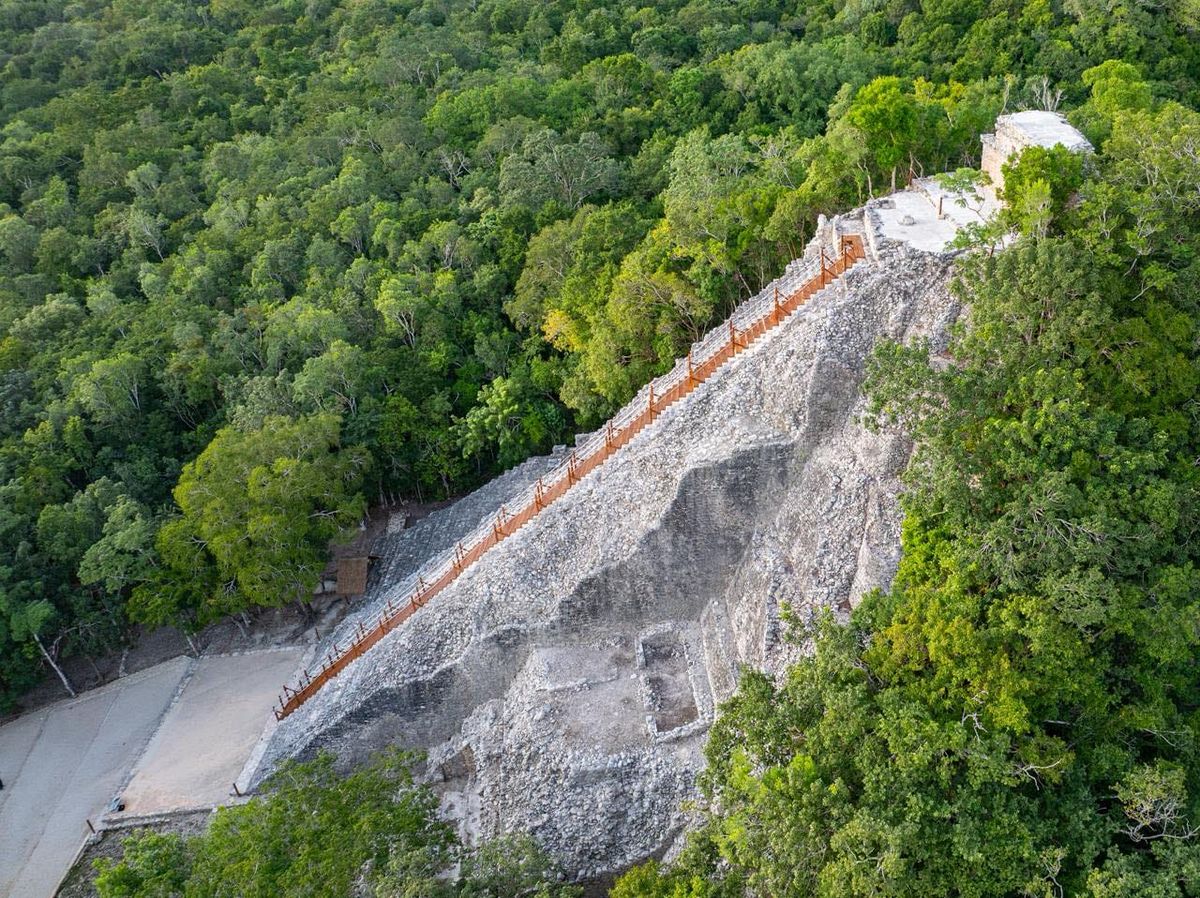
Visitors to Cobá awoke Sunday to a change many had been waiting for. After a six-year closure, the climb to the top of Nohoch Mul, the 42-meter structure that dominates the archaeological zone, has reopened to the public. The inauguration, led on December 7, 2025, by Mexico’s culture secretary, Claudia Curiel de Icaza, marked a turning point for one of the most emblematic prehispanic monuments in Quintana Roo and for the policies that shape cultural access across the Riviera Maya. The event also unveiled a new service unit built under the federal improvement program linked to the Tren Maya, giving the site a renewed sense of purpose as tourism patterns shift throughout the region.
The reopening draws local attention because Nohoch Mul is not only the highest pyramid in the northern Maya area. It is also a reminder of how cultural heritage and economic development weigh on one another in Mexico’s busiest tourism corridor.

A ceremony framed by memory and political meaning
Curiel de Icaza used the occasion to emphasize a narrative that might resonate with residents and visitors. She spoke of continuity, of a territory shaped by generations who safeguarded its history. Her remarks underscored that Cobá still reveals fragments of the past in real time. And in a line that quickly circulated among attendees, she said, “Cobá is a city that keeps unveiling who we are.”
Officials from Tulum, Quintana Roo’s state government, and the National Institute of Anthropology and History gathered alongside ejidatarios of Cobá. Their presence signaled an attempt at unity after years of debate about the site’s management. It was a carefully orchestrated moment at a time when the country, under President Claudia Sheinbaum, appears focused on reframing cultural policy as collective stewardship rather than isolated institutional control.

One short sentence carried the broader message: “Patrimony belongs to everyone, but its care depends on community.” It was the kind of statement built to live on social platforms.
What the new structure means for Nohoch Mul
The new wooden staircase rises along the pyramid’s slope, giving visitors a safer ascent while preserving the original stonework beneath. Designed to reduce wear on the historic steps, the structure integrates local materials such as tzalam, caoba, parota, and chicozapote, worked by artisans from Noh Bec who have long supplied the region with durable timber infrastructure.
Archaeologist Julieta Ramos Pacheco, who oversees field operations for the improvement program at Cobá, explained that the team completed a step-by-step topographic survey before anchoring each section of the staircase. The process required precision because every cavity and irregularity shaped the engineering solution. It was not simply about rebuilding access. It was about finding a method that could prolong the life of one of Mexico’s most visited monuments without compromising scientific standards.

But the new structure is not only functional. For many visitors, the climb frames one of the most wide-reaching views of the surrounding Maya forest. It offers a perspective that links the ancient city’s historical footprint to the vast ecological landscape of the northern Yucatán Peninsula.
Cobá’s historical weight in the Maya world
INAH director Joel Omar Vázquez Herrera used the event to lay out a revised understanding of Cobá’s place in Maya history. He noted that during its prime, roughly between 200 and 600 CE, the city covered an estimated 70 square kilometers and may have held up to 50,000 inhabitants. Its reach extended through commercial ties with Chichén Itzá, Ichkabal, and even faraway centers such as Tikal.

Recent epigraphic work, conducted under the same improvement program, led researchers to refine the site’s founding date to May 12, 569 CE. These findings underline that Cobá remains an active point of research in Mexico’s archaeological field. The new staircase might draw tourists back, but for scientists it is the constant flow of data that keeps the site relevant.
For residents of Tulum and its surrounding communities, this scientific dimension coexists with daily life. Many local families view Cobá as a cultural anchor, even as the region evolves into a global tourism hub.
Community voices shaping the reopening
Among the most compelling moments of the ceremony came from Atilano Huicab Nájera, who spoke on behalf of the ejidatarios of Cobá. His words fused identity, land, and memory. He said the new access point symbolized a “doorway to a new time,” one in which unity within the ejido could shape decisions about their territory.
Such statements reveal a quiet tension that often sits beneath large infrastructure announcements. Communities appreciate investment, but they also seek control over how heritage sites intersect with their economic opportunities. In Tulum, this conversation has grown sharper as the municipality navigates rapid population growth, increasing land pressure, and the arrival of new tourism markets driven in part by the Tren Maya.

In a separate reflection, Lilian Villanueva Chan, the state’s culture director, described everyday practices that still guide Maya communities. She mentioned crafts, handwoven bejuco, and the ritual act of asking permission before entering sacred or ancestral spaces. Her comments appear to signal that cultural continuity remains essential, even as development accelerates around the archaeological zones of the Riviera Maya.
The Promeza program and the role of the Tren Maya
The staircase and service unit at Nohoch Mul are part of a broader federal initiative to improve archaeological sites affected or connected to the Tren Maya. Officials say nearly five million pesos were directed to this stage of work at Cobá. The improvement program covers 11 sites in Quintana Roo, combining research, conservation, infrastructure upgrades, and cultural access strategies.
The connection to the train is practical and symbolic. On one hand, improved facilities aim to manage a possible rise in visitors once the rail system fully integrates the region. On the other hand, the government appears committed to presenting heritage protection as part of a larger national project.

This interplay raises questions for policymakers. How should Mexico balance tourist demand with preservation imperatives. How can local communities remain central to decisions that affect their land, their rituals, and their ability to benefit from cultural tourism.
A day of reopening and a micro-story of effort
Hours after the official ribbon-cutting, a small group of visitors from Mérida made the climb. One of them, an older man leaning on the railings, paused midway to catch his breath. He turned to the forest, pointed to the horizon, and told his grandson that this was how he remembered Cobá many years ago, before the closure. The brief exchange captured the essence of the day: the return of an experience interrupted by time and circumstance.
Moments like this explain why the reopening matters. They highlight how historical structures become personal landmarks, shaped as much by memory as by archaeological research.

What this signals for tourism in the Riviera Maya
The shift could influence regional tourism patterns, particularly for travelers who seek cultural experiences alongside the beaches of Quintana Roo. For Tulum, which has navigated debates about urban development and natural resource pressure, Cobá’s reopening might redistribute visitor flow and inspire renewed interest in inland excursions.

The Tulum Times has tracked how access improvements at heritage sites can recalibrate local economies. If Nohoch Mul becomes a preferred stop again, nearby communities could see increased demand for lodging, guiding services, and artisanal markets. The challenge will be ensuring that this growth does not overwhelm the resources that anchor the site’s cultural value.

A closing view from the top
The reopening of Nohoch Mul crystallizes a broader story about Mexico’s evolving approach to heritage. It merges federal investment, archaeological rigor, community voices, and tourism expectations. It also raises the stakes for how the peninsula will manage cultural and ecological pressures in the years ahead.
What happens next depends on whether access, conservation, and community benefit can move together rather than in conflict. Nohoch Mul will remain at the center of that conversation.
We’d love to hear your thoughts. Join the conversation on The Tulum Times’ social media.
How do you think increased access to archaeological sites should be managed in Quintana Roo?