

Less than two years ago, the idea of Tulum hosting one of the world’s top airports might have sounded like a travel blogger’s dream. Today, it’s official.
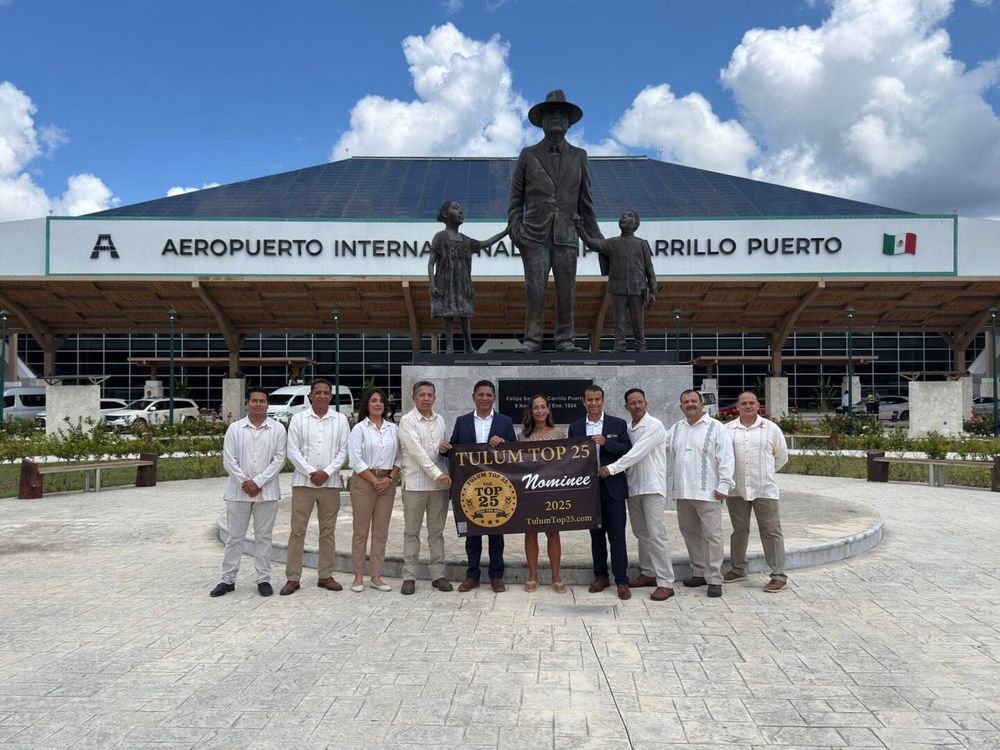
The Tulum International Airport “Felipe Carrillo Puerto” has been named among the 25 best international airports in the world by the International Top 25 Approved Award 2025. In a region already known for its turquoise waters and ancient ruins, the airport’s rise marks a new era, not just for tourism, but for global visibility.
From newcomer to contender
In just 22 months of operation, the airport has earned a place on the same list as titans like Changi in Singapore, Hamad in Doha, and Charles de Gaulle in Paris. The recognition, delivered by InternationalTop25.com, acknowledges excellence in infrastructure, customer service, connectivity, staff satisfaction, and continuous improvement.
At a formal ceremony, Yasaman Jozdani, CEO of International Top 25, presented the award to Javier Diego Campillo, the airport’s administrator. Flanked by key figures from Grupo Aeroportuario Mundo Maya, including Adolfo Héctor Tonatiuh Velasco Bernal and David Sandoval Martínez, the moment felt symbolic, a nod to just how fast Tulum is rewriting the rules of air travel in Mexico.

Building more than a runway
Awards like this don’t land out of nowhere. Behind the polished terminals and sharp architecture lies an aggressive strategy to turn Tulum into a world-class air hub.
In its first year alone, the airport doubled projected passenger demand. And if current patterns hold, this second year might push the limits even further. But the real story isn’t just in the numbers, it’s in how the airport has become a shared project, pulling together municipal leaders, tourism authorities, airlines, and private partners.
“This recognition is not a destination. It’s a launchpad,” said an airport spokesperson during the event. The phrase echoed in the room, equal parts ambition and challenge.
A Caribbean gateway with global ambition
The award cements Tulum’s role as a strategic connector in the Mexican Caribbean, complementing older, more established terminals like Cancún and Playa del Carmen. For years, Tulum felt like the quiet, bohemian younger sibling. Now it’s flexing its muscle in logistics and infrastructure.
Haydee Hernández Pastrana, Director of Tourism Promotion in Tulum, emphasized that the award reflects deliberate coordination between stakeholders. “On instructions from the municipal president, we’ve worked together to position the airport in both national and international markets. Today, Tulum stands recognized globally,” she said.

How a regional terminal entered the global spotlight
To be clear, the International Top 25 list isn’t a participation trophy. It’s the result of rigorous evaluations, service quality, operational excellence, passenger experience, and even workplace culture. Tulum’s inclusion means it beat out dozens of airports in larger cities with more established routes.
What stands out even more is the company it now keeps. Airports like Orlando, Las Vegas, Minneapolis, and La Guardia in the U.S. also made the list, as did El Dorado in Bogotá and Los Cabos in Baja California Sur. These are heavyweights in regional and international connectivity.
Tulum’s presence among them signals something deeper: Quintana Roo isn’t just a vacation hotspot, it’s becoming a logistics and travel powerhouse.

A story that’s still unfolding
Sure, awards are great for press releases. But for locals, the real win is what comes next. The economic ripple effects, increased flights, better infrastructure, job creation, and stronger supply chains, have the potential to reshape daily life in Tulum.
Some residents voice concerns about over-tourism and unchecked development, yet others see this as a chance to design a smarter future, one with sustainability and community inclusion baked into the foundation.
And that tension is part of what makes the story compelling. Tulum isn’t just a dot on the map anymore. It’s a case study in how rapidly a destination can evolve when investment meets vision.
More than a milestone, a momentum shift
The Tulum Times has followed the airport’s evolution from an ambitious blueprint to an international success. This latest accolade doesn’t close the chapter, it opens a wider lens.
As global travelers land in ever-growing numbers, Tulum is no longer just the end of the road for adventurers. It’s now a starting point.
“The runways may be short, but the vision isn’t,” said one attendee at the award ceremony, sipping coffee under the hot Quintana Roo sun. A casual remark, yet it captured the mood.
This airport, born in the jungle, backed by the Maya legacy, and now validated by global standards, is setting a new bar. The question now is: How far can it really go?
We’d love to hear your thoughts. Join the conversation on The Tulum Times’ social media.
Will Tulum’s rise as an aviation hub benefit the region long-term or strain it beyond its limits?