
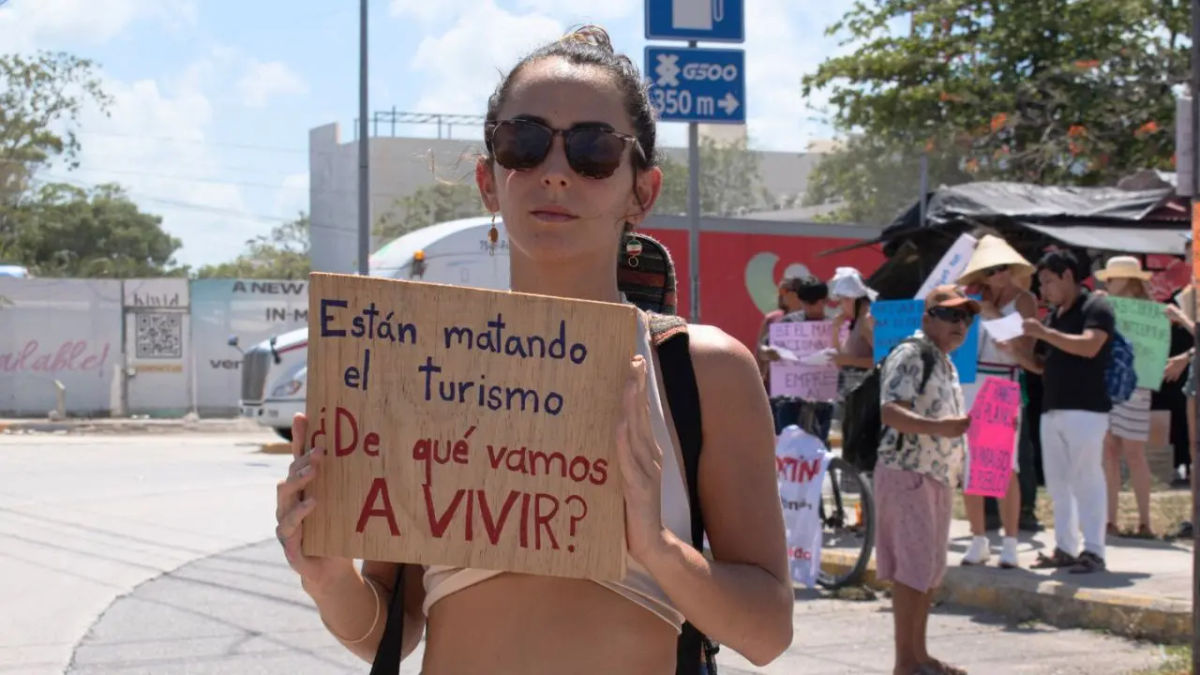
A new set of Sunday charges has triggered a local storm in one of Mexico’s most visited beach towns. The federal Ministry of Tourism’s plan to introduce Tulum beach access fees, 60 pesos for national visitors and 220 pesos for foreigners, has drawn sharp opposition from residents, tourism workers, and the collective Movimiento Playas Libres Tulum. The policy, they say, conflicts with federal law and chips away at a right that many in Quintana Roo consider nonnegotiable.
A crowded weekend, a closed debate
On recent Sundays, lines formed before sunrise outside the public route linking Plaza de los Artesanos with the Tulum Archaeological Zone and the beaches of Santa Fe, Pescadores, Maya, and Mangle. Vendors unloaded coolers. Workers clocked in early. Families looked for shade. Then word spread about new fees, and the mood changed. Parents counted bills. Some turned back. Others argued that a basic day at the sea should not require a wristband.
The pushback coalesced online within hours. Movimiento Playas Libres Tulum published a statement calling the fees “contrary to federal legislation” and “a direct blow to the local population, tourism workers, and visitors.” The group’s central claim is simple and forceful. “A beach cannot be called free if entry depends on paying a fee.”
What is being charged, and by whom
Officials describe the charges as a combination of costs tied to the National Commission of Natural Protected Areas, known as CONANP, and the management of the Tulum Archaeological Zone. Activists add another layer, noting a broader tariff increase approved by Congress that is scheduled to take effect on January 1, 2026. The sum of those elements, they argue, is already changing who can spend a Sunday at the sea in the Riviera Maya.
The debate cuts to first principles. Article 27 of the Constitution and Articles 7, 8, and 11 of the General Law of National Assets define beaches and the federal maritime zone as public goods used for common purposes. The movement argues that conditioning transit, stay, or access to basic services on payment contradicts that framework. The claim is legal, but it is also social. Families who live paycheck to paycheck say the new costs add up fast.
Micro-story from the shoreline
Around noon last Sunday, a waiter from a modest eatery in downtown Tulum met his sister and her two children near the newly opened route. They had packed sandwiches to save money. When they heard about the fee, the children asked if they could swim for just an hour. The adults hesitated. They did the math. They left. One hour later, the siblings were back at their apartment, beach towels still folded. A small story, yet it captures a larger shift.
Movement demands and a call to the presidency
Movimiento Playas Libres Tulum has asked President Claudia Sheinbaum to intervene and guarantee unrestricted access to beaches in Tulum. Their proposals are specific. First, the CONANP wristband should not be mandatory to enter or remain on the beach. Second, Jaguar Park should charge only those who voluntarily use its attractions and services. Third, restrooms and basic facilities should remain free for residents and tourists. These requests, the group insists, align with the General Law of Ecological Balance and Environmental Protection, which can support conservation without blocking the public.
They also want clarity. Who pays, and under what conditions. Do bicycles and scooters remain free to enter. Will guests at beach clubs or restaurants inside the protected area be charged CONANP fees even if they only plan to dine. In Tulum, uncertainty is expensive. It changes weekend plans and business forecasts in the same stroke.
Tulum beach access fees meet constitutional questions
The controversy turns on the meaning of public space. Advocates of the fees argue that protected ecosystems need resources and that modest charges can support maintenance, safety, and conservation. Critics respond that the costs should be borne by budgets, concessions, and dedicated funds, not by families at the shoreline. Both views claim to defend the coast. Only one, however, closes the gate to those who cannot pay.
There is a policy design issue as well. If the goal is conservation, charging for specific activities inside Jaguar Park could align costs with impact. A blanket entry fee for beach access, opponents say, looks less like stewardship and more like a barrier. “A beach is not free if entry depends on a wristband.” The line has spread across local chats because it is clear, repeatable, and hard to ignore.
The government’s tightrope in Quintana Roo
Tulum sits at the junction of federal authority, state regulation, and municipal enforcement. That patchwork is already complicated by the growth of the Riviera Maya, shifting visitor patterns, and the legacy of concessions along the coast. The Ministry of Tourism, CONANP, and the archaeological site administration must coordinate on rules, staffing, and payment systems. Any misalignment shows up first at the turnstile and then on social media.
Here is the subtle editorial reflection. Conservation and access do not have to collide, yet they often do when policy is designed from the center out. Local context matters. Prices that look small on paper can feel heavy on a Sunday afternoon in Tulum.
Protest date set as questions multiply
With no detailed response from the authorities so far, the movement has called for a peaceful demonstration on November 15 in Tulum. The invitation includes residents, tourism workers, service providers, and visitors. Organizers frame the protest as a defense of peace and safety, truly open beaches, and the collective right to the sea. They also want an end to what they call improper charges on national assets.
Business owners are divided. Some say fees could be justified if they are transparent, limited, and clearly linked to conservation projects. Others fear a slippery slope that will deter national visitors, push spending away from small businesses, and deepen inequality along the coast. What happens in Tulum rarely stays in Tulum. Policies tested here often appear later in other towns in Quintana Roo.
What a better plan could look like
There are paths forward. One option is to separate conservation funding from simple entry. Keep Tulum beach access free, then offer voluntary passes for guided trails, parking, or special conservation activities inside Jaguar Park. Another option is differential pricing that exempts local residents and low-income families, with strict caps to prevent fee creep. Clear signage and a unified online portal would reduce confusion and give visitors a way to understand where money goes.
The Tulum Times has heard from readers across Mexico who want that clarity. They are not against conservation. They are against gates that feel arbitrary. A policy that respects the law, funds stewardship, and keeps the shoreline open is not an impossible equation.
What is at stake for Tulum and beyond
Tourism is the engine of the Riviera Maya. Legal uncertainty scares investors. Social tension erodes community trust. And barriers at public beaches change the image of Mexico abroad. If the government revises the plan, it could send a message that conservation and inclusion can move together. If it doubles down, expect more protests and more litigation.
The November 15 protest will be an early signal. Not only of public sentiment, but also of how the Sheinbaum administration plans to handle conflicts at the edge of the sea. For families in Tulum, the question is not abstract. It is whether a child gets to swim on a Sunday without a fee.
In short, Tulum beach access fees have become a test of policy design, legal interpretation, and social fairness. We’d love to hear your thoughts. Join the conversation on The Tulum Times’ social media.
Should beach conservation be funded without charging people to enter the shoreline on Sundays?