
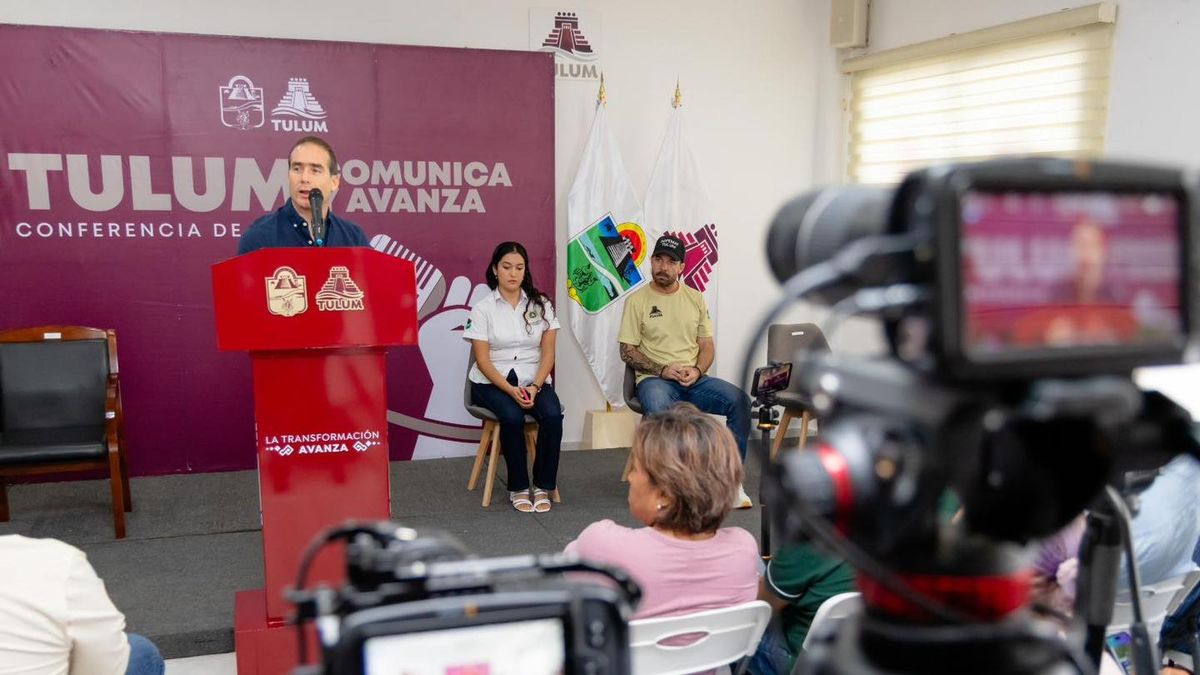
Tulum’s mayor, Diego Castañón Trejo, announced significant progress in restoring public access to the beaches of Parque del Jaguar and in strengthening public services, tourism promotion, and local security. The update came during the latest “Tulum Comunica y Avanza” press conference, where municipal authorities shared the latest steps to ensure that the city’s development aligns with federal and state initiatives.
The mayor emphasized that multiple meetings and field visits have taken place with federal and state officials, including Tourism Secretary Josefina Rodríguez, Grupo Mundo Maya director Adolfo Héctor Tonatiuh Velasco Bernal, and Governor Mara Lezama. Representatives from Sedena, Profepa, and Fonatur have also joined the process, reflecting a broad coordination effort aimed at long-term urban and environmental balance in the Riviera Maya.
Agreements to reopen beach access gain momentum
According to Castañón Trejo, the agreements for reopening beach access points within Parque del Jaguar are progressing and being formalized with federal support. The mayor explained that the municipality is fully involved in ensuring these spaces remain public, safe, and environmentally responsible.
“We are moving forward with firm steps, and very good news is coming soon for Tulum,” he said, signaling optimism about the federal government’s next announcements.
He added that a container placed inside Parque del Jaguar will soon be removed at the request of the federal Tourism Secretariat as part of a broader plan to reclaim public spaces for community use and ecological recovery. Meetings with tour operators, hoteliers, and Civil Protection authorities are ongoing to ensure that all beaches remain inclusive, clean, and safe for visitors and residents alike.
Tourism recovery reflected in growing hotel occupancy
In his address, Castañón Trejo reported a visible increase in the number of visitors arriving at Tulum’s beaches. Hotel occupancy is expected to reach 80 percent in November and up to 95 percent in December, signaling a strong close to 2025.
The mayor highlighted that the municipal government will maintain an active presence in international tourism fairs to strengthen Tulum’s position as a global destination. Delegations from Tulum have already participated in promotional events in Paris and will soon attend the World Travel Market in London, followed by FITUR in Madrid in January 2026.
These efforts, he said, are essential for sustaining the local economy and supporting thousands of jobs in Quintana Roo’s tourism sector. The upcoming FIFA World Cup in 2026 is also expected to extend the high season from November through April, bringing an additional boost in international arrivals.
Strengthening coordination with the tourism sector
During the press conference, the mayor shared details of his recent trip to Mexico City, where he met with federal and state tourism officials, including Secretary Rodríguez and Quintana Roo’s Tourism Secretary Bernardo Cueto. Rodríguez is expected to return to Tulum this week to continue discussions with tour operators and will meet again next week with Civil Protection authorities.
Castañón Trejo said the federal government will make the final decisions regarding the management of access points in Parque del Jaguar, but reiterated that his administration will fully support the process. “Our goal is clear: to guarantee that every resident and visitor enjoys Tulum’s beaches as they should, freely and responsibly,” he remarked.
Focus on transport, safety, and fair pricing
Beyond tourism, Castañón Trejo addressed several community-focused issues. He announced that he would meet with the general secretary of the taxi drivers’ union to review the local fare structure. The plan aims to make taxi rates transparent and easily available in hotels and commercial establishments, promoting fairness for both tourists and locals.
The mayor also instructed Tulum’s Secretary of Security, Edgar Aguilar Rico, to closely monitor traffic-related complaints and improve transportation services. “A destination’s image starts on its streets,” he noted, underlining that efficiency and safety are key to maintaining Tulum’s reputation among visitors.
Collaboration as a foundation for progress
The conference underscored a growing consensus between municipal, state, and federal authorities: that Tulum’s sustainable future depends on transparency, collaboration, and public access. The combined involvement of Sedena, Profepa, Fonatur, and the Tourism Secretariat suggests that beach recovery, tourism planning, and urban management are now being treated as interdependent priorities.
For residents and investors alike, the developments signal a more coordinated governance model in Quintana Roo, one that might redefine how tourism hubs manage shared natural assets.
As The Tulum Times observed, these actions could mark a new chapter for local governance, one where environmental protection and tourism growth are pursued hand in hand.
A new phase for Tulum’s beaches and community
The path toward reopening the beaches of Parque del Jaguar remains closely linked to federal resolutions, but municipal cooperation appears stronger than ever. With tourism rebounding and new plans underway to improve mobility and public safety, Tulum is positioning itself to enter 2026 with renewed confidence and international attention.
Efforts to restore free beach access, enhance public spaces, and promote fair economic participation could set a precedent across the Riviera Maya.
Tulum’s success, as officials suggest, will depend not just on policy, but on how its people and institutions continue working together for the common good.
We’d love to hear your thoughts. Join the conversation on The Tulum Times’ social media.
What changes do you think are most needed to make Tulum’s beaches truly accessible and sustainable for everyone?