

Tulum doesn’t break your heart. People do.
And sometimes those people wear a smile and a branded polo. Sometimes they hold a radio. Sometimes they carry a badge. But the place itself, the sea, the jungle, the thick, electric air that clings to your skin like memory, that’s not the enemy. That’s the victim.
On a hot, ordinary day in the hotel zone, where salt meets asphalt and every sunset looks like it was painted by something holy, a man named Salvador, known to thousands online as salvadrumz, decided to record a moment. Nothing grand. Just a glimpse of a place he loves, the way many of us do. He rolled up on his motorcycle, parked briefly near what should have been a public entrance to the beach, and got ready to film.
But in Tulum these days, even that carries a price. Even stopping to breathe can be a transaction.

Where Public Ends and Profit Begins
He left his bike on the sidewalk. Not blocking traffic. Not trespassing. Just parked.
That’s when they came. A man approached him, no uniform, but an air of authority sharpened by habit. He said he worked for Valet Parking Tulum, a private company that operates in the hotel zone. And according to him, the very patch of concrete Salvador had used, part of a public walkway, was theirs to control. Their turf. Their rules. Their fee.
That’s the part that stings the most. This wasn’t some enclosed lot or private driveway. It was a sidewalk. A slab of urban fabric meant for everyone. And yet, here was someone twisting the rules, turning public access into private profit.
Salvador explained his point calmly that this was public property. That no one had the right to charge for it. He documented the exchange, his camera rolling as proof, not provocation. But logic, here, is a weak currency. The man didn’t budge. Instead, he called the police.
And they came.
What followed should disturb anyone who still believes the badge is there to serve the people.
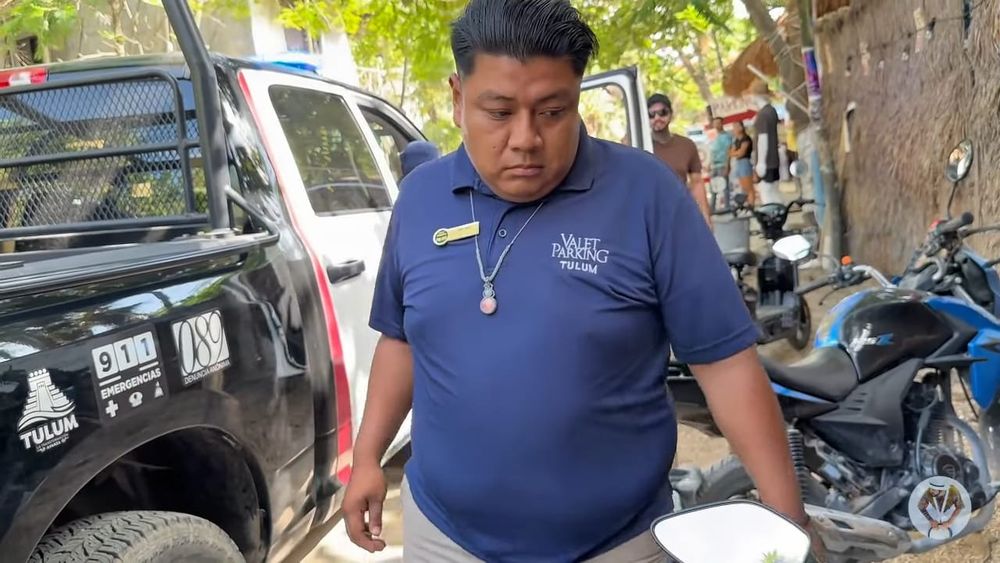
Arrested for Refusing to Pay the Toll of Injustice
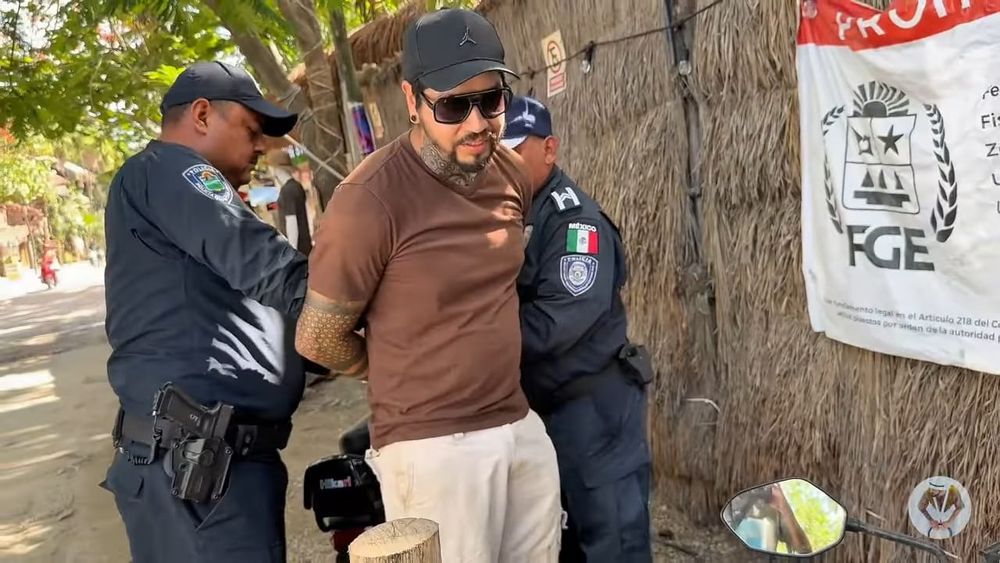
When the municipal officers arrived, Salvador tried to speak. Tried to explain. Tried to point out the absurdity: a civilian using public space being harassed by a company that had claimed it as its own.
But the police didn’t ask questions.
They didn’t investigate.
They didn’t verify ownership or consult any map of public zoning.
They detained him.
And they didn’t do it gently.
What followed was not a lawful mediation. It was force. It was silence. It was the machinery of a broken system spinning smoothly, effortlessly, crushing the very citizens it was built to protect. For filming. For parking. For standing on ground that should have been his as much as anyone’s.

And here’s the part that’s hard to ignore: the second a camera is pulled out, something shifts in their eyes. A tightening. A flash of threat where there should be none. Why is that? Why do so many officers act as though being filmed in public is an act of aggression? As if capturing the truth is the real offense?
Maybe it’s because they don’t want you to see what really happens. Maybe it’s because somewhere deep inside, they know this kind of power, unchecked, unaccountable, can’t stand up to exposure. Recording public servants in public spaces is a right, not a crime. And yet, over and over, we see phones ripped away, people handcuffed for pressing “record,” justice turned upside down while the rest of us watch in stunned silence.
Because who do we call when the people abusing power are the power?
Paradise as a Commodity
The real story here isn’t just about Salvador, though his story matters. It’s about what Tulum is becoming in the hands of those who see land not as sacred, but as saleable. Those who see beach access as an asset to flip, sidewalks as verticals to monetize, and tourists and locals alike as open wallets with feet.
Walk down the hotel zone, and you’ll feel it. The invisible tolls. The polite extortions. Want to park? Pay. Want to sit on the sand? Pay. Want to take a photo where the jungle kisses the waves? Someone, somewhere, will try to charge you.
But none of this is natural. This isn’t the soul of Tulum. This is the residue of unchecked greed. A creeping corrosion of something once wild and free and fiercely beautiful.
And in this dance between dollar signs and silence, it’s not just visitors who suffer. Locals too, workers, artists, guides, elders who’ve watched the coastline change color and shape over decades, are being priced out of their own town. Their roots pulled up for luxury spas. Their culture is packaged into wellness retreats and sold back to them at 10 times the cost.
This isn’t development. It’s displacement.
When the Uniform Becomes the Barrier
It would be easier to stomach if someone in charge did something. Suppose there were mechanisms in place to hold abusive officers accountable. But the truth is harsher. There is no line of defense. No watchdog. No internal affairs hotline that makes a dent. When something like this happens, when a man is arrested for filming, for standing, for saying “this isn’t right”, there is no recourse.
We’re on our own.
And that’s the deepest bruise of all. Not the arrest. Not the intimidation. But the realization that we, as civilians, are defenseless in the face of this. That the very structures meant to protect us have folded in on themselves, serving the powerful and punishing the honest.

This Isn’t About One Man
Yes, Salvador’s arrest was unjust. And yes, it was a moment worth documenting. But it’s also a warning. A small, sharp crack in the mirror that reflects a larger truth:
Tulum is being carved up. And it’s not by tourists or even foreigners. It’s by the slow, calculated hand of those who believe everything beautiful must be branded, parceled, priced, and policed.
That hand now reaches into the sidewalk. Into the sea.
And into the dignity of anyone who dares to say, “No.”
But there’s still time. There’s still a heartbeat beneath the concrete. Still, there are locals who remember what this place was. Still, visitors who come not for consumption, but for connection. Still, stories like this refuse to be silenced.
Tulum is not the enemy.
The enemy is greed.
And if we name it, if we confront it, if we refuse to let it twist beauty into business as usual, maybe, just maybe, we can keep the magic alive.
We’d love to hear your thoughts, join the conversation on The Tulum Times’ social media.