
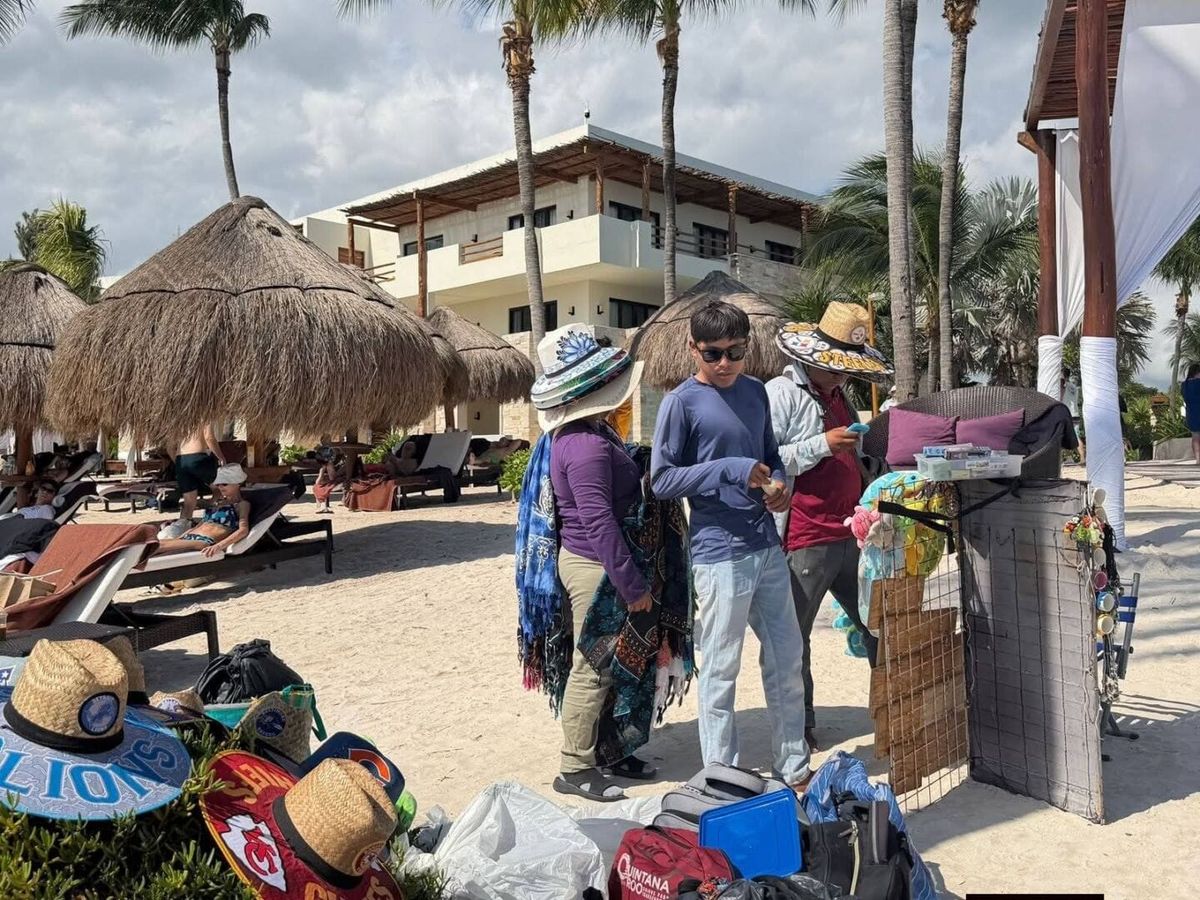
The growing presence of beach vendors in Tulum has become a flashpoint in a broader debate about order, legality, and reputation in one of Mexico’s most visible tourist destinations.
David Ortiz Mena, president of the Tulum Hotel Association and of the Mexican Caribbean Hotel Council, warned this week that the expansion of informal street vending along the beaches is undermining efforts to project stability in Tulum and could be facilitating more serious crimes.
At a moment when local businesses and authorities are trying to counter perceptions of chaos in the Riviera Maya, Ortiz Mena said, allowing illegal activity in highly visible public spaces sends the opposite message.
“While everyone is working to change the narrative, tolerating prohibited activities on the beaches contradicts those goals,” he said in an interview.
Tulum, located in the southern part of Quintana Roo, has faced growing scrutiny in recent years over public safety, urban disorder, and uneven enforcement of regulations, even as tourism remains the backbone of the local economy.
No permits and no legal gray area, says hotel association
Ortiz Mena was blunt about the legal status of beach vending. According to him, there are no permits that authorize the sale of goods on Tulum’s beaches, regardless of the arguments used to justify it.
“There are people who say ‘the sun rises for everyone’ to defend street vending,” he said. “But they forget that this is a prohibited activity. Nobody has permission to sell on the beach.”
From the hotel sector’s perspective, the issue is not only about aesthetics or visitor comfort. It is about enforcing the rule of law in a destination that depends heavily on international confidence.
Tourism operators in Tulum and across the Mexican Caribbean have invested heavily in marketing, infrastructure, and coordination with authorities to stabilize the destination’s image after years of headlines about crime and disorder.
And yet, Ortiz Mena argued, those efforts risk being neutralized if illegal practices are allowed to proliferate in plain sight.
When informal sales become a cover for serious crimes
The concern goes beyond tourism branding. Ortiz Mena warned that street vending can act as a façade for other illicit activities, including human trafficking.
“Among the vendors there are foreigners and minors,” he said. “And in several arrests, authorities have discovered criminals operating while disguised as street sellers.”
That assertion reflects a recurring concern among business leaders in Quintana Roo, where informal economies sometimes overlap with organized crime networks, particularly in high-traffic tourist zones.
While Ortiz Mena did not provide specific case numbers, he said recent detentions support the claim that beach vending can be exploited as a cover for criminal operations.
For hotel operators, this adds urgency to calls for enforcement. What might appear to some visitors as harmless commerce, they argue, could mask deeper risks to public safety.

A simple test of authority in Tulum’s public spaces
Ortiz Mena framed the issue as an opportunity for authorities at all three levels of government to demonstrate control and coordination.
Containing and stopping illegal beach vending, he said, would be a clear signal that order exists in the destination.
“It is a simple way to show that there is control,” he argued.
The message is aimed not only at local officials but also at residents, whom he urged not to normalize or defend activities that fall outside the law.
In a destination like Tulum, where the line between tolerance and neglect can quickly blur, public perception often moves faster than policy.
And perception, as tourism leaders frequently note, can be as consequential as reality.
Social media narratives add another layer of tension
The debate over image and responsibility has also played out online.
Recently, Jesús Almaguer, former president of the Cancun, Puerto Morelos, and Isla Mujeres Hotel Association, publicly criticized residents of Tulum for what he described as damaging commentary on social media.
According to Almaguer, negative posts exaggerate the destination’s problems and contribute to a denigrating narrative that ultimately harms the local economy.
“People make a living from tourism,” he said at the time. “Yes, there are things to improve, but it’s being exaggerated.”
Almaguer suggested that much of the critical content circulating online comes from individuals who had a bad personal experience and then generalize it across the destination.
Still, he expressed hope that a coordinated strategy involving federal, state, and municipal authorities could help stabilize Tulum’s reputation.
The remarks added fuel to an already sensitive discussion about who controls the narrative of Tulum, and how criticism should be balanced against economic dependence on tourism.
Tourism dependence and the limits of patience
Tulum’s transformation from a small coastal town into a global tourism brand has been rapid and uneven.
Luxury hotels coexist with informal settlements. High-end wellness retreats sit next to infrastructure that often struggles to keep pace with demand. Visitors are drawn by the promise of natural beauty and culture, but they are also quick to share dissatisfaction online.
In that context, the growth of beach vending has become symbolic of larger governance challenges.
Some residents see enforcement as selective or inconsistent. Others argue that informal vendors are filling economic gaps in a town with rising costs and limited opportunities.
The hotel sector, however, views the situation through a different lens. For them, unregulated activity threatens not only aesthetics but also safety, legality, and long-term sustainability.
There is no easy resolution. But the tension underscores how fragile Tulum’s balance has become.

World Cup 2026 brings hope, but also uncertainty
Ortiz Mena also addressed expectations surrounding the 2026 FIFA World Cup, which will be hosted jointly by Mexico, the United States, and Canada.
While the event has generated excitement across the Mexican Caribbean, he cautioned against overly optimistic projections.
Two national teams are expected to establish training bases in Quintana Roo, and the tournament will take place during the summer, traditionally a challenging season for hotels in Tulum.
These factors could work in the region’s favor.
But Ortiz Mena said claims that up to one million additional visitors will arrive in the Mexican Caribbean lack clear backing.
“There’s a scenario where fans come only for the matches,” he explained. “And another where some take advantage of the proximity to visit destinations in the state.”
For now, neither scenario is visible in booking data.
As of today, Ortiz Mena said, there is no noticeable increase in reservations tied directly to the World Cup, making it too early to draw conclusions.
Waiting for data in a cautious market
The hotel sector plans to monitor figures closely in the coming months to better understand the tournament’s real impact.
In a market as volatile as Tulum, expectations can shift quickly, influenced by global travel trends, security perceptions, and currency movements.
Optimism exists, but it is tempered by recent experience.
Tourism leaders have learned that global events do not automatically translate into local benefits, especially without coordinated planning and effective governance.
Order, perception, and what is at stake for Tulum
At its core, the debate over beach vendors reflects a larger question about Tulum’s future.
Is the destination capable of enforcing its own rules while remaining inclusive? Can it protect its image without ignoring underlying social pressures? And who bears responsibility when informal practices become normalized?
Ortiz Mena’s warning places the issue squarely in the public arena, framing beach vending not as a minor nuisance but as a test of authority, legality, and credibility in the Riviera Maya.
For a destination that depends so heavily on how it is perceived abroad, those questions are not abstract. They shape investment decisions, visitor flows, and the daily lives of those who live and work in Tulum.
As The Tulum Times has reported before, image and reality are deeply intertwined here.
What happens on the beaches may determine far more than what tourists buy.
We’d love to hear your thoughts. Join the conversation on The Tulum Times’ social media.
Should stricter enforcement on Tulum’s beaches be a priority, or does it risk ignoring deeper social challenges?