
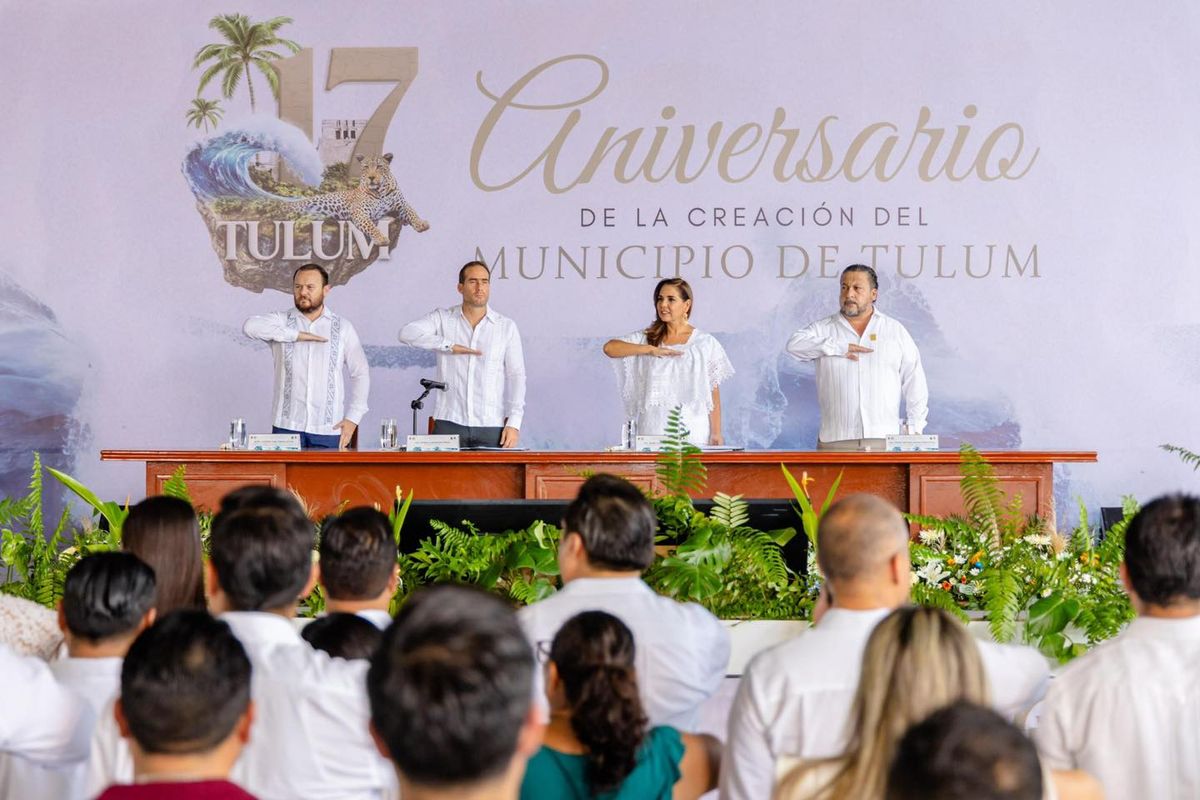
On May 29, 2025, Tulum marked its 17th anniversary as an autonomous municipality, a moment of celebration, reflection, and more profound questions about identity, growth, and responsibility.
What began as a modest territory in 2008 has since evolved into one of the most dynamic and controversial municipalities in Quintana Roo. At 17, Tulum is no longer a fledgling experiment in governance. It is a place where opportunity and urgency coexist.

Civic ceremony honors Tulum’s political development
The day opened with a solemn public session of the municipal council, held at the Domo Doble of Unidad Deportiva. Led by Mayor Diego Castañón Trejo and attended by Governor Mara Lezama Espinosa, the event reflected on the municipality’s progress while emphasizing the shared responsibility for what lies ahead.
“This is not just about how far we’ve come, but who we’ve brought with us,” said Mayor Castañón during his address.
Governor Lezama echoed the sentiment, calling for unity and action: sustainable development, improved public services, and safety for all. With state and federal representatives present, the symbolism was clear: Tulum is now a key player in regional politics.

Music, pride, and a call to community
As the sun set, the tone shifted from institutional to celebratory. Hundreds gathered at the esplanade of the Municipal Palace for a free concert featuring Nativo Show and Banda La Grandiosa. The crowd sang, danced, and reclaimed a shared space that, in recent years, has felt increasingly divided by social and economic forces.
For many residents, the concert offered more than entertainment, it was a temporary return to a sense of community.
“I love seeing the town grow,” said local vendor Rosa Méndez, “but sometimes I wonder if we’re still building it for the people who live here.”

Security and infrastructure: urgent priorities at 17
Despite the festive air, the undercurrents of concern remain strong. Over the past decade, Tulum has grappled with the darker side of rapid expansion. Public safety is a pressing concern, and infrastructure struggles to keep up with demand.
Organized crime, overcrowding, and gentrification have altered the social fabric of a once tight-knit town. As more developments rise, questions mount: who benefits from this growth, and at what cost?
A new generation of local leaders is now tasked with responding to these realities, not just with vision, but with concrete action.

Tulum’s future: inclusivity, dignity, and participation
If the 17th anniversary made anything clear, it’s that Tulum stands at a crossroads. It is a destination known worldwide, but also a community where many feel left behind.
The path forward will require more than infrastructure and policing. It will require policies that prioritize inclusion, affordable housing, education, and environmental responsibility. It will require listening, not just to tourists or investors, but to the residents who have been here all along.

Timeline of a young municipality
- 2008: Tulum officially becomes a municipality, separating from Solidaridad.
- 2010–2015: Tourism accelerates, with infrastructure development struggling to keep pace.
- 2016–2022: Rise in real estate projects, international attention, and socio-economic tensions.
- 2023–2025: New leadership faces pressure to stabilize growth and address security.
- 2025: Tulum celebrates 17 years with mixed pride and concern.

A call to reflect, and to act
This anniversary was not just a celebration; it was a milestone. It was a mirror. And while the fireworks may fade, the questions must remain lit: Can Tulum become a model of sustainable and inclusive development? Can it be more than a brand, can it be a home?
We invite you to join this conversation.
What does Tulum mean to you today? What do you hope it becomes in the next 17 years?
Join us on Instagram, Facebook, or X, and share your vision using #TulumAt17.