

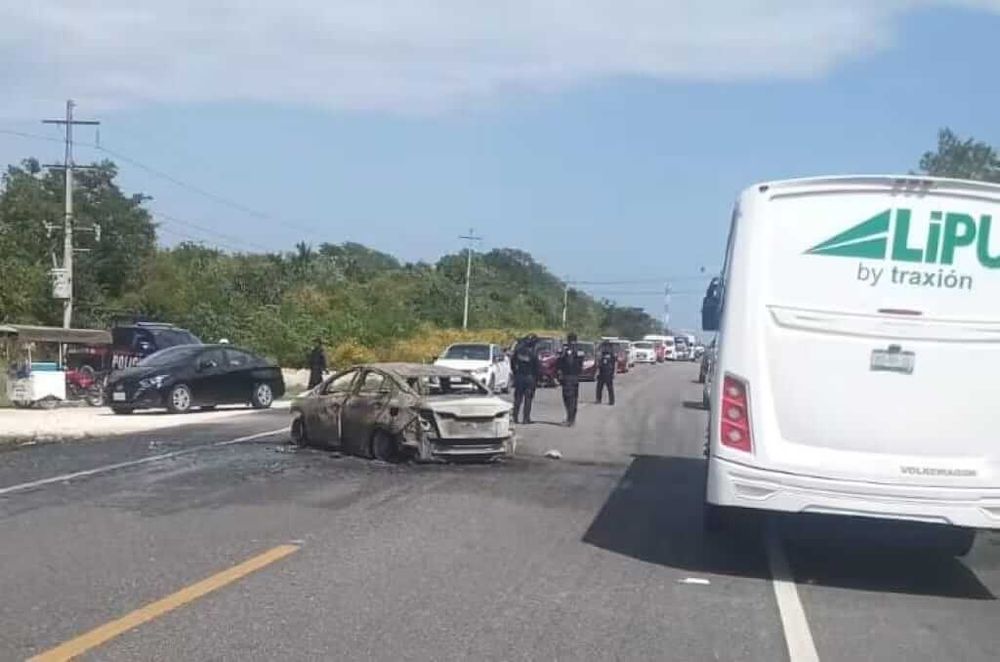
The Tulum–Cobá highway was temporarily closed on Sunday before reaching the community of Macario Gómez after several vehicles were set on fire, in an incident authorities are analyzing amid a wave of violent events reported in multiple states across Mexico following the capture of Nemesio Oseguera Cervantes, known as “El Mencho,” in Jalisco.
Emergency crews and security forces responded to the scene to extinguish the flames and secure the area, leading to a suspension of traffic along the route. As of Sunday evening, authorities had not reported any injuries or arrests related to the incident.
Incident disrupts key access route to Cobá
The closure occurred along one of the main roadways connecting Tulum to Cobá, a corridor frequently used by residents, workers, and visitors traveling between the municipality and surrounding communities. The temporary suspension of circulation required drivers to wait while authorities worked to control the situation and assess potential risks.
Officials have not released details about the number of vehicles involved on the Tulum–Cobá stretch, nor have they confirmed whether the fires were directly coordinated with incidents elsewhere in the state or country.
For Tulum, the disruption affected a strategic access point that links urban areas with rural communities and tourism zones. Even short-term closures along this route can complicate mobility for local families, transportation services, and businesses that rely on road connectivity.
Statewide fires reported in Cozumel, Playa del Carmen, and the Cancún corridor
The highway incident occurred on the same day as other vehicle fires and property damage across Quintana Roo.
In Cozumel, a Bodega Aurrerá store was set on fire. In Playa del Carmen, two vehicles were burned in the parking lot of Plaza Centro Maya. Authorities also reported at least three vehicles set ablaze along the Cancún–Leona Vicario highway, prompting a temporary closure of that roadway and a broad security operation at access points to Cancún.
The coordinated timing of these events led authorities to examine whether the Quintana Roo incidents may be linked to violent episodes reported in at least 11 states nationwide. Across those states, authorities have documented road blockades, vehicle burnings, and attacks on facilities following the reported federal operation in Jalisco that resulted in the capture of Nemesio Oseguera Cervantes.
Security cabinet in permanent session
In response, the Quintana Roo state government, led by Governor Mara Lezama, placed the state’s Security Coordination Table in permanent session. The objective is to monitor developments in real time and coordinate actions with federal and municipal authorities.
State officials indicated that investigations remain ongoing to determine whether the events in Quintana Roo are directly connected to incidents reported elsewhere in the country. Meanwhile, reinforced security presence has been deployed at strategic points to guarantee public safety.
For residents of Tulum and neighboring communities, the reinforced operations mean increased patrols and checkpoints in key areas. Authorities have not announced additional restrictions, but security forces continue to maintain visibility along highways and urban access routes.
What this means for Tulum residents and travelers
While no injuries or arrests have been confirmed in connection with the Tulum–Cobá highway incident, the temporary closure highlights the potential impact of broader national security developments on local mobility.
Tulum’s economy and daily life depend heavily on road access. Routes such as Tulum–Cobá and Cancún–Leona Vicario connect workers to jobs, residents to essential services, and businesses to supply chains. Even isolated disruptions can ripple across transportation schedules and local commerce.
Authorities have not confirmed a direct link between the Quintana Roo incidents and the broader events in other states. However, the simultaneous timing has prompted heightened coordination among state, federal, and municipal security bodies.
The situation remains under investigation, and officials continue to evaluate the scope and possible coordination of the incidents. For now, circulation on the Tulum–Cobá highway has resumed after emergency services controlled the fire and secured the area.
The immediate change for residents is the presence of reinforced security and the possibility of temporary traffic interruptions as authorities maintain vigilance. The broader question is whether further incidents will occur or whether the state’s security measures will prevent additional disruptions.
The Tulum–Cobá highway incident underscores how national security operations can have immediate local consequences, even when details remain limited. What happens next will depend on the outcome of ongoing investigations and the effectiveness of coordinated security efforts.