

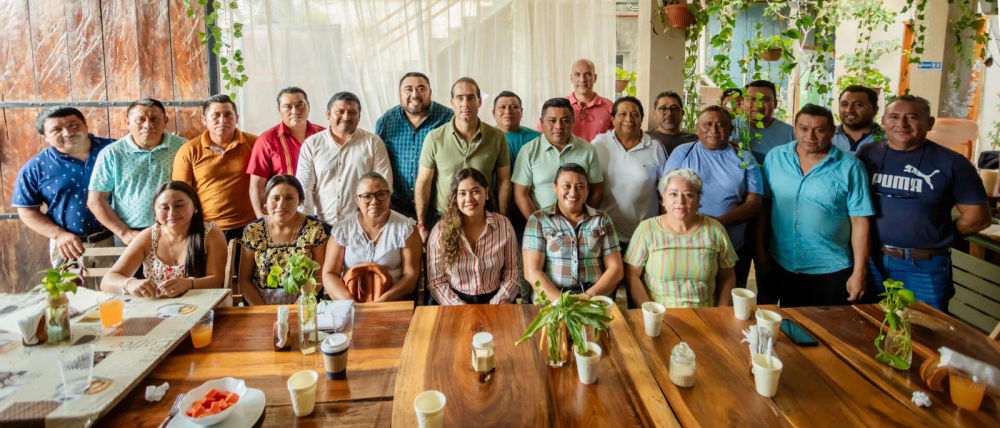
The fans buzzed softly overhead, barely keeping up with the July heat. In a modest room tucked behind the municipal palace of Tulum, chairs scraped the tile floor as local delegates took their seats, one by one. It wasn’t the kind of room where history gets made. No velvet drapes, no polished podiums. Just folding tables, notebooks, and the sharp hum of real voices, voices tired of promises, hungry for change.
And seated at the head of it all, not behind a screen or flanked by consultants, was Diego Castañón Trejo, Tulum’s municipal president, showing up for another round of what’s quickly become his administration’s quiet ritual: a monthly face-to-face with the very people living the reality of his policies.
He calls it essential. The community calls it overdue.

The Practice of Listening
Let’s not kid ourselves, politicians love microphones, not folding chairs. But Castañón seems to be trying something different. “For me and my administration, it’s fundamental to hear from people directly,” he said during Tuesday’s gathering. “That’s why these monthly meetings matter, we evaluate what we’ve done, where we’ve fallen short, and look for answers together.”
That “together” isn’t rhetorical fluff. It’s a principle grounded in a growing global movement toward community engagement, the idea that governments don’t just serve people but build alongside them. That progress isn’t decreed; it’s negotiated, block by block, voice by voice.
And in that cramped room on July 8th, the negotiating was alive.

Asphalt, Speed Bumps, and Health Posts
You don’t need to run a poll to know what’s missing in Tulum’s outer delegations. Just ask someone from Cobá or San Pedro. Roads torn open like old wounds. Speeding traffic where kids walk barefoot. Clinics that are more rumor than reality.
So when Castañón laid out the current slate of projects, paving roads, installing speed reducers, and opening new health posts in the Maya zone, the room didn’t break into applause. That’s not how these meetings work. But there were nods, murmurs, a shift in posture. It wasn’t gratitude exactly. It was something quieter. Hope, maybe.
Ezequiel Maya Ascorra, delegate from Cobá, didn’t sugarcoat it: “These meetings are positive for the delegations’ progress. We’re the bridge between the people and the government.” Electricity, or the lack of it, is the battle he’s currently fighting. “Right now, we’re tackling power supply issues. It’s time for better service, and we’re taking that directly to the authorities.”
That’s the grind of community engagement. Not grand speeches, but utility bills, potholes, and the guts to say, “This isn’t working.”
A Glimmer in San Pedro
Rigoberto Cen Can, from San Pedro, got news that turned the whole room a little warmer: the long-awaited health center in his community is finally going to break ground. “It’s encouraging,” he said, voice steady but proud. “They’re listening. We’re working together. That means something.”
Francisca Tun Canal, of San Juan, chimed in, her voice clear and direct. “It’s excellent that they hear us. When we talk directly to the president, follow-through becomes possible. We’re truly happy about that.”
No PR filters. No staged Q&A. Just people talking to the person who holds the pen on the next budget draft.
Beyond Symbolism
Castañón isn’t pretending these monthly meetings are magic. But he’s betting on consistency. He closed the session with a promise: the meetings will continue. And more than that, he’ll keep walking the villages, this Friday, he said, he’ll be out again, on foot, listening.
That’s not optics. That’s infrastructure for trust. And trust, unlike pavement or power lines, doesn’t get rolled out overnight.
Community engagement isn’t just a buzzword for Diego Castañón. It’s strategy and survival, politics and humanity rolled into one. Like a town hall in miniature, repeated month after month, it’s an experiment in governance that runs on questions, not answers.
Will it work?
The fans overhead kept spinning. Outside, the heat hadn’t let up. But inside that room, something had moved.
We’d love to hear your thoughts, join the conversation on The Tulum Times’ social media.