
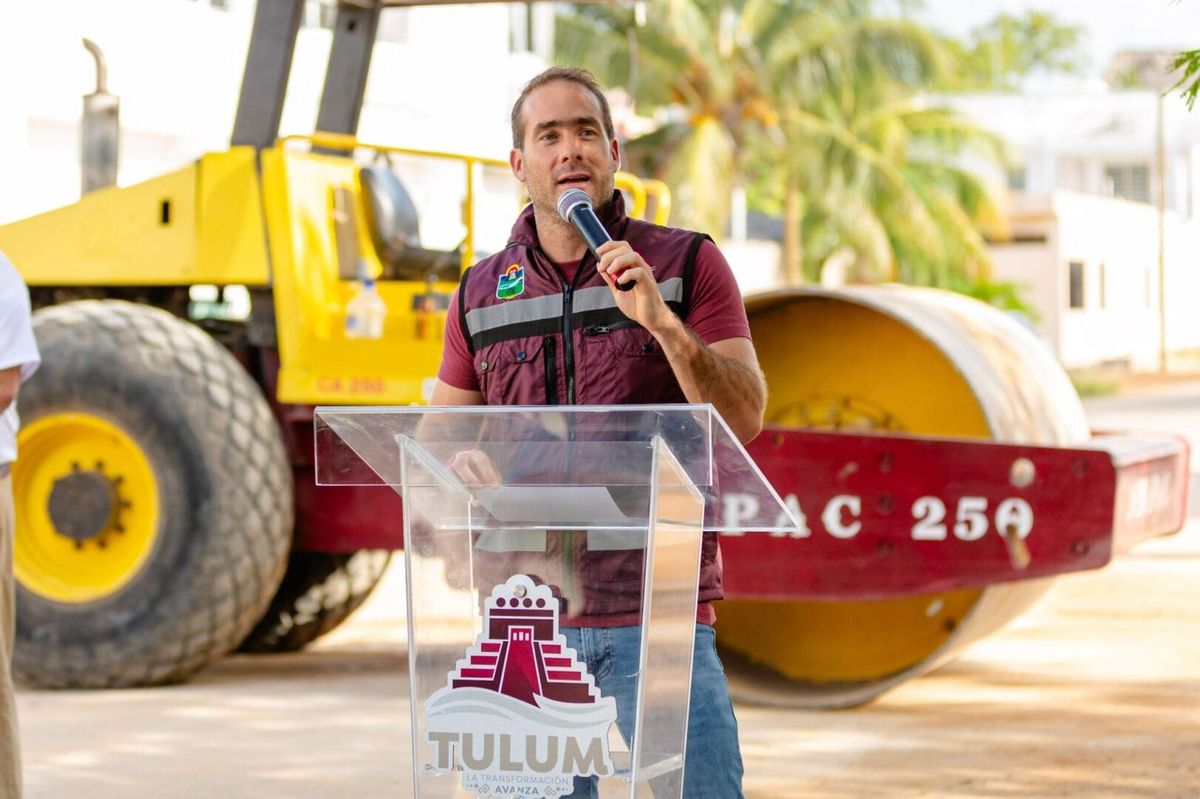
It doesn’t happen often, a town feeling seen, truly seen, by its government. But in Tulum, under the pressing sun and between jungle-draped horizons, something resembling political affection is starting to take root. Not the cheap kind, paraded out during election cycles. No, this is the kind that smells of asphalt, sounds like jackhammers at dawn, and looks like a mother walking safely with her child to a doctor just across the street. Tulum earns a rare kind of political affection, and it’s written in concrete.

A Road to Health, Not Just Anywhere
The sleepy community of Macario Gómez, nestled along the arterial roads leading out of Tulum proper, has long existed in a liminal space, close enough to the city to be visible, yet far enough to be overlooked. That started to change when the municipal government, led by Mayor Diego Castañón Trejo, cut the ribbon on a brand-new health center designed to serve not just Macario Gómez but the constellation of rural communities that orbit it.
And then, the second shoe dropped: a newly paved road, 568 meters of it, unfurling like a promise finally kept. Mayor Castañón, speaking to a crowd of residents and officials, framed it as a matter of dignity. “This isn’t just asphalt. It’s access, it’s opportunity, it’s respect,” he said.

Christian Moguel, Director of Project Oversight, confirmed that this was no rushed patch job. The avenue was prioritized because of its role as a critical connector to healthcare services. Built to meet legal and engineering standards, the road is expected to withstand Tulum’s brutal rainy seasons, a vital feature for a town often marooned by impassable mud and flooding.
Beyond the ribbon-cuttings and speeches, what happened in Macario Gómez was a subtle but seismic shift: government listening, then responding. It’s a pattern that residents are beginning to notice, and in a place where patience often wears thin, that’s significant.

Ya’ax: Where Asphalt Meets Memory
The resonance of that transformation echoes in the community of Ya’ax, where an even more ambitious infrastructure effort is underway. There, 1,300 meters of road are being laid down with the same deliberate focus. The paving of streets in Ya’ax is more than a logistical upgrade; it’s a reclamation of space and safety for a neighborhood long pushed to the periphery.
“We’re not giving handouts,” Mayor Castañón told a group of residents gathered beneath tarpaulins strung between trees. “We’re fulfilling an obligation. One that should’ve been met years ago.”
Christian Moguel again provided the technical scaffolding: the work includes not only asphalt laying but also topographic surveys, material compaction, and waterproof layering. The attention to detail is striking, a far cry from the ad hoc, ephemeral fixes that communities here have grown too accustomed to.

It is worth noting that the community of Ya’ax, with approximately 46,000 residents, represents a dense tapestry of working-class families, many of whom rely on foot and bicycle transportation. Smooth, safe roads mean less time detouring through backlots, less risk for children commuting to school, and fewer injuries during the perilous rainy season. It’s more than convenience; it’s protection.
Infrastructure as a Moral Contract
This growing network of infrastructure, stretching from Macario Gómez to Ya’ax and likely beyond, forms the skeletal framework of what the municipal government has dubbed a “comprehensive urban improvement strategy.” But what does that mean, beyond PowerPoint slides and press releases?

It means that roads are being considered not in isolation, but as part of a system: sidewalks are being reconstructed, storm drains are being re-engineered to prevent flash flooding, and traffic signage is being updated for safety. There’s even talk of planting green corridors along new roads, an effort to harmonize urban development with the ecological identity that Tulum fiercely protects.
The projects, while still in early phases, are being conducted with a degree of transparency and community engagement that feels refreshingly novel. Residents have been invited to planning meetings, their input sought on everything from speed bumps to lighting placement. It’s democracy by shovel and spade.
Listening, Then Building
The mayor has repeatedly framed this wave of public works as a response, not a favor. “We asked, and people answered,” he said. “Now it’s our turn.” That sort of reciprocal rhetoric may sound trite elsewhere, but in Tulum, where neglect often masqueraded as governance, it rings with unusual authenticity.

Locals, long skeptical of top-down initiatives, are watching. More importantly, they’re participating. Neighborhood committees are being formed to monitor the construction progress, report inefficiencies, and advocate for continued improvements. One resident of Ya’ax, speaking candidly at a community gathering, put it this way: “For the first time, it doesn’t feel like they’re building for someone else. It feels like they’re building for us.”
Toward a Different Kind of City
And maybe that’s the real story here: not the asphalt or the engineering reports, but the changing weather of trust between people and their local government. These streets are being etched into the landscape with more than tar and stone. They’re paved with the collective memory of what it feels like to be overlooked, and the cautious hope that those days are coming to an end.
If the mayor keeps his word, and if the people keep holding him to it, Tulum might just become something rare in politics: a place where promises go to live, not die.
We’d love to hear your thoughts, join the conversation on The Tulum Times’ social media.