
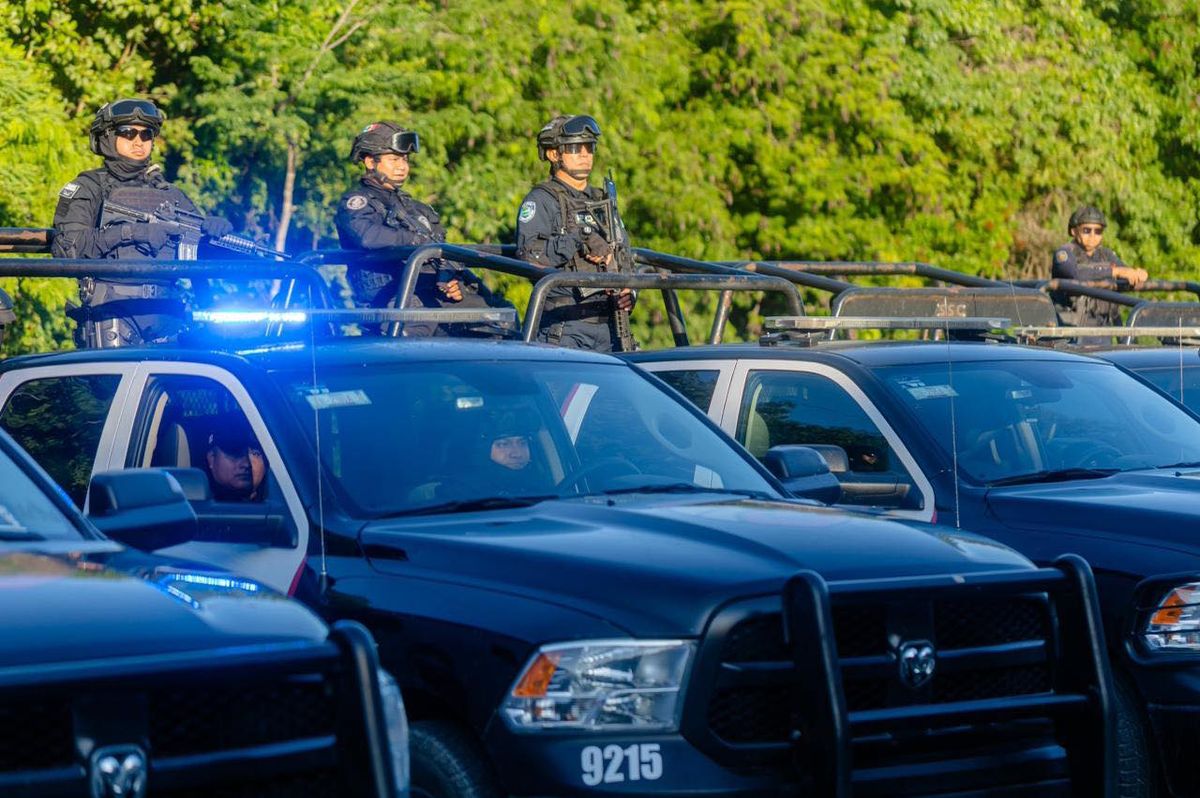
Authorities across Tulum opened the holiday season with a coordinated security operation meant to support a municipality that could soon reach near full hotel occupancy. The special Guadalupe–Reyes deployment, announced by municipal, state, and federal agencies, aims to protect residents and thousands of travelers expected to arrive in the coming weeks. The operation is already visible across beaches, highways, archaeological zones, and busy public corridors, where mobility typically intensifies through early January.
Hotel managers in the Riviera Maya report a steady rise in reservations, and local officials say Tulum remains among the ten most visited destinations worldwide. That ranking, celebrated by many business owners, places additional pressure on public safety teams who face longer shifts and higher call volumes. The question on the minds of many is whether the joint deployment can keep pace with the seasonal surge.
“Security is not a slogan. It is a daily test,” a local tourism operator said after the announcement, in a remark that quickly circulated on social media.
How Tulum prepares for a holiday stretch that rarely pauses
The season that stretches from the Feast of Guadalupe to Reyes has long been one of Mexico’s busiest travel periods. It compresses family vacations, year-end tourism, and major festivities into a single timeline. In towns across Quintana Roo, these weeks tend to amplify both economic activity and public risk.
During the launch event, Mayor Diego Castañón emphasized the scale of the moment. He noted that Tulum’s inclusion among the world’s top destinations brings opportunity but also responsibility. His administration appears intent on showing that visitors can move through beaches, jungle corridors, hotel zones, and archaeological sites without major disruption. And he framed the goal succinctly: reaching the end of the holiday period with what could be a clean safety record.
A short micro-story shared by a local business owner illustrated the stakes. Last year, she recalled, a minor highway collision near the entrance to the hotel zone escalated into a long traffic standstill that left travelers frustrated and late for flights. The delay, she said, underscored how even a single incident at peak hours can ripple across the region. This year, she hopes the unified deployment will help prevent similar scenarios.

Agencies converge as part of the main keyword security plan
The holiday operation brings together an unusually broad coalition. Municipal police will work side by side with the Policía Estatal, the National Guard, the Secretaría de Marina, and the Secretaría de la Defensa Nacional. Prosecutors from both the Fiscalía General del Estado and the Fiscalía General de la República are also involved, along with health teams, ambulance crews, and firefighters.
That convergence mirrors a trend seen in other tourism hubs, where layered security networks have become standard practice during high-season events. But in Tulum, the coordination carries particular resonance. The municipality’s rapid expansion over the past decade has often outpaced public infrastructure. Officials appear mindful that managing high season now requires not just presence but synchronization.
Rafa Domínguez, director general of Protección Civil y Bomberos, explained that the security apparatus will not be limited to the coastal core. It will extend to Cobá, where a medical unit and an additional patrol will operate as part of the broader emergency response plan. Cobá’s archaeological site draws steady crowds, and road access can be narrow. Domínguez suggested that pre-positioning teams there could reduce response times and improve outcomes should an incident occur.

Rising occupancy adds pressure to the region’s safety network
Local authorities say hotel occupancy in Tulum is already close to 80 percent. Industry forecasts suggest it could reach 95 percent in the coming days, driven by domestic travelers, international arrivals, and seasonal events that attract nightlife and cultural tourism. Such volume affects everything from beach access to highway capacity. It also intensifies the workload on security personnel who must manage lost tourists, traffic collisions, medical calls, and beach-related emergencies that often spike at sunset.
For residents who navigate these weeks every year, the dynamic is familiar. Restaurants stay open later. The airport corridor in nearby Cancún moves at a near-constant flow. Rental cars fill the highways toward the Riviera Maya. And yet each year seems to carry a hint of unpredictability, shaped by weather, flight delays, or shifts in traveler behavior. That unpredictability is what makes coordination so central to this season’s plan.
The Tulum Times has previously reported that holiday visitors often move between multiple municipalities in a single day. That movement can complicate jurisdictional boundaries and strain communication between agencies. Officials now appear intent on smoothing those gaps, at least temporarily.

Why officials believe shared accountability matters this year
Security operations rarely come without debate. Some residents worry that increased enforcement could lead to unnecessary inspections or slowdowns at checkpoints. Others argue that the presence of uniformed personnel offers reassurance in a municipality that has grown rapidly and still contends with sporadic criminal incidents.
In addressing the crowd, Mayor Castañón tried to weave those concerns into a larger frame. His message suggested that community collaboration is not auxiliary but essential. The call for cautious driving and respect for local regulations was repeated by several agencies, underscoring a view that safety is not only institutional but collective.
One subtle reflection hung over the speeches. As tourism grows, Tulum’s social fabric must continuously adjust. That adjustment includes accepting the costs of development and reexamining how a destination with global visibility can maintain its character while ensuring safety for those who live and visit here. Growth, in other words, demands not just celebration but calibration.

How regional presence and symbolic leadership shape the launch
The event drew regional officials, including Karen Román Flores, the representative of Gobernación in the Mesas de Seguridad. Her presence signaled federal alignment with local goals. It also illustrated how Quintana Roo’s security agenda often transcends municipal borders.
Several regidores, the municipal síndico, and operational commanders also attended. Their collective appearance projected consensus, even as the underlying tasks remain complex and labor-intensive. For many in attendance, the message was clear. Seasonal tourism is not simply a boost for the local economy. It is also a test of institutional readiness.
Officials said operations will run 24 hours a day, adapting to crowd patterns that shift between early morning beachgoers, mid-afternoon archaeological tours, and nighttime restaurant and club traffic. Emergency teams will monitor conditions in real time, an approach that might help mitigate unexpected surges or disruptions.

What remains at stake as the holiday period unfolds
As the first holiday visitors settle in, authorities hope the initial deployment sets the tone for the weeks ahead. The main keyword security operation is designed to absorb pressure from rising tourism while supporting economic activity that many businesses depend on. Whether it succeeds could influence how similar operations are planned across Mexico’s tourism corridor.
The closing message from officials repeatedly returned to public cooperation. Travelers and residents were urged to follow posted rules, remain attentive in high-traffic areas, and respond to official instructions. Those reminders might feel routine. But in a destination where international attention rarely slows, they carry real weight.
Tulum continues to evolve, and with that evolution comes broader questions about how tourism, safety, and community values intersect. The coming weeks will offer one more window into how the region manages that balance.
The holiday season is poised to be one of the busiest in recent years. And as visitors continue arriving, the municipal government hopes that coordination, preparedness, and shared responsibility will define the outcome.
The main keyword security operation will remain active through early January. We’d love to hear your thoughts. Join the conversation on The Tulum Times’ social media.
What safety measures feel most urgent to you during peak travel periods?