
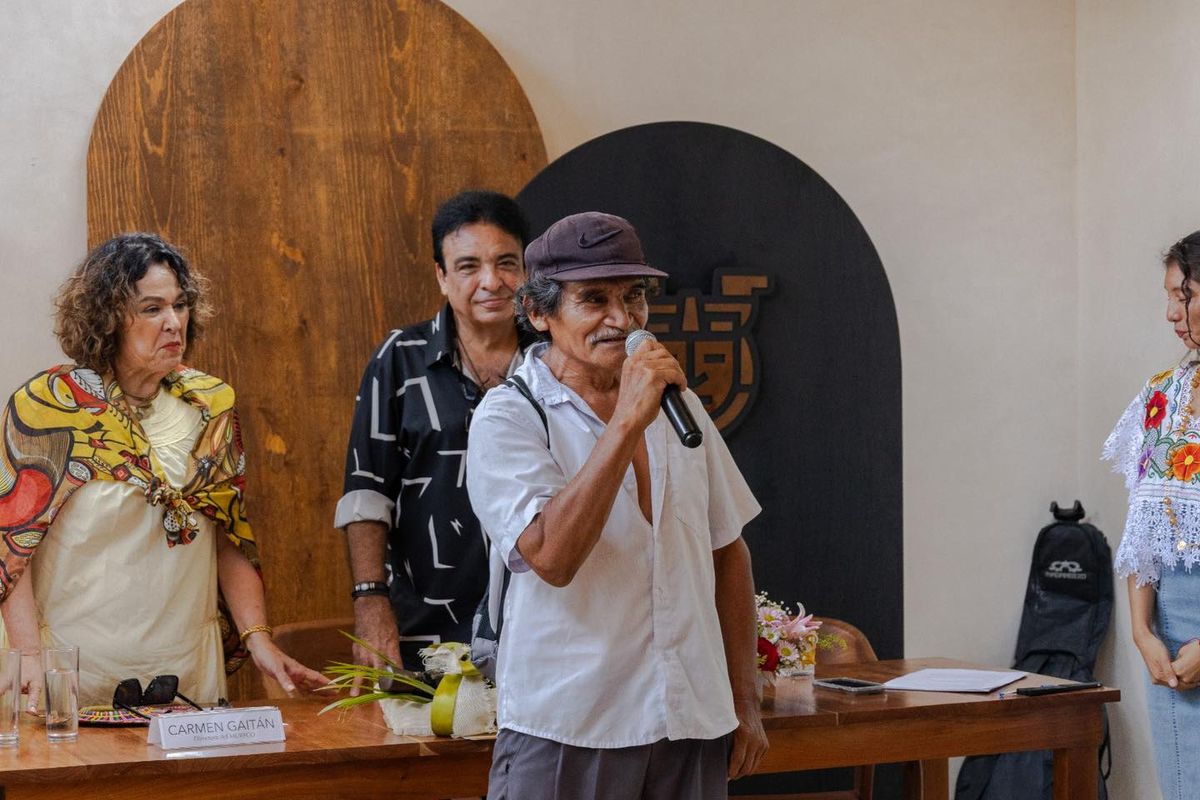
In the humid stillness of Tulum, where jungle presses against stone and time folds in on itself, a name rises, not as headline, but as haunting: Angelino Chalé Chi. It echoes like a footstep in sacred ruins, tethered to a lineage burned into the bloodied soil of Yucatán’s past. His name is not part of history books taught in polite classrooms, but it lives where memory survives: in whispers, in rituals, in stubborn remembrance.
At the Museo Regional de la Costa Oriental, beneath portraits faded not by time but by silence, the exhibition Últimos Testigos opened with the weight of an overdue breath. Not merely an art opening, but a reckoning. Not just images on walls, but history staring back.

What Is Últimos Testigos?
An Exhibition Rooted in Resistance, Not Aesthetics
Conceived by Canadian photographer Serge Barbeau, Últimos Testigos is more than a curated experience. It is, at its core, a confrontation, an act of visual resistance. The exhibition consists of intimate portraits of Maya elders, descendants of those who fought, fled, or bore witness to the Caste War (Guerra de Castas), a 19th-century indigenous uprising that both disrupted and defied colonial order in the Yucatán Peninsula.
Each face in Barbeau’s lens becomes a document. A testimony. A relic and a roar. These portraits do not embellish. There’s no romanticism in them. No sepia-tinted nostalgia. Just eyes that look straight into yours, carrying something older than fear and deeper than pain.
Their silence is not passive. It accuses. It reveals. It resists.

The Caste War: A History Mexico Never Fully Buried
Understanding the Blood Beneath the Soil
To grasp the emotional gravity of Últimos Testigos, one must look back, not in vague gestures, but directly into the wound. The Caste War began in 1847 as a revolt of Maya communities against a system of racialized land dispossession, forced labor, and colonial cruelty. It was a war not just of arms, but of cosmologies, Maya gods and European saints thrown into violent opposition.

Cecilio Chi, one of the rebellion’s key leaders and ancestor to Angelino Chalé Chi, embodied this resistance. He wasn’t a rebel for power’s sake. He was a man who chose war because dignity demanded it. His name is still whispered in corners where memory endures longer than empire.
But as with many indigenous uprisings, history did what it does best: it buried the rebels and exalted the generals until now.
A Museum Night Unlike Any Other
Collective Memory Awakened in a Colonial Shell
On opening night, the museum pulsed not with celebration, but with something more fragile and sacred: remembrance. The air felt charged as if the ancestors were watching.
Cultural dignitaries like Carmen Gaitán, director of the Museo Nacional de Arte, and Silvia Landeros of Fundación Zamná mingled with municipal leaders, artists, and, crucially, members of local Maya communities. Their presence wasn’t decorative. It was the point.

Speeches opened the night, but they didn’t dominate it. They guided it. Mario Colli Colli grounded the event with a searing historical lecture on La Cruz Parlante, a symbol that turned spiritual resistance into strategic insurgency. Then Carlos Chablé Mendoza and anthropologist Georgina Rosado offered a haunting dive into the legacy of María Uicab, a female leader whose very memory seems to disturb the comfortable narratives of nationalism.
Then, without spectacle, came Arturo Bayona. His music wasn’t for entertainment. It was a ritual. A melody that moved like prayer.

When History Walks Into the Room
The Appearance of Angelino Chalé Chi
At the night’s emotional crescendo, Angelino Chalé Chi stood before the audience. A direct descendant of Cecilio Chi. A living echo of one of the rebellion’s fiercest voices.
He didn’t have to speak much. He was the message.
His body carried memory the way old trees carry storms, quietly, without ceremony, but with an undeniable weight. When he was honored with a special mention for his lineage, the room didn’t erupt. It fell silent. Reverent. As if even applause might feel vulgar in the face of such presence.
In that moment, history wasn’t in the past. It stood upright, looked everyone in the eye, and waited to be acknowledged.

Taste as Testament
Maya Cuisine as Cultural Continuity
As the evening drew to a close, the museum offered something deceptively simple: food. Not hors d’oeuvres, not catered abstractions, but traditional Maya dishes that tasted of land, labor, and lineage.
Empanadas de chaya. Tamales wrapped in banana leaves. Kibis are filled with spice and survival. Roasted elotes kissed by fire. Drinks brewed in clay pots passed from generation to generation.
This was more than hospitality. It was pedagogy. It was proof that culture does not survive in textbooks, it survives in kitchens, in recipes whispered across centuries, in hands that still remember how to make masa without measurement.

The Weight of Location
Why Tulum’s Museum Matters More Than It Appears
The Museo Regional de la Costa Oriental sits inside Tulum’s archaeological zone, a tourist magnet with Instagram appeal and ancient stones. But here, beneath the glossy surface of Riviera Maya’s boomtown, the museum becomes a contradiction: colonial architecture preserving anti-colonial memory.
Steps away, tourists pose atop crumbling ruins, unaware of the spiritual war still being fought in the galleries nearby. Yet the exhibit doesn’t demand attention. It doesn’t shout. It waits. It knows memory takes its time.
The Urgency of Now
Why Últimos Testigos Is Not Just About the Past
Though Últimos Testigos will remain on display, the urgency it carries feels immediate. It doesn’t ask to be admired. It asks to be felt. Deeply. Uncomfortably. Honestly.
Because this is not just history, it is an inheritance. A burden. A gift.
And in the face of cultural erasure, tourism-driven gentrification, and a global narrative that still treats indigenous identity as folklore, exhibitions like this are not optional. They are vital.

Final Thoughts: When Art Becomes Ancestral Duty
What happens when art stops being decorative and becomes ceremonial? What happens when a photograph isn’t a product, but a provocation?
Últimos Testigos answers with silence. With stillness. With eyes that refuse to look away.
And perhaps that is the most profound offering of all.
Join the conversation on The Tulum Times’ social channels. History needs more than readers, it needs witnesses.