

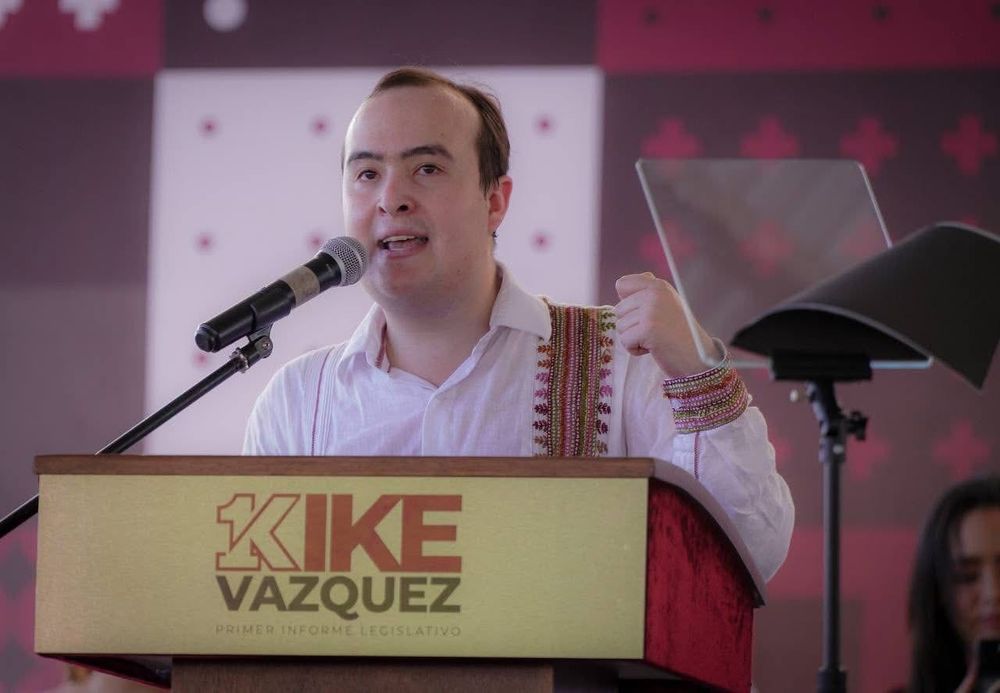
The first legislative report of Enrique Kike Vázquez, the 22-year-old congressman from Quintana Roo, widely promoted as the youngest federal legislator in Mexico’s history, has become the latest flashpoint in Tulum. The event, held over the weekend at the Domo Dos Aguas, placed the main keyword Enrique Kike Vázquez at the center of a growing debate over who should lead the municipality as the 2025 electoral season approaches.
What should have been a routine accounting of congressional activity quickly turned into a public show of political force. And it drew national attention to a rising figure whose youth, trajectory, and residency status might shape the future of one of the most contested municipalities in the Riviera Maya.
“I will remember today for the rest of my life,” the young legislator wrote on his social media channels after the event. His phrasing caught the attention of supporters and critics alike, especially in a region where political transitions often take on significant local and national weight.

National Figures Fill the Room as Local Doubts Take Shape
The presence of senior Morena officials turned the session into something larger than an ordinary report. Marcelo Ebrard, now serving as Economy Secretary; Senator Manuel Velasco; Ricardo Monreal, head of the Chamber of Deputies’ Political Coordination Board; and labor leader Pedro Haces were among those who joined Vázquez on stage.
Their attendance sparked immediate interpretation that this was not a neutral exercise in accountability. It was a stage, and it had a clear protagonist.
Still, the absence of Quintana Roo Governor Mara Lezama stood out. Her name was invoked by Vázquez as he thanked her leadership, yet her empty chair subtly shifted the room. In a political landscape built on signaling, that silence appeared louder than any applause.
Local figures took notice. Tulum councilor Jorge Portilla questioned whether the legislator met the residency requirements to run for municipal office, stating that available information suggests Vázquez has not lived five continuous years in the municipality. He was joined by state lawmaker Silvia Dzul, who argued that Tulum’s next mayor should be someone rooted in the community, not a political arrival with limited ties.
Their remarks reflect a longstanding tension in Quintana Roo, where rapid population growth has often collided with expectations of local identity and representation. It is a debate that reveals more than personal differences. It shows a municipality asking who gets to claim its future.
A Carefully Crafted Showcase or a Standard Political Rite?
The gathering appeared meticulously arranged. It took place not in neighborhoods, plazas, or accessible community spaces but in a controlled indoor venue featuring a curated guest list. Attendees described the tone as ceremonial rather than conversational.
One participant summed up the atmosphere in a sentence that spread across WhatsApp groups in Tulum: “This felt more like a coronation than a report.”
That line reflects a deeper concern about political processes in tourist-driven municipalities such as Tulum, where economic interests, land disputes, and environmental pressures converge. Local leaders sometimes see these mechanics as crucial tests of transparency and legitimacy.

The Tulum Times has previously reported on how political selection processes in the municipality can influence decisions on zoning, policing, and long-term development. For many voters, the question is not only who holds power but how that power is assembled.
The Image of the Youngest Legislator Collides With Scrutiny
Vázquez’s age has positioned him as a symbol of generational change within Morena. Yet it has also drawn scrutiny over experience and readiness. His legislative record contains only one initiative, a fact mentioned frequently by critics who argue that the role of mayor demands a deeper grasp of administration.
His public persona has produced mixed interpretations. He has gained attention for irreverent appearances and viral moments, including dressing as a Christmas tree during a budget debate in 2024. He also faced criticism for a widely circulated video of him dancing in a club in Ibiza last year, an episode that highlighted tensions between personal image and the austerity discourse promoted by the national government.
Inside Morena’s congressional group, colleagues say he has maintained a close working relationship with Ricardo Monreal. Observers view that connection as influential in shaping his path and his presence on political stages. But reliance on mentorship is not unusual in national politics. What unsettles some Tulum residents is the impression that these alliances might outweigh local legitimacy.
A seasoned political adviser in Quintana Roo described the disconnect in simple terms: “If you want to govern Tulum, people expect you to know Tulum.”

A Municipality Recovering From Tourism Strain Watches Closely
The context underlying this conversation is sensitive. Tulum is still emerging from a tourism downturn linked to security concerns, infrastructure pressure, and global market shifts. Mayor Diego Castañón has faced criticism for what some see as a lack of local grounding. His administration recently opened free access points to public beaches in an effort to reconnect with residents and restore confidence.
Against that backdrop, the possibility of another outsider candidate has heightened public unease. Portilla and Dzul insist that the next mayor should be someone with demonstrated knowledge of the municipality’s challenges, from land regulation to environmental stewardship along the fragile Caribbean coastline.
One short sentence from a local business owner captures the sentiment that has echoed throughout the region: “Tulum has no room for experiments.”
Behind the Applause, a Deeper Reflection on Authority and Youth
Political ambition at a young age is not uncommon in Mexico, and youth does not preclude competence. But the rapid rise of Vázquez invites reflection on what leadership requires in municipalities like Tulum, where economic opportunity and political tension frequently intersect.
There is a micro-story circulating among residents about a moment after the event when a young attendee asked Vázquez how one becomes a federal lawmaker so quickly. His answer, according to those who overheard, focused on working hard and believing in oneself. It was an earnest response, but it left out the network of patrons that critics say have shaped his path.

This contrast underscores a crucial tension. Public narratives often highlight merit while political realities hinge on alliances, timing, and internal support structures. Understanding both layers is necessary to grasp why this report generated such an intense reaction.
What Comes Next as Morena Weighs Its Decision
Morena has not yet defined its municipal candidate for Tulum. Party leaders emphasize that internal processes must run their course. But the scale of the event, the guests present, and the messaging around the young lawmaker suggest that his name will remain central to speculation.
Councilor Portilla urged patience and warned that party affiliation alone should not determine the next mayor. Manuel Velasco and Ricardo Monreal, meanwhile, praised the enthusiasm of a new generation. Developing a consensus might require balancing these competing visions of political renewal.
What is clear is that the municipality is paying close attention. The debate around Enrique Kike Vázquez reveals deeper questions about legitimacy, representation, and the future direction of one of Mexico’s most complex tourism hubs. Tulum has always been a place where national forces converge. Now, it appears to be a stage where Morena’s internal dynamics will unfold openly.
In the end, one line from the event lingers in the public conversation: “Leadership is earned, not staged.” Whether this becomes a rallying cry or a cautionary note will depend on what Morena decides in the coming months.
The Stakes for Tulum and the Path Ahead
As Tulum continues to navigate economic recovery, disputes over land development, and growing pressure on public services, residents might demand a leader who carries both credibility and local experience. The future of the municipality often sets precedents for the broader Riviera Maya, making the outcome of this process significant beyond its borders.
The discussion sparked by Enrique Kike Vázquez highlights how political ambition can become a proxy for community expectations. And it reveals the complexities of governing a region where global attention collides with local identity.
The main keyword returns for a final time: Enrique Kike Vázquez now stands at the center of a larger conversation about youth, legitimacy, and authority. What happens next could shape Tulum’s political landscape for years.
We’d love to hear your thoughts. Join the conversation on The Tulum Times’ social media.
What qualities do you believe are essential for Tulum’s next mayor?