
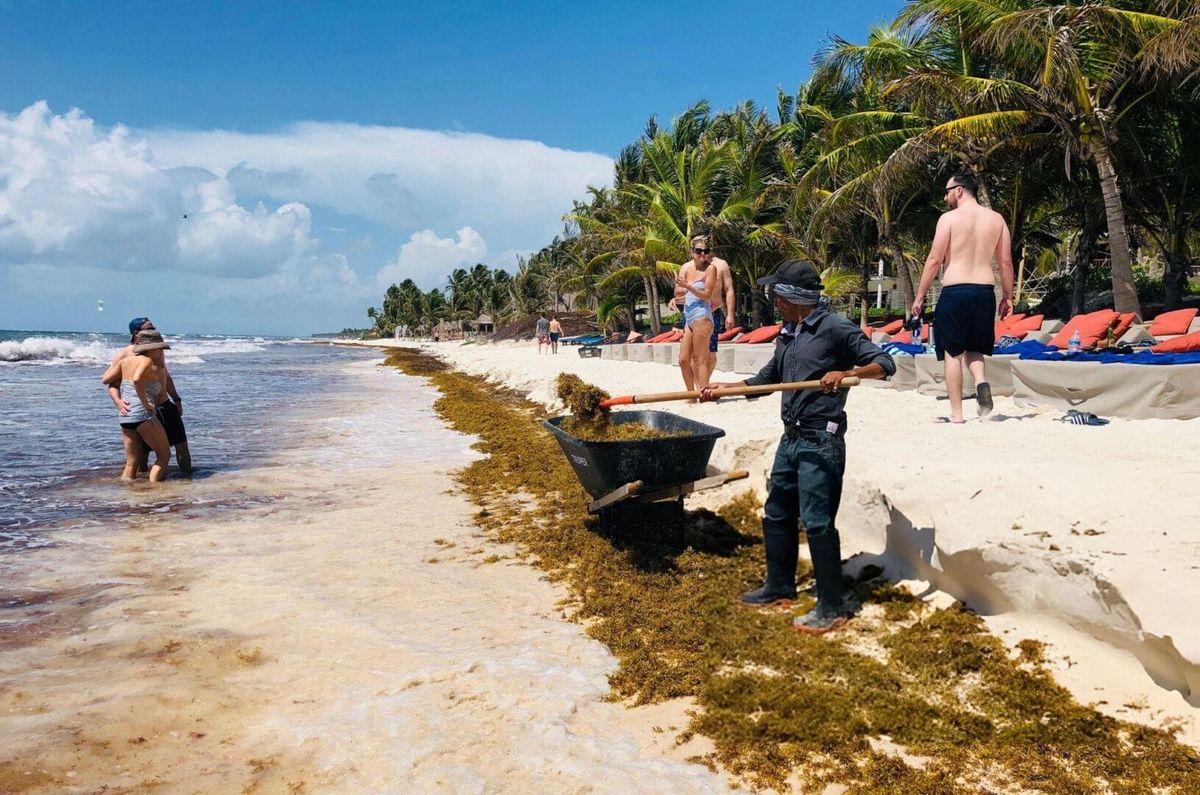
Just past sunrise, the beach at Playa Paraíso in Tulum is quiet. A few early risers walk barefoot through damp sand, finding it oddly free of the usual tangle of brown seaweed. The scene feels almost too clean. For locals and seasoned visitors, that absence is loud. It’s the sound of a reprieve from sargassum, a stubborn presence that has defined recent Caribbean mornings.
As autumn casts its first shadow across the Mexican Caribbean, something unexpected is unfolding along parts of Quintana Roo’s coast. The relentless surge of sargassum appears to be easing, at least in pockets like Tulum and Playa del Carmen. But don’t celebrate just yet. Offshore, vast mats of algae are still drifting, and the southern and northern stretches of the state continue to report heavy landings.
This fluctuation isn’t random. It’s tied to a subtle shift in ocean behavior, tracked closely by experts like Esteban Jesús Amaro Mauricio, director of the Sargassum Monitoring Network of Quintana Roo. He says it’s all about wind and water. With the seasonal weakening of the trade winds, the invisible forces that usually push the algae toward the shore, some of that sargassum is now lingering in open sea, or drifting elsewhere entirely. It’s not gone. It’s just circling.
Mapping the Brown Menace
According to regional tracking systems, nearly 30 coastal zones still show excessive sargassum accumulation as of the second week of September. The southern coastlines, stretching from Xcalak to Uvero, remain hotspots. Meanwhile, on the northern end, sargassum has settled around Cozumel and scattered along the Riviera Cancún and Arco Maya in Tulum.
The sargassum “stoplight” map, used by scientists and local authorities, flashes red in these areas. It’s a visual cue for communities and travelers alike, green means clear, red means knee-deep trouble. The impact reaches far beyond the beach, touching tourism, fishing, and even public health.

A War Waged in Boots and Boats
Behind the scenes, a coordinated effort is underway. The Secretariat of Ecology and Environment (SEMA) of Quintana Roo, led by Óscar Rébora Aguilera, is on the front line of sargassum defense. Their daily deployments include shoreline brigades, offshore boats, and floating barriers designed to intercept the algae before it hits the sand.
SEMA reports more than 41,000 tons of sargassum removed from Quintana Roo’s beaches this year alone, a figure that paints a picture of both effort and scale. It’s like scooping water from a sinking boat: vital, but never quite enough.
But there’s more than cleanup at stake. The newly installed 2025 Sargassum Strategy Roundtable, chaired by Governor Mara Lezama Espinosa, is aiming to go beyond response mode. It brings together government officials, scientists, business leaders, and civil society under one roof. The goal? Long-term solutions, shared protocols, and perhaps a new economy built around the seaweed itself.
From Nuisance to Opportunity?
That’s the vision some are starting to entertain. In official briefings, SEMA and the state government have floated ideas to transform sargassum into energy or sustainable materials. It’s a pivot from crisis management to circular economy, and in theory, it could turn a seasonal enemy into an environmental asset.
Skeptics remain. Turning seaweed into opportunity requires more than press releases and pilot projects. But for coastal communities that have watched tourists cancel bookings and fishermen lose income, the idea of reimagining the problem carries weight.
In nearby Cancún, similar efforts have faced mixed results. Meanwhile, Tulum’s fragile eco-tourism model makes any long-term disruption especially dangerous. The algae doesn’t just foul beaches, it eats into livelihoods.

One Man, One Shovel
Walk a little past the boutique hotels and you might spot him. A middle-aged man with a curved back and a red cap, knee-deep in wet seaweed. No uniform, no logo, just a shovel, a wheelbarrow, and the will to clear a small patch of paradise. He doesn’t work for the government. He just lives nearby. And he’s tired of waiting.
It’s people like him, quiet, persistent, who give this story its heartbeat.
Still Watching the Horizon
So what now? The sargassum might be retreating for the moment, but the battle isn’t over. The biomass remains offshore, and with one shift in the wind, it could be back by next weekend. That unpredictability keeps local authorities on alert and keeps everyone else guessing.
The Tulum Times continues to follow the story closely, tracking not just the data but the day-to-day lives affected by it. And if there’s one thing this season has made clear, it’s this: adaptation matters more than prediction.
As one local business owner put it, “We don’t fight the sea, we learn to dance with it.”