
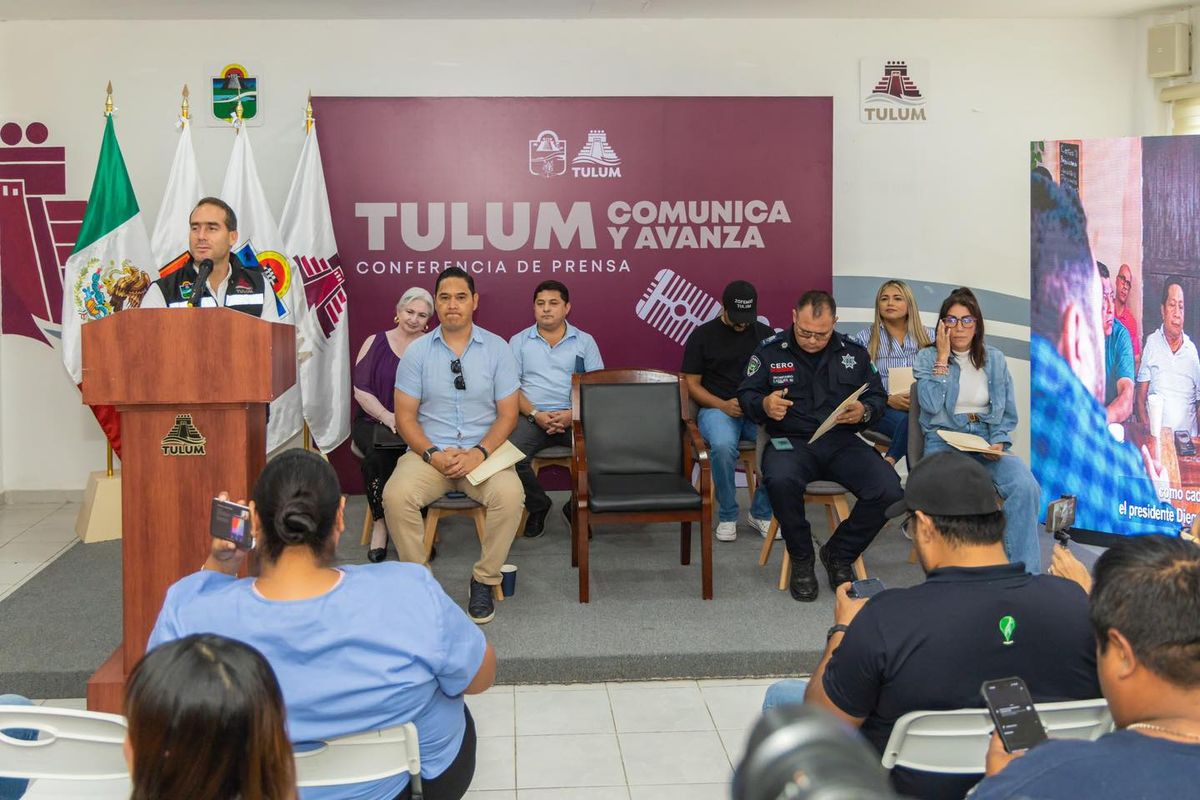
It begins with a microphone. Not a grand one, just a simple, slightly smudged piece of plastic shaped by fingers and coastal humidity, but it carries weight. Because each week in Tulum, that modest mic becomes the tool of a quiet revolution: a model of transparent government that actually shows up, literally, on schedule.
This isn’t just another campaign slogan wrapped in ceremonial tape. It’s becoming something closer to a ritual. And at the center of it stands Diego Castañón Trejo, the municipal president of Tulum. Every week, like clockwork, he faces the press not with rehearsed spin but with the intent to speak plainly. The question is: can consistency really rebuild trust?
A New Model of Political Presence
Castañón doesn’t believe in political honeymoons. “There are no 90 days of grace here,” he says, drawing a clear line. You don’t get time to settle in. You get to work. Immediately.
His approach is disarmingly direct. Every department head, whether from Youth and Sports, the Treasury, or the Coastal Zone Authority, is expected to show up and speak up. No assistants whispering from the wings, no evasive memos. They answer questions. They own their results. And when they don’t have answers, well, that’s visible too.
It’s a break from the choreography of typical politics, where most information is filtered, delayed, or buried in the footnotes. Here, the philosophy is simple: if you’re paid to serve the public, you should be willing to face them.
Tackling Security Without the Showmanship
One of the clearest expressions of this approach is in how the administration handles public safety. It’s a topic often cloaked in vague terms or turned into electoral leverage. But in Tulum, there’s a different tone.
Each week, the Secretary of Public Safety, Edgar Aguilar Rico, lays out operations and outcomes in detail. He doesn’t rely on buzzwords. He points to collaborations, highlights actions, and focuses on prevention. There’s no illusion of invincibility here, just a clear willingness to talk about what’s working, and what still needs attention.
It’s a little like being invited under the hood of your own car. You may not understand every part, but at least someone is showing you where the noise is coming from, instead of pretending the engine is fine.

Partnerships That Go Beyond the Press Release
Transparency also extends to Tulum’s external relationships. New agreements with the municipalities of Bacalar and José María Morelos aim to boost local economies, support small producers, and encourage cultural exchange.
These aren’t secretive deals inked in backrooms. They’re public, dissected, and discussed in full view of the press. The emphasis isn’t just on doing things, but on explaining them, clearly, openly, and repeatedly.
That level of detail may sound exhausting. But in a region often plagued by miscommunication and bureaucratic fog, it’s also strangely refreshing.
Accountability Without Excuses
Castañón has also drawn a line within his own government. He’s made it unmistakably clear: if you’re a director or a department head, you don’t get to hide behind your title. You’re expected to respond when the press or the public calls.
“If a journalist wants an interview, you go. You talk. You give results.” That’s not a suggestion. It’s a job description.
His message to critics is just as firm. This administration, he says, is not beholden to personal interests or internal politics. It’s not a placement agency for friends or a shelter for mediocrity. And if there’s criticism, it has to outlast the results. Otherwise, it dissolves in 48 hours, like sea foam after a storm.
This kind of bluntness might feel abrasive to some. But for many residents, it’s a relief. They’re not being fed empty optimism. They’re being treated like adults.
A Glass House in the Town Square
Think of Tulum’s government as a glasshouse built in the heart of the city. There are no walls to block the view. You see who’s coming in, who’s stepping out, and what they’re doing while inside.
It’s not perfect. It’s not supposed to be. The transparency means that when mistakes happen, they’re visible too. But that’s the cost of real openness. And according to Castañón, it’s worth it.
Mistakes, after all, can be corrected. Hiding them is what truly corrodes trust.
Is Transparent Government Really Possible?
What Tulum may be proving, week after week, briefing after briefing, is that transparent government is not a dream. It’s a discipline. It doesn’t depend on charisma or crisis. It depends on showing up. On listening. On being accountable not just in speeches, but in practice.
And the test isn’t whether this rhythm lasts through the year. It’s whether the habit outlives the people in power. Can this become institutional? Can it be the norm instead of the exception?
That’s the real question. But for now, at least, there’s a mic waiting every week in Tulum. And someone is standing behind it.