
Some places you visit. Others, you carry inside you forever.”
It is June in Tulum. The scent of salt mixes with copal rising from quiet porches. Bougainvillea spills color over stone walls, and the wind moves slowly, like it’s listening.
We are halfway through 2025, and Tulum finds itself in one of the most delicate and defining chapters of its story, not because of a single crisis, but because of many stacked layers of sediment, shaped by pressure, by time, by history. If you walk our streets, you’ll feel it: a kind of collective breath being held, a silence laced with both fatigue and faith.
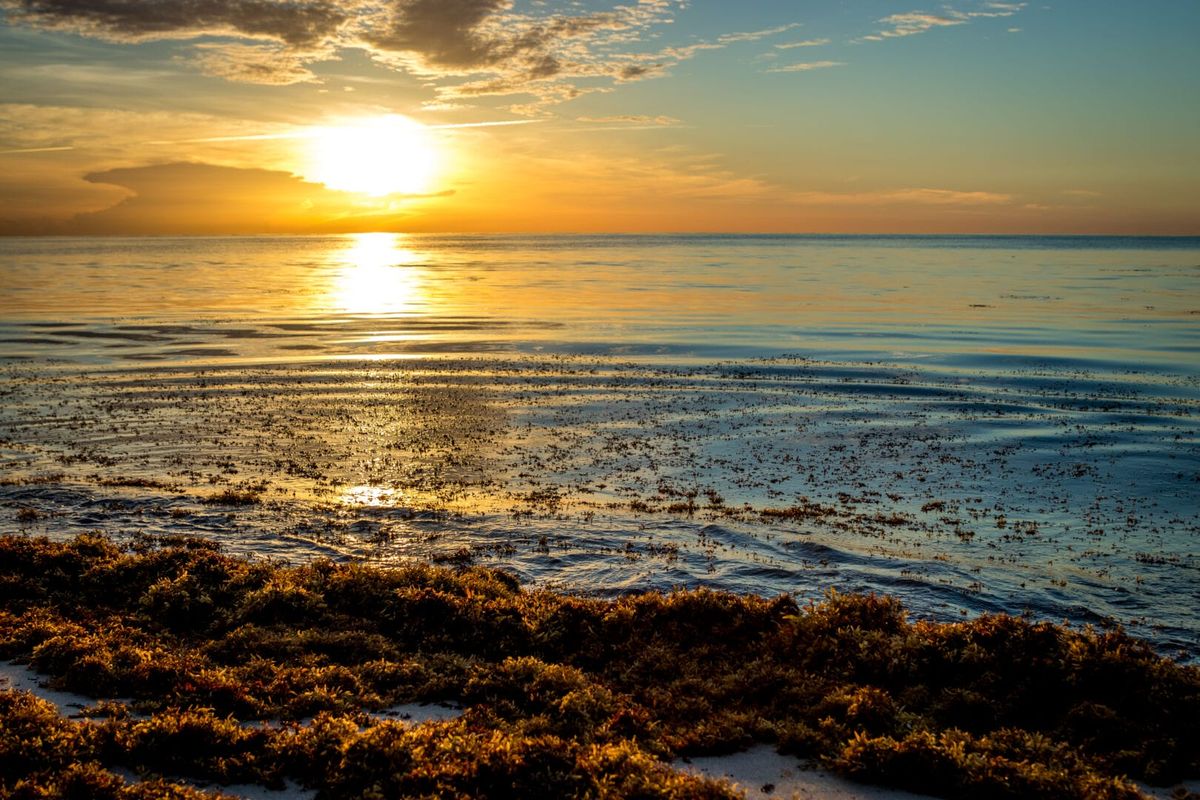
This year’s sargassum arrived early. And it didn’t trickle in, it surged. The seaweed stretches across our coastline in thick blankets, dulling the turquoise waters and silencing the glittering welcome of our beaches. But this isn’t just about algae. It’s about imbalance. It’s about what happens when global decisions reach local shores. This isn’t Tulum’s fault. It is Tulum’s burden.
Tulum lives off tourism. That truth is no secret here. When the beaches are blocked, the town slows. Hotel beds go untouched. Restaurant tables wait in vain. Boutique shops and family-run cafés hang on, day by day, with hopeful chalkboard menus and prayers whispered between receipts. We are in a season of vacas flacas, where creativity feeds more than currency, and resilience is the only real capital.
And yet, the spirit of Tulum remains unbroken.
It lives in the artisans who still rise with the sun, their hands shaping stories into clay and fabric. In the cooks who stir pots as if every guest were family. In the guides who offer their knowledge of jungle trails and ancient ruins with a reverence born from love. In the workers who rake the beaches not once, but three, four, five times a day. “Some days we clean the beach three times before noon,” says a local worker, wiping his forehead. “But we do it because this place matters.”
We see it in those who expect nothing and give everything:
The volunteers who patrol the beaches at night under red-filtered flashlights gently protect sea turtle nests that hold thousands of years of memory.
The community members who sweep jungle paths and cenote banks, offering nothing but care, asking nothing in return.
The men and women who sweat under the Caribbean sun, pushing back the sargassum day after day in what often feels like a losing battle.
The local teams are preparing for hurricane season, not panicking, but educating, informing, and supporting. Their voices ripple through WhatsApp groups and neighborhood chats with calm and clarity.
These are the guardians of Tulum. They wear no uniforms. They hold no office. And yet, they are the reason this town keeps breathing.
But Tulum is not only facing nature. We are navigating multiple storms.
We face the threat of overdevelopment, structures that rise faster than the roots beneath them can hold.
We face a slow erosion of cultural authenticity, as tradition is too often sacrificed for spectacle.
We face deep social divides, growing inequality, rising costs of living, and the quiet displacement of the very people who built this town with their hands.
We face shadows that grow longer after dark: corruption, organized crime, and exploitation that stain what should remain sacred.
We face a bureaucracy that sometimes responds too slowly to protect what’s slipping away fast.
We face the growing global instability, wars, inflation, uncertainty, that ripples into our tourism, our economy, and our peace.
And still, we rise.
Tulum is not broken. It is awakening. And through all this hardship, something deeper is taking root. A kind of collective remembering. A return to the things that made this place magical long before it was a hashtag.
To those wondering if Tulum is still worth visiting: yes. But not just for the beach.
Come for the cenotes, crystal eyes of the Earth, hidden under jungle canopies.
Come for the lagoons, where the sky melts into stillness.
Come for the ruins that echo with the knowledge of the Maya, standing with quiet pride.
Come for the music, the ceremonies, the scent of roasted cacao, the sound of three languages in a single conversation.
Come for the people, for the ones who live here, not because it’s easy, but because it’s meaningful.
Tulum is not just a place. It is a rhythm. A spirit. A prayer made of stone, salt, jungle, and fire. And though its path is uncertain, its heart is unmistakably strong.
At The Tulum Times, we hold no political flag. Our voice is neutral, but our commitment is not. We stand with our community, locals, foreigners, workers, creators, dreamers. We stand with the ones who care, who stay, who believe. We defend not just the land, but the right to live here in peace, with freedom, with dignity.
This is a love letter.
To those who clean.
To those who create.
To those who inform.
To those who resist.
To those who love this place like family.
Tulum is not waiting to be saved. It is worth remembering what it truly is.
And when the sea trembles, the soul of Tulum whispers louder.
This editorial reflects the commitment of The Tulum Times to amplify the voices of the community, to protect the spirit of Tulum, and to remind the world of the beauty that still lives here, quietly, bravely, and without pause.