

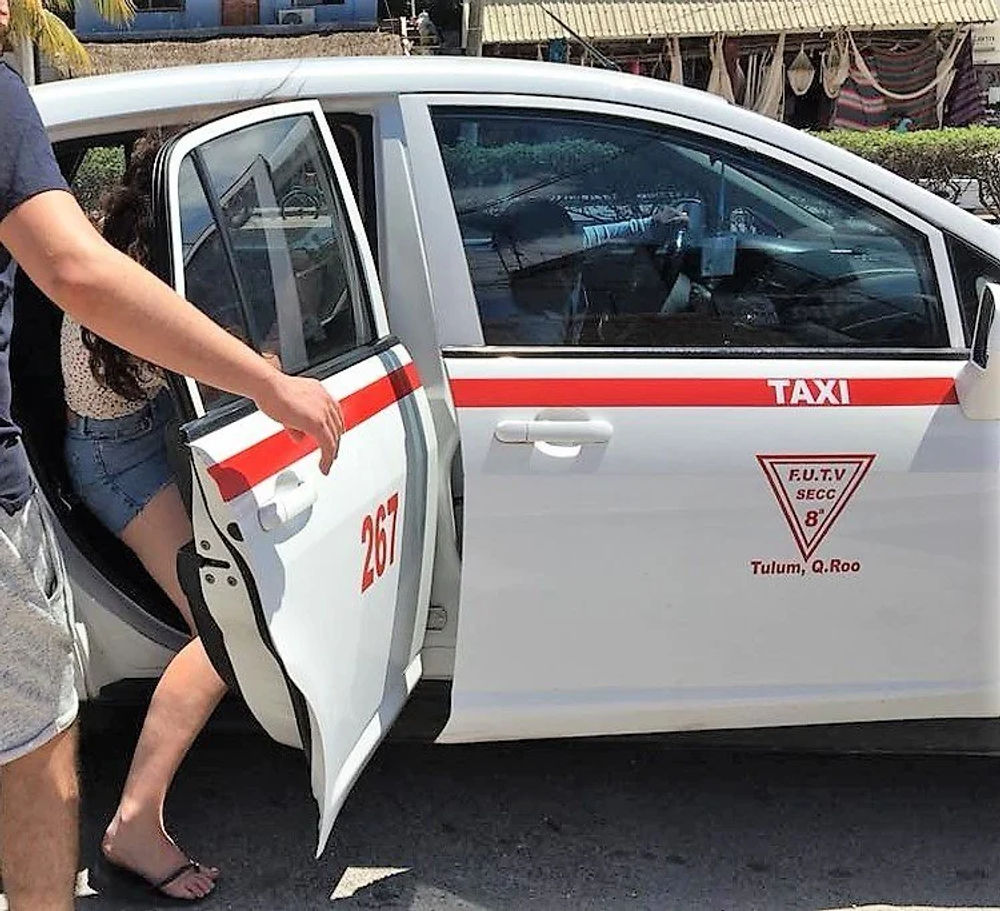
They call themselves the Tiburones del Caribe, the Sharks of the Caribbean, but in Tulum, it’s the visitors who end up bleeding. The local transportation union operates more like a cartel than a service: tightly woven with political influence, driven by self-interest, and united in its opposition to one thing that might bring order to the chaos, the taximeter.
In a town where 95% of tourists who choose not to return cite pricing abuse as a key reason, the absence of transparent fares isn’t just a flaw in the system. It’s the system.
The Cost of Chaos: Tulum Without Taximeters
Welcome to Tulum, a paradisiacal outpost along Mexico’s Caribbean coast, where the beaches are pristine, the jungle lush, and the fares, outrageously unpredictable.
The Tiburones del Caribe union refuses to adopt taximeters, clinging instead to an outdated scheme of state-approved “fixed fares.” It might sound orderly, but the reality is closer to theater, fare charts (“tarifarios”) that are rarely posted, widely ignored, and functionally meaningless during peak hours or in remote areas.
Tourists have paid up to 700 pesos (roughly $42 USD) for a 7-minute ride. The justification? One driver put it bluntly: “No hay turismo.” Translation: “There aren’t enough tourists, so we charge more to those who are here.”
Fare Charts or Fiction?
The union argues that as long as fares are publicly listed, meters are unnecessary. But these printed tariffs are about as useful as a weather forecast in a hurricane. They’re props in a performance where the driver always wins, a house game with no chips for the guests.

Who’s Afraid of the Meter? Follow the Money
This isn’t just ideological stubbornness. It’s a numbers game.
A taximeter calculates distance and time, removing the option to inflate prices under vague justifications like “bad traffic” or “few passengers.” That would hit drivers, especially those operating near tourist hotspots, right in the wallet.
Drivers defend overcharging as a form of survival. They say empty return trips from remote areas like Tulum’s airport eat into their earnings, so they double the fare to make up the loss. A 40-km trip? Billed like it’s 80. Under a taximeter, that creative math collapses.
Creative Accounting and Side Hustles
There’s also the practice of running colectivos, shared rides where each passenger pays separately. A taximeter, designed for single-party trips, would disrupt this arrangement. Less profit, more regulation. And even with government subsidies for installing meters, many drivers remain resistant, citing concerns about maintenance, calibration, and tampering.
But what they really fear isn’t a broken meter. It’s a system they can’t manipulate.

Politics at the Wheel: The Power Behind the Union
Scratch the surface, and you’ll find that the roots of resistance run political.
Transportation unions in Quintana Roo, Tiburones del Caribe, among them, wield substantial influence over local government. In many cases, their leaders are politicians in disguise. Take Eleazar Sagrero, former head of the Tulum union and, at the same time, a city councilman for the Partido del Trabajo (PT). A man with one hand on the steering wheel and the other in the municipal budget.
When Uber won a legal battle to operate in Quintana Roo in 2023, the unions didn’t quietly object. They shut down roads, paralyzed cities, and brought global attention to their tactics. In 2024, following Sagrero’s arrest on homicide charges, the union retaliated by blocking Highway 307 and halting service altogether. The official line? A political vendetta for their anti-Uber stance and fare hike demands.
Clearly, this is more than a meter dispute. It’s a war over power.
The Ground Reality: Tourists and Locals Speak Out
On social media, the stories pile up like receipts that were never printed. Tourists charged $100 USD instead of 100 pesos, harassed when they objected, left with no paper trail and no recourse.
Even influencers have joined the chorus. Luisito Comunica, one of Mexico’s biggest YouTubers, exposed a scam ride from the airport priced at 2,000 pesos ($117 USD). Hoteliers, tired of damage control, warn that unchecked fare abuse threatens Tulum’s long-term appeal.
Some local entrepreneurs are calling for collective action, labeling the union a “mafia” that operates without oversight. Their message is clear: no taximeters means no transparency, and the town’s economy is bleeding.
Maria, a barista in Aldea Zama, says she pays nearly half her daily wage just to get to work and back. “And there’s no way to argue. You pay or you walk.”

Disruption on the Horizon: Uber, Didi, and the Battle for the Streets
Uber and Didi see Tulum not as a market, but a frontline. Though Uber won legal status in 2023, the terrain remains hostile. Drivers operate under the radar. Pickups happen discreetly, often a block away from hotels to avoid confrontation.
Citizen advocacy groups argue that Tulum’s fares are among the highest in Mexico, exceeding even those in Mexico City. Why? Because here, the monopoly reigns unchallenged.
And without meters, there are no receipts, no price baseline, no accountability.
According to the State Mobility Secretariat, over 70% of complaints filed in 2024 were related to overcharging and fare inconsistencies.
The Regional Picture: Resistance Isn’t Isolated
This is not just a Tulum problem. Across Quintana Roo, from Playa del Carmen to Cozumel, unions have stalled meter rollouts. Though the 2022 state mobility law mandates taximeters, implementation is perpetually “under review” to appease the unions.
In Cancun, the powerful Andrés Quintana Roo union rejected a 2025 pilot program outright. Their demand? Higher fares, not greater transparency.
Contrast this with cities like Mexico City, Guadalajara, or Mérida, where taximeters and digital tracking are the norm. Tulum, by comparison, feels not like a destination, but a cautionary tale.
A State Plan in Motion: IMOVEQROO and the Push for Reform
The Quintana Roo Mobility Institute (IMOVEQROO) continues to advocate for the introduction of taximeters across the state’s major cities to address fare overcharging. The initiative, which could begin as early as August or September, aims to establish transparent and fair pricing for both drivers and passengers, according to IMOVEQROO Director Rafael Hernández Kotasek.
Challenges in Standardizing the System
Hernández Kotasek acknowledged significant hurdles in implementing the system, citing structural differences between urban, rural, and federal jurisdictions. These disparities complicate efforts to standardize taximeter usage. Additional obstacles include unique fare structures in certain municipalities, such as the “ruleteo” (shared ride) system, and point-to-point services, which make uniform application difficult.
The director noted that payment method variations in urban areas further complicate the rollout. The taximeter proposal was first introduced in 2023 as part of Quintana Roo’s mobility plan, launched in 2022. However, pilot tests have yet to be conducted due to these complexities, despite initial plans for implementation in early 2025.
Commitment to Modernizing Public Transport
Hernández Kotasek emphasized that taximeters will promote fairness for both drivers and passengers by ensuring transparent pricing and preventing excessive charges. He reiterated the state government’s commitment to modernizing public transportation as part of a broader mobility strategy.
New Reporting System for Passenger Complaints
To enhance accountability, IMOVEQROO will launch a WhatsApp hotline next month, allowing passengers to report irregularities in public transport services. Complaints may include unauthorized fare charges or vehicles exceeding passenger capacity limits.
Hernández Kotasek stressed the importance of public participation in identifying violations, despite regular inspection and verification operations conducted by authorities.

Toward a Fair Future: Taximeters as a Compass
Let’s be clear, a taximeter isn’t a punishment. It’s a tool. It doesn’t jail the driver; it levels the playing field. Locals shouldn’t be penalized for not being tourists. And visitors shouldn’t be punished for being foreign.
A taximeter is not a cage. It’s a compass, pointing toward consistency, trust, and a better tourism experience.
The state has promised a pilot program. But in Tulum, promises evaporate faster than morning dew on hot jungle pavement. Until implementation comes with real enforcement, the union will continue to dominate, unchecked.
If transparency is ever to become the norm in Tulum, it will require more than government promises, it will take sustained pressure from citizens, business owners, and tourists alike.
And so, the question remains: How long can a paradise survive if its visitors are treated like prey?