

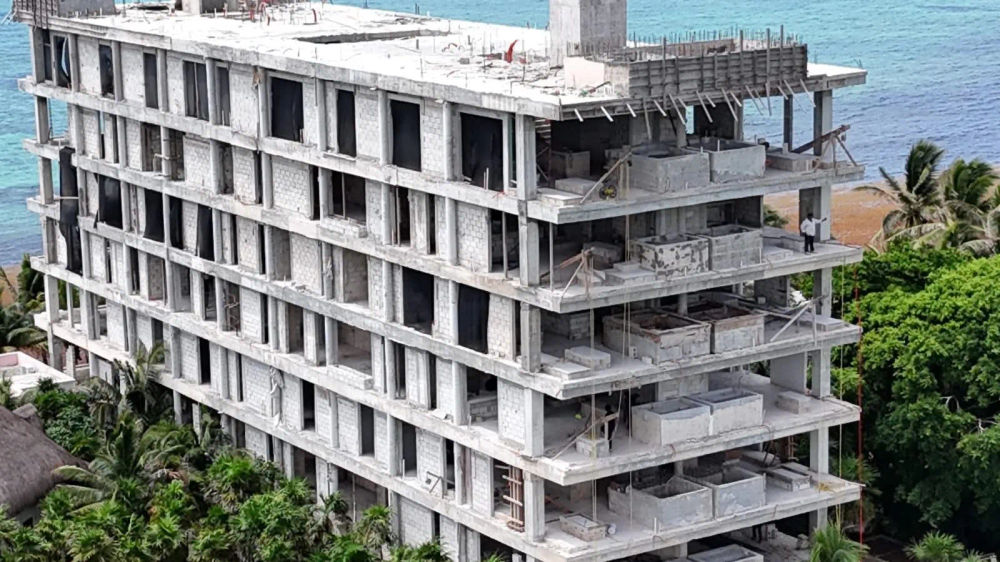
On a quiet stretch of Tulum’s coastline, where the turquoise of Bahía de Solimán meets the mangroves of Tankah IV, a concrete skeleton now stands silent. What was once billed as an upscale residential development, Adamar, has been forcefully paused by a judge’s order. Why? Because it never should have risen in the first place.
The General Prosecutor’s Office of Quintana Roo (FGE) has officially secured the Adamar project site after determining that the construction was initiated without federal environmental authorization. Following a criminal complaint by the Federal Attorney for Environmental Protection (Profepa), the project is now under legal lock and key.
A judge’s ruling halts Adamar’s advance
On September 23, in a courtroom hearing not far from the beach town buzz of Tulum, a judge ruled in favor of the FGE’s request to seize the Adamar development. Profepa participated in the case not just as an observer, but as a formal complainant and victim, a statement that carries legal and symbolic weight.
The ruling grants Profepa custodianship of the seized property, meaning Desarrollos Tulum Dieciséis, S.A.P.I. de C.V., the company behind the construction, must cease all work until both administrative and criminal liabilities are resolved.
According to Profepa, the developer ignored multiple environmental closures, continuing work despite repeated orders to stop. The agency’s own complaint, filed on July 16, alleges environmental crimes, misuse of public resources, and illegal urban development. The damage, they claim, extends far beyond paper violations, it reaches into the very soil and ecosystems of the Riviera Maya.

A site under legal and ecological pressure
Profepa’s public statement doesn’t mince words: the Adamar site was built in defiance of federal environmental law. Multiple attempts were made to halt the construction, but each time, activity resumed. The violations, they argue, are not only administrative but criminal, targeting Mexico’s already fragile biodiversity.
And the legal storm doesn’t stop there. A federal district judge previously issued a separate mandate ordering that the land be returned to its original ecological state. That ruling followed a successful legal challenge by the association Defendiendo el Derecho a un Medio Ambiente Sano (DMAS), an environmental advocacy group that has been tracking the development closely.
According to DMAS, the only way to achieve ecological restitution is through demolition. “Returning the site to its natural condition can’t be done with luxury villas still standing,” said a spokesperson for the group. Their stance is firm: no half-measures, no cosmetic fixes.
The company fights back
Desarrollos Tulum Dieciséis isn’t folding without resistance. According to information shared with El Universal, the company has appealed the ruling, acting as a third party in the ongoing case. While the district judge’s sentence is not yet final, the implications are clear: this is no longer just a dispute over permits. It’s a clash over the future of Tulum’s coastline.
This stretch of the Riviera Maya, often painted in marketing brochures as an untouched paradise, is under increasing scrutiny from environmental watchdogs. Tulum, once a sleepy town of fishermen and yoga retreats, is now a battleground of competing interests, tourism dollars, ecological preservation, and unchecked development.
Tankah IV and the battle for Tulum’s soul
Locals in Tankah IV remember when this area was mostly jungle and beach, with turtles nesting undisturbed in the sand. Now, the question of who gets to decide what happens here is at the heart of a broader conversation in Quintana Roo.
Unlike Playa del Carmen or Cancún, where urban sprawl and hotel chains dominate, Tulum still holds pockets of raw nature. But that nature is vulnerable. Each new unregulated development chips away at what makes this coastline unique.
The Tulum Times has followed these environmental flashpoints closely, and the Adamar case underscores a growing trend: legal frameworks are slowly catching up with the construction boom. But is it fast enough?

A moment of reckoning for enforcement
What’s at stake is more than just one beachfront property. This case could set a precedent for how environmental violations are treated across the Riviera Maya. If demolition is enforced, it might signal a new era of accountability.
Yet there’s a familiar sense of uncertainty. Local environmental groups cautiously welcome the seizure, but many have seen similar cases drag on for years, bogged down by appeals and legal loopholes.
“The real victory,” one activist told The Tulum Times, “will come when we stop reacting to damage and start preventing it.”
What comes next for Adamar?
For now, the site sits dormant. But its fate hangs in legal limbo.
Profepa’s designation as custodian suggests that investigations will intensify. Administrative and criminal responsibilities still need to be determined. Whether Adamar is eventually demolished or merely fined remains to be seen.
But the broader question echoes louder: Can Tulum protect its coastline from becoming just another cautionary tale?
We’d love to hear your thoughts. Join the conversation on The Tulum Times’ social media.
What would you do with the Adamar project, rebuild, demolish, or something else?