
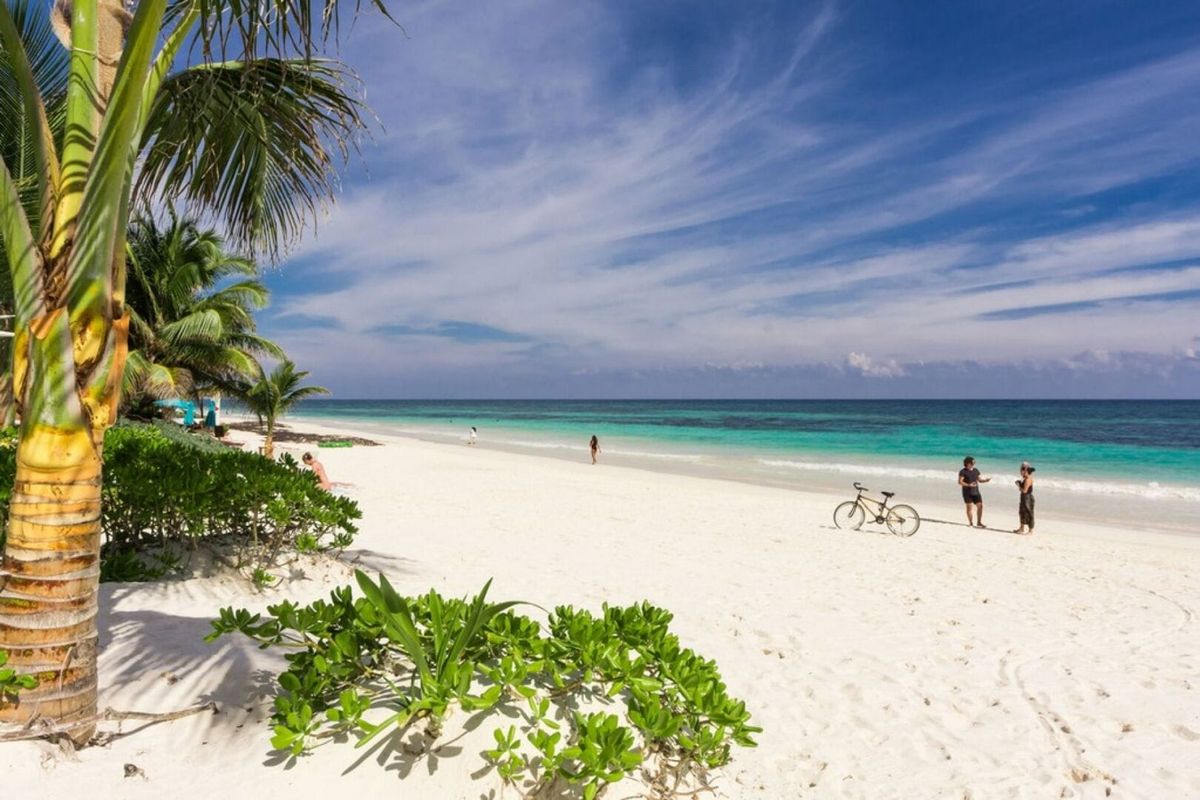
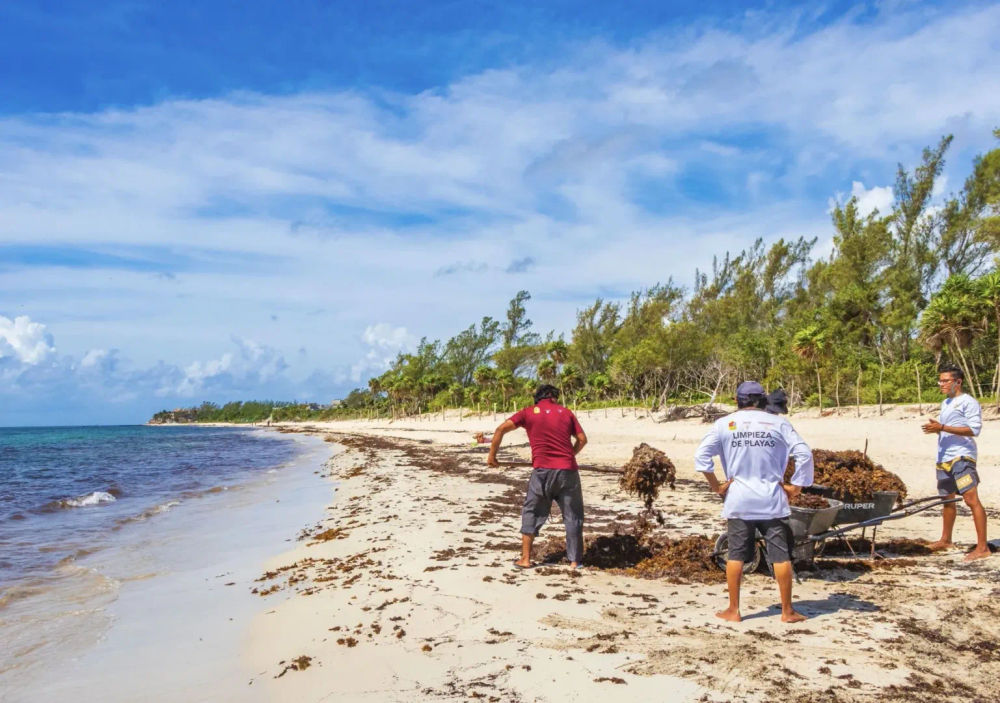
In June, municipal workers in Tulum spent their mornings pushing wheelbarrows and lifting heavy piles of sargassum from the beaches that frame one of the most visited destinations in the Riviera Maya. It was a familiar scene, yet the scale stood out. Local officials reported collecting about 1,900 tons of seaweed by midyear, already surpassing the total amount gathered in all of 2024. The number signaled a shift. It also coincided with a noticeable drop in visitors, raising questions about what exactly is reshaping Tulum tourism in 2025.
Officials, hoteliers, and researchers say the answer is not singular. The problem appears to be a convergence of pressures: environmental strain, economic uncertainty in the United States, uneven public security, and a fragile planning model still adjusting to rapid growth. Together, they are redefining how Tulum and parts of Quintana Roo approach a year that was expected to bring stability after the accelerated expansion triggered by the pandemic.
When seaweed becomes a signal of deeper shifts
Sargassum has visited Tulum for years, but this season’s arrival felt more disruptive. Several hotel managers interviewed described the 2025 invasion as the heaviest since 2018. Some compared the scene to an unexpected high tide that changed business rhythms and forced hotels to redirect staff from guest services to beach maintenance.
The images of workers scraping the shore with shovels formed a micro-story of resilience, but they also revealed how environmental cycles can influence the destination’s reputation. Travelers who expect clear Caribbean waters often reconsider when beaches look brown or cluttered. And in Tulum, a place that markets calm, beauty, and outdoor leisure, perception shapes economic momentum.
A hotel owner in the central zone put it simply: “The beach still matters more than anything else,” a sentence that could easily circulate on social media. The remark captured a truth familiar to local authorities, who insist the seaweed is only one part of a broader challenge.
How U.S. economic uncertainty slowed the summer season
During the summer months, Tulum registered fewer tourists than in 2024, according to state tourism records. Hotel occupancy between August 16 and 22 was about 53 percent. In September, it slid slightly below 50 percent. For a region accustomed to steady inflows from the United States, the drop raised concern.
David Ortiz Mena, who leads the Tulum Hotel Association, said this year’s figures were roughly four percentage points below last year’s. But he avoided dramatizing the trend. Summer, he noted, is not the prime season for Tulum, and reservations usually rise toward the final quarter. What caught his attention was the behavior of the U.S. market, which supplies about 60 percent of Tulum’s international visitors.
According to Ortiz Mena, inflation, fluctuating interest rates, and the recent 43-day federal government shutdown in the U.S. created uncertainty. Many Americans postponed travel plans or trimmed vacation budgets. “People simply waited to understand what was coming,” he said. But he also mentioned signs of recovery, pointing to recent occupancy increases in late October and early November, which reached nearly 70 percent.

Eliazar Mas Kinil, a municipal councilor responsible for tourism and commercial affairs, echoed this interpretation. What happens in the United States, he said, tends to move Tulum directly. And while the summer displayed hesitation, he anticipates a stronger end to the year.
A security climate that affects traveler decisions
Uncertainty is not only financial. Public safety remains a sensitive topic for the destination. In March, Tulum’s municipal security chief, José Roberto Rodríguez Bautista, was killed in an armed attack. The incident drew national attention and was condemned by Quintana Roo’s governor, Mara Lezama. While authorities emphasize that most violence does not involve tourists, perception still plays a role.
The U.S. Department of State currently classifies Quintana Roo under its level-2 travel advisory, urging Americans to exercise increased caution. The recommendation asks travelers to remain in tourist areas, be more vigilant at night, and stay informed about local restrictions. For destinations like Cancún, Playa del Carmen, and Tulum, even a moderate alert can shape visitor expectations.

This atmosphere, combined with the sargassum season and economic hesitation abroad, produced a layered stress on Tulum tourism. Yet experts argue that the most significant challenge is not external. It is structural.
The pressures of a destination that grew too fast
After the pandemic, Tulum experienced an accelerated expansion driven by new infrastructure like the Tulum International Airport and the Maya Train. Both projects strengthened connectivity and ignited investment, pushing the local market into a boom. But that boom came with side effects.
Hazael Cerón, a researcher at the Anáhuac University’s Center for Tourism Competitiveness, believes the destination urgently needs a strategic planning model. Without it, variables accumulate: taxi fares that appear excessive, beach access disputes, and inconsistent service quality. He noted cases where a single coconut was priced at 200 pesos, the equivalent of about 10 dollars. Small details, he warned, can influence a visitor’s decision to return.

“Tulum became a basket of golden eggs, and some tried to squeeze it too hard,” he said. For him, the solution requires collaboration between the private sector, local government, and academic institutions to analyze traveler trends, design long-term strategies, and prevent reactionary policies.
Debates over beaches and the Jaguar Park territory
One of the latest debates emerged around changes in territorial limits at the Jaguar Park, a protected natural area that includes access points to several beaches. When part of the coastline was incorporated into the park’s boundaries, authorities introduced restrictions such as bans on disposable items. Confusion followed, especially on social media. Some posts claimed that beaches were no longer public.
Mas Kinil clarified that access remains free for both residents and foreign visitors. The restrictions, he said, focus on environmental protection, not exclusion. But the episode revealed something deeper: Tulum is still negotiating how to balance conservation, tourism pressure, and public perception.

The Tulum Times has reported similar tensions in previous years. Each case illustrates that the destination’s strength also lies in how it manages communication and expectation, two factors that can either reinforce or erode trust among travelers.
Preparing for the World Cup wave in 2026
Despite the pressures of 2025, optimism remains for the next major global event: the 2026 FIFA World Cup, which Mexico will host alongside the United States and Canada. Although Tulum will not hold matches, hotel owners and officials believe the event could bring a new wave of visitors looking for beaches, rest, and proximity to major stadiums.

Ortiz Mena estimates that the broader Mexican Caribbean, including Cancún and Playa del Carmen, could attract up to one million additional travelers during the tournament. Tulum’s 10,800 available hotel rooms, ranging from luxury suites to hostels priced near 20 dollars per night, position the town as a potential base for travelers seeking both leisure and mobility.
Why the future of Tulum tourism depends on new decisions now
Experts agree on one point: Tulum has enormous potential, but potential is not a guarantee. As Cerón put it, the destination is a “strategic planning alert.” Rapid growth requires thoughtful management, especially in places where nature, infrastructure, and global trends intersect.
A quiet reflection emerges from this narrative. Tulum is not only reacting to outside forces; it is defining the terms of its own sustainability. And the decisions made now could shape the Riviera Maya’s tourism model for years.
In the end, the stakes extend beyond economic recovery. They involve preserving access, protecting ecosystems, improving services, and strengthening governance. All of them determine how travelers perceive Tulum and whether they return.
Tulum tourism faces a complex year, and its resolution might reveal the next chapter in Mexico’s Caribbean region.
We’d love to hear your thoughts. Join the conversation on The Tulum Times’ social media.
What challenge do you think should be Tulum’s top priority right now?