

Some stories begin with a buzz, literally.
In the lush backroads of Chanchen Primero, deep in the heart of Tulum’s Maya zone, the clinking of glass bottles and the hum of bees tell a tale of survival, legacy, and one hell of a good beer. What started as a response to plummeting honey prices has fermented into Nikte-Kaab, a handcrafted beer that tastes like resilience and smells faintly of wildflowers.
Behind this brewing renaissance stands Jorge Dzib, a third-generation beekeeper who refused to let climate and market forces write the final chapter of his family’s 75-year-old apicultural story. “We’re apiculturists first,” he says. “But when honey prices dropped, we had to think differently if we wanted to keep the bees, and our history, alive.”
That’s how Nikte-Kaab, meaning “flower and honey” in Maya, was born.

A Beer Brewed from Tradition
Since 2019, Dzib and his small team have been crafting beer in Tulum the old-fashioned way, by hand, with patience, and using ingredients that speak of the land. Their key ingredient? Multifloral honey, harvested by local families in the Chanchen Primero community. This is not supermarket squeeze-bottle syrup. It’s rich, complex, and floral, like tasting the jungle in bloom.
The result is two signature brews that couldn’t be more distinct: Ámbar, a floral, caramel-toned beer with a kiss of sweetness from the honey, and Stout, a bold, dark blend with notes of coffee, chocolate, and oats, all grounded by that same local nectar.
“There’s nothing else like it,” Dzib says, tapping a cold bottle with pride. “The quality of our honey gives our beers their body, their soul.”
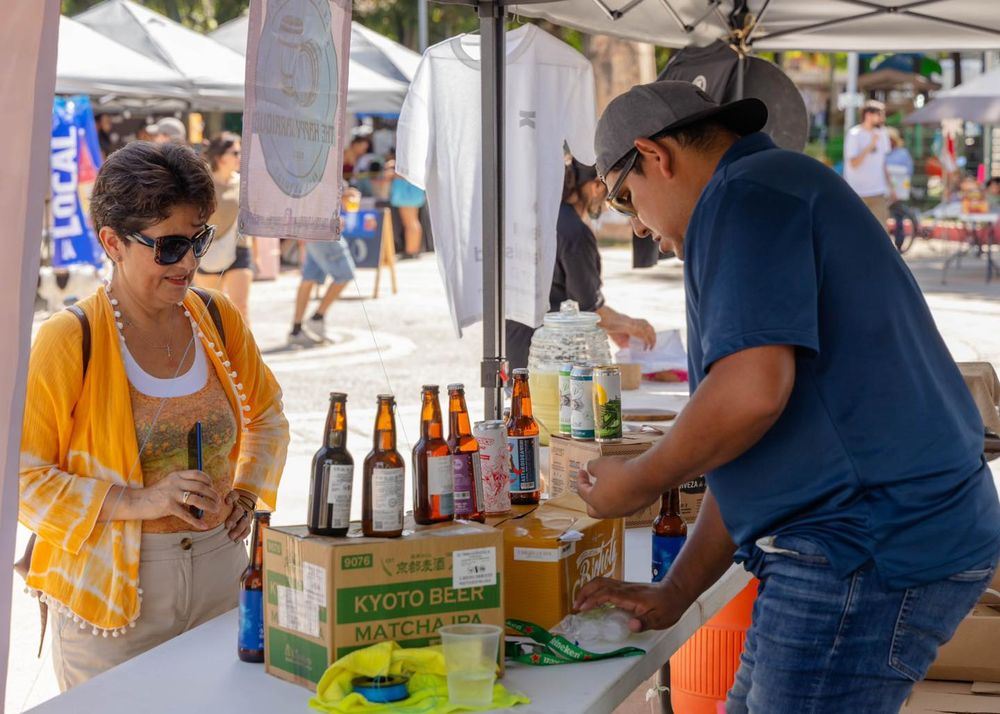
At a recent appearance at the Festival de la Cerveza de Tulum, held on August 30 and 31, Nikte-Kaab didn’t just pour samples, it poured out a narrative of cultural pride and innovation. And it resonated. Locals, tourists, and beer snobs alike took notice.
Maya Bees, Modern Struggles
Beekeeping in the Riviera Maya isn’t just about producing honey. It’s a cultural inheritance. A ritual. A way of life passed down through calloused hands and whispered stories.
But in recent years, apiculturists like Dzib have been stung by global pressures. Climate change, pesticides, deforestation, and the unpredictable dance of market economics have made it harder than ever to survive on honey alone. What used to be sustainable living is now an uphill struggle.
Dzib’s pivot to beer wasn’t just about adding value. It was about making sure the Maya bees, and the people who keep them, don’t disappear from the story of Mexico’s future.
“This isn’t just our achievement,” he says. “It belongs to every apiculturist in the region. We want them to feel proud of what we’re building together.”
And pride is something Tulum has in spades.

Local Roots, Global Sips
Though production remains small, Nikte-Kaab’s reach is slowly extending beyond Quintana Roo. The beers have gained traction at the national level, and limited exports are already underway. It’s not mass-market stuff, and that’s the point.
Each bottle is a conversation. A sip of something uniquely Maya, made by hands that know the forest and understand the bees. In an industry saturated with copycat craft beers and trend-chasing flavor profiles, Nikte-Kaab feels grounded, real, and unreplicable.
“It’s not just a drink,” said one attendee at the beer festival, holding up an amber bottle like a torch. “It’s a statement.”
And as The Tulum Times observed throughout the event, it’s a statement that people are eager to rally behind, tourists drawn to authentic Mexican flavors, and locals looking for proof that heritage and innovation can walk hand in hand.

A Sweet, Sustainable Future?
It’s tempting to romanticize this story. A beekeeper saves his family tradition by making craft beer in the jungle? Feels almost cinematic. But the truth is grittier, stickier, like scraping honey from the hive with bare fingers.
Nikte-Kaab is still fighting for market space. Competing with imported beers and industrial-scale brands isn’t easy, even with a superior product. Scaling up without compromising quality? Another tightrope walk. And protecting the fragile ecosystems that support the bees? That’s a whole other battle.

Yet Dzib presses on. His mission isn’t just to sell beer. It’s to prove that local can be premium. That Maya knowledge belongs in modern markets. The jungle still has stories worth bottling.
“We’ll keep pushing,” he says. “Our honey, our culture, our natural products, this is who we are.”
And maybe, just maybe, every bottle of Nikte-Kaab cracked open in a beach bar or a Mexico City terrace is one more reason to keep the bees buzzing.
We’d love to hear your thoughts. Join the conversation on The Tulum Times’ social media.
Do you think traditional practices like beekeeping can thrive through innovation, or is something lost in translation?