
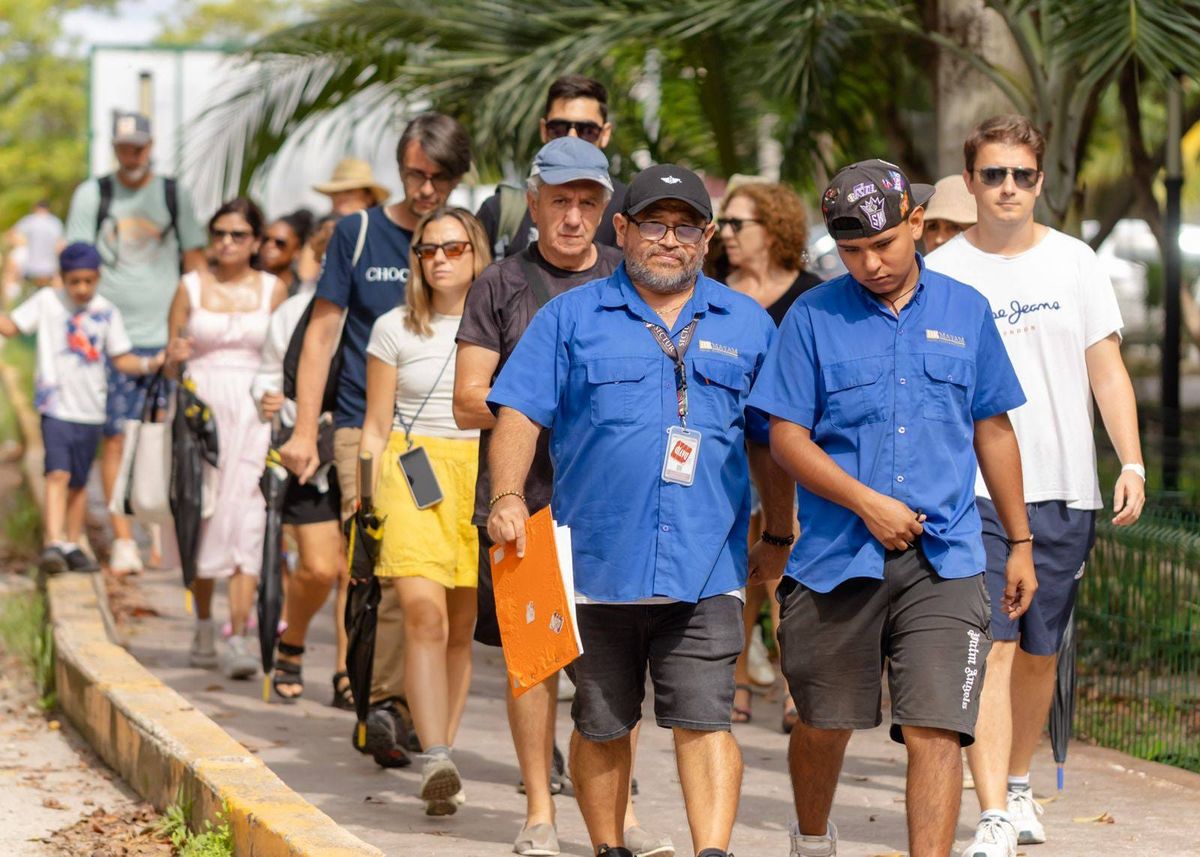
The early days of November brought a change of tone to Tulum. After months of decline, local merchants and tourism workers report a mild but noticeable increase in visitor flow, a shift they largely attribute to the new free entry policy at the archaeological zone.
According to local shopkeepers, the number of tourists arriving from Cancún and Playa del Carmen has grown by roughly 20 percent compared with previous months. The weekends, in particular, have become livelier. “The increase comes on Sundays because there’s no entry fee now,” said a vendor from Viva México Tulum, a small shop facing the well-known red #Tulum sign. “They have free access, and that has helped us recover some sales.”
For a town that relies almost entirely on tourism, even a modest uptick feels significant. The change might not erase the financial strain of recent months, but it signals that Tulum’s tourism engine, though fragile, is turning again.
A Slow Recovery After a Harsh Low Season
The months leading up to November were tough. Local agencies and vendors saw sharp drops in visitor numbers, particularly after price increases at the Jaguar Park, which led some tour operators to divert traffic toward cheaper alternatives such as Yucatán’s cenotes and the ruins of Chichén Itzá.
Pedro Canul Méndez, administrator of the Centro Artesanal Tulum, confirmed that the first signs of recovery appeared in early November. “We started to see more movement, not in huge numbers, but it’s slowly coming back,” he told The Tulum Times.
Still, he described the current flow as highly inconsistent. “It’s been strange. One day we have 100 vehicles arriving, the next only 20. It’s very variable,” he said. Such fluctuations underline how dependent Tulum remains on external factors like weather, road access, and flight prices.

Free Access Policy Draws Families and Curiosity-Driven Travelers
The free entry measure at the archaeological site has had an immediate impact. For many families, especially domestic visitors, it removes one of the key financial barriers. The decision, introduced by federal and municipal authorities, aims to stimulate local tourism and encourage more visitors to explore Tulum beyond its luxury resorts.
Canul Méndez noted that the change also created a wave of curiosity. “Some people come because they want to see if what they’ve heard about Tulum being too expensive is true,” he explained. “They find it’s almost the same as two years ago.”
That curiosity-driven tourism might not bring the highest spending, but it reintroduces the destination to travelers who had been priced out or discouraged by earlier policies. Sundays, in particular, have turned into small local festivals, with tourists strolling through artisan markets, sampling tequila and chocolate tastings, and taking advantage of free public restrooms provided by nearby stores.
Shifts in the Tourist Mix Reflect a Changing Market
Local merchants point out that Italians, French, and Canadians now make up the majority of foreign visitors. The once-dominant U.S. market, which sustained much of Tulum’s economy year-round, still lags behind.
“Foreign visitors come, but they spend very little,” said the Viva México Tulum vendor. “Before, the Americans were the ones who left the biggest economic impact.”
Tourism experts suggest that currency fluctuations, tighter budgets, and shifting travel trends have affected U.S. arrivals. Meanwhile, European tourists, often staying longer and traveling across the Riviera Maya, appear to be rediscovering Tulum as part of multi-stop itineraries that include Playa del Carmen and Isla Mujeres.

Municipal Optimism and the Promise of Upcoming Announcements
Mayor Diego Castañón Trejo recently hinted during a morning press briefing that “good news” is coming soon for Tulum, though he did not share details. The comment sparked speculation about further measures to stimulate the local economy, possibly involving infrastructure upgrades or tourism incentives linked to the Jaguar Park and the Tren Maya corridor.
Canul Méndez echoed the cautious optimism of many business owners. “We hope these changes really improve things,” he said. “We want visitors to come back, pay what they used to, and enjoy the beaches and the ruins like before.”
The optimism is cautious but real. Many see these small gains as the early signs of a gradual normalization after one of the toughest low seasons in recent memory.
Between Expectation and Reality, Tulum Adjusts to a New Normal
Despite the uneven flow, the psychological effect of seeing more movement in the streets matters. The artisans, tour guides, and vendors who form the backbone of Tulum’s local economy are learning to navigate a more unpredictable market.
“The difference between a quiet and a busy Sunday can decide whether a shop stays open,” said one vendor. Such small swings carry weight in a town where tourism drives almost every sector, from crafts to transport.
But there is also resilience. Locals continue to find creative ways to keep their businesses afloat. Free tequila samples, cultural workshops, and beach access partnerships have become tools to attract and retain visitors. The effort reflects a broader determination to keep Tulum relevant in the post-pandemic tourism map of Mexico.

Looking Toward the Year’s End
As December approaches, business owners hope the combination of free entry, improved accessibility, and seasonal travel will boost both foot traffic and spending. The expectation is not for a boom, but for stability.
“We’re optimistic,” said the Viva México Tulum vendor. “If authorities continue supporting these initiatives, we can finish the year strong and start the next one better.”
The feeling is echoed across the Riviera Maya. A slow, steady recovery might not make headlines, but it suggests that Tulum’s appeal endures beyond short-term challenges.
The tourism in Tulum appears to be finding its rhythm again, balancing the allure of its beaches and ruins with practical measures that welcome more visitors.
We’d love to hear your thoughts. Join the conversation on The Tulum Times’ social media.
Do you think free access policies are the right way to revive tourism in destinations like Tulum?