
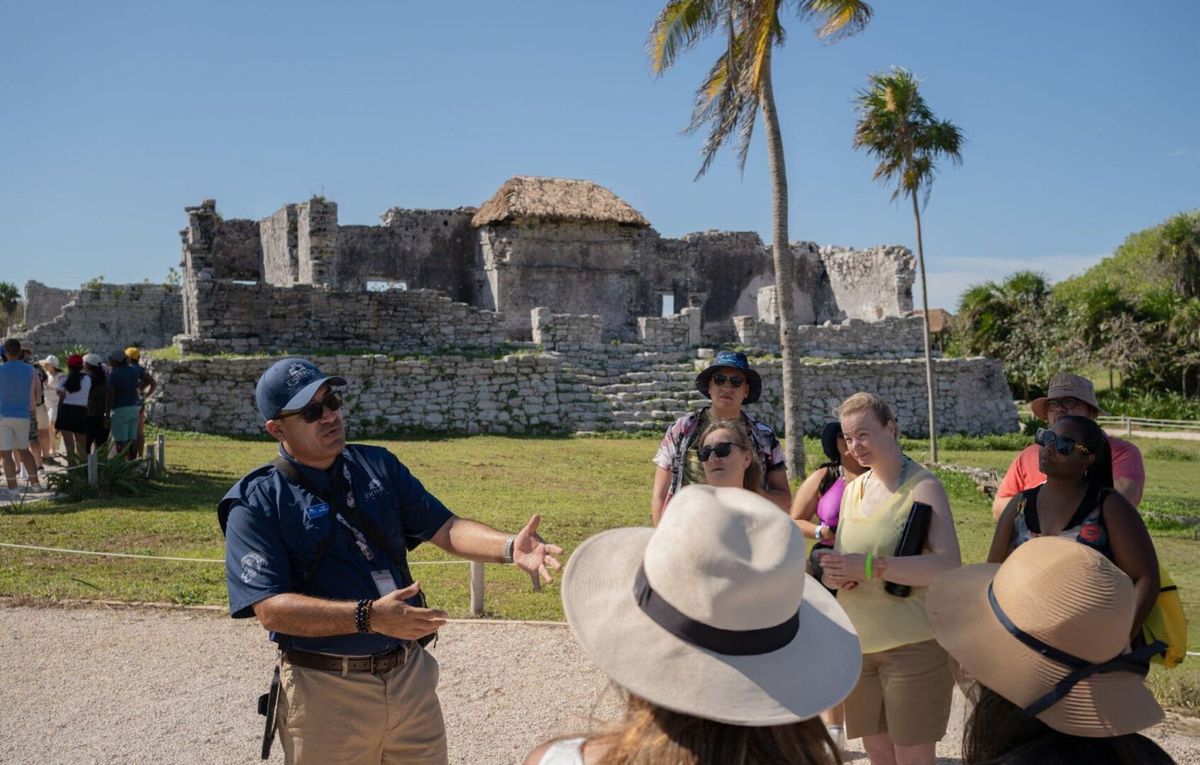
The new increase in access fees for foreign tourists at Mexico’s archaeological sites has raised concerns among guides and tour operators in Tulum. Many fear the higher costs could reduce international arrivals as early as 2026, weakening one of the region’s strongest tourism drivers.
Approved by the Chamber of Deputies and promoted by the federal government, the reform will double entrance fees for non-residents at emblematic sites such as Tulum, Cobá, San Gervasio, and Kohunlich, from 100 to 210 pesos. The change coincides with a new rise in the Non-Resident Fee (DNR), which will climb from 861 to 983 pesos per traveler. Together, these measures could make visiting the Riviera Maya more expensive than comparable destinations in the Caribbean.
A controversial adjustment in the name of preservation
Federal officials have argued that the price hike seeks to guarantee the long-term conservation of Mexico’s archaeological heritage. According to government sources, the additional funds will be directed toward maintenance programs and the operation of the Tren Maya, a flagship infrastructure project connecting key tourism corridors in the southeast.
However, local industry figures see the change as ill-timed. The post-pandemic tourism recovery remains fragile, and higher travel costs could discourage budget travelers who make up a significant portion of Mexico’s foreign visitors. The adjustment, they argue, may contradict efforts to diversify the tourism economy and expand beyond luxury markets.

Uneven policies fuel regional discontent
The controversy deepened when Yucatán was granted an exemption allowing differentiated rates at Chichén Itzá and Uxmal. By contrast, Quintana Roo must implement the full increase without distinction. For guides and operators in Tulum, this difference appears unfair and reveals the lack of coordination between federal and local authorities.
“Raising the price to double is excessive,” said one local guide who has worked in the archaeological zone for two decades. “Visitors will start comparing prices, and some will skip Tulum altogether.”
That perception is widespread across the Riviera Maya. While federal authorities emphasize equity and heritage funding, regional actors see a measure disconnected from the economic reality of coastal communities dependent on tourism.
A test for tour operators already facing global competition
For tour agencies that offer packages combining several archaeological and ecological attractions, the new tariffs could represent a breaking point. Multi-site tours, one of the most popular formats among European and North American travelers, will become significantly more expensive.
Local agencies say the increase could shift demand toward destinations where pricing remains stable. Operators mention Costa Rica and the Dominican Republic, where heritage sites and eco-tourism excursions maintain relatively steady costs for foreign visitors. “Our packages will lose their appeal,” noted a bilingual guide from a Tulum-based agency. “Travelers want affordable options, not unexplained surcharges.”
The price gap could also affect airlines, hotels, and restaurants tied to package sales, creating a ripple effect across the regional economy.

Economic logic versus tourism strategy
Tourism experts point out that Mexico’s pricing model is drifting away from international trends. While most countries apply modest conservation fees to foreign visitors, few implement sudden, double-digit increases. The decision to link archaeological access revenue to projects like the Tren Maya could reinforce public skepticism about how funds are managed.
According to tourism analysts, the reform reflects a broader political approach: centralizing resource allocation under federal programs rather than regional ones. “It may be justified as heritage protection, but in practice it behaves like a new tourism tax,” said an economist at a Cancun-based research center.
The balancing act between heritage funding and accessibility
Archaeological conservation is undeniably costly. Sites like Tulum and Cobá face erosion, climate risks, and mass tourism pressure that require sustained maintenance. Yet, as several observers note, preservation policies work best when they balance environmental needs with market realities.
The dilemma lies in whether higher prices will truly translate into better care. Without transparent mechanisms to ensure that additional revenue benefits the sites directly, skepticism remains high. “If the goal is to protect heritage, people want to see visible improvements,” said another guide. “Otherwise, it feels like a collection effort, not conservation.”

Lessons from neighboring destinations
Regional comparison provides useful insight. In Costa Rica, national parks maintain fixed foreign entry rates aligned with the local cost of living and reinvest a portion into community tourism programs. The Dominican Republic’s approach integrates archaeological conservation within broader tourism promotion, keeping fees stable to attract steady flows.
By contrast, Mexico’s fee structure is fragmented, varying by institution and state. This inconsistency, analysts argue, weakens the country’s competitiveness and confuses international travelers seeking clarity and fairness.
Federal ambitions meet local realities
For the federal government, connecting cultural heritage with large-scale infrastructure projects such as the Tren Maya remains a key development strategy. Officials argue that integrating archaeological corridors into the train’s route will create new jobs and distribute tourism benefits more evenly across the southeast.
Still, for communities like Tulum, where tourism already sustains most of the local economy, the short-term effect could be contraction rather than expansion. “Policies must consider the ground reality,” said a regional tourism consultant. “Rising costs may benefit budgets in Mexico City, but they could undermine local livelihoods in Quintana Roo.”
A quiet warning for Mexico’s tourism future
The tension between funding heritage and keeping destinations accessible is not new. Yet this latest increase has revived the debate over Mexico’s broader tourism vision. Should archaeological and cultural experiences remain open and affordable to a global audience, or evolve into a higher-priced, limited-access model?
For now, the sector waits to see how travelers will respond once the new fees take effect in 2026. A sharp drop in visitation could force authorities to reconsider. A moderate adjustment might be absorbed quietly. Either way, the measure serves as a test of whether Mexico can balance sustainability, inclusivity, and fiscal ambition in its tourism policy.
As The Tulum Times has reported in previous analyses, maintaining that balance is vital to preserving both heritage and the communities that depend on it.
How should Mexico balance heritage preservation with fair access for international travelers?