

Winter arrivals of sargassum along the Mexican Caribbean are heightening concern among real estate developers and local planners, who warn that Mexico lacks the international coordination needed to address the problem at its source. The warning comes as satellite images indicate unusually large sargassum formations moving toward the region months earlier than historically expected.
Speaking Wednesday morning ahead of a meeting related to urban planning in Tulum, Gustavo Maldonado Saldaña, representative of the Asociación de Desarrolladores Inmobiliarios de la Riviera Maya, said the country continues to respond to the sargassum phenomenon too late in the process, focusing on coastal containment rather than early-stage intervention.
Maldonado was interviewed prior to attending a session where he had been invited to participate in the Municipal Council for Territorial and Urban Planning of Tulum. He said the presence of sargassum during winter months, when it traditionally does not reach the coast, should be treated as a warning sign of a growing and poorly managed regional crisis.
Winter sargassum arrivals signal deeper structural problem
According to Maldonado, the current situation reflects a failure to address the origins of the phenomenon, which he described as transatlantic and nutrient-driven. He explained that sargassum growth is fueled by nutrient runoff originating near Cape Verde off the coast of Africa, combined with contamination from major South American river systems discharging near Brazil.
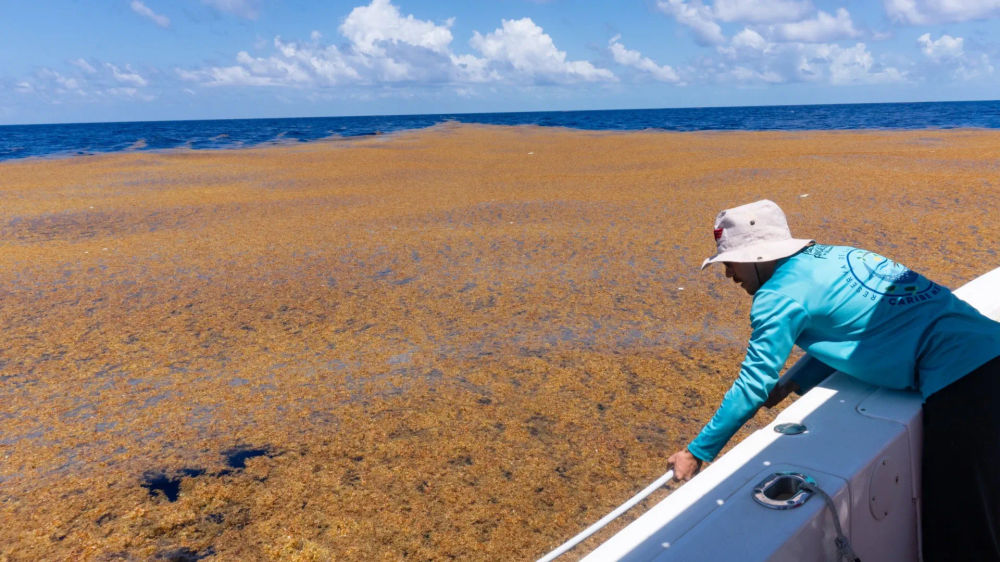
The abundance of nutrients, he said, allows two sargassum species to reproduce at an accelerated rate as they move across the Atlantic toward the Caribbean basin. Under these conditions, Sargassum can double its biomass in less than two weeks.
“What we have is a problem that is being addressed at the end of the chain, when actions should be taken at the beginning of the chain,” Maldonado said, emphasizing that coastal cleanup and barrier systems treat the symptoms rather than the cause.
He added that while Mexico has participated in preliminary international discussions, there appears to be limited executive capacity to advance those efforts into binding or coordinated action at the international level.
Calls for stronger international engagement
Maldonado pointed specifically to the need for engagement with multinational bodies such as the Organization of American States and other Caribbean-focused associations that convene member states affected by sargassum influxes.
He said addressing the issue upstream would be significantly less costly and more effective than current strategies, which rely heavily on coastal barriers, manual collection, and emergency response measures once sargassum has already reached shore.
“Technologically, there could be solutions,” he said. “But we are not seeing the level of executive action that is required. I do not believe the federal government has a full perception of the magnitude of the problem that sargassum represents for Quintana Roo.”

Satellite images heighten concern for the coming months
Recent satellite images circulating publicly, showing what has been described as a massive “island” of sargassum, have further intensified concerns among stakeholders in the region.
Maldonado said the images are alarming, particularly given the rapid reproduction cycle of the algae. If significant sargassum masses are already detectable during winter, he warned, the scale of arrivals later in the year could be severe.
“Just imagine what could reach our coasts during peak season if we are already detecting these masses in winter,” he said. “It is difficult not to be concerned about what the rest of the year may look like.”
While acknowledging that containment barriers can provide some relief, Maldonado compared the current approach to treating a severe lung infection with superficial remedies. In his view, such measures offer limited protection while allowing underlying conditions to worsen.
Environmental impacts extend beyond tourism
Maldonado stressed that the consequences of unchecked sargassum arrivals extend far beyond tourism and beach aesthetics. He described the environmental impacts as the most serious and potentially irreversible.
As sargassum decomposes in coastal waters, it alters water chemistry and reduces transparency, a condition that directly affects coral reefs, which depend on sunlight to survive. Reduced water clarity also threatens seagrass beds, which serve as critical habitats and feeding grounds for multiple marine species.
“These are just the first repercussions,” he said. “There are many more, and the list would be very long.”
He added that environmental degradation inevitably carries economic, social, and political consequences for coastal communities that depend on healthy marine ecosystems.
Investment uncertainty compounds regional challenges
Beyond environmental concerns, Maldonado addressed growing uncertainty surrounding foreign investment in both Tulum and Mexico more broadly. He said the real estate development sector is navigating multiple risk factors simultaneously, including security concerns, the sargassum crisis, and legal uncertainty linked to recent judicial reforms promoted by the federal executive.
According to Maldonado, changes to the judiciary have sent a cautionary signal to foreign investors, who are increasingly unsure how legal frameworks and dispute resolution mechanisms may function in the future.
“They do not have certainty about how the rules will be applied or what legal guarantees their investments will have,” he said.
As a result, Maldonado said the sector is experiencing a contraction in investment flows. He estimated that more than 30 percent of previously anticipated real estate investment remains on hold rather than withdrawn entirely.
Projects stalled as investors wait for clarity
Maldonado said many development projects in the region have been effectively paused, a situation he described as particularly concerning. The issue is not only the absence of new capital, he said, but also the paralysis of investments that had already been made and are now inactive.
“There is no certainty about when these projects might be reactivated or what the real reasons are behind that inactivity,” he said.
He added that external geopolitical factors are also influencing investor sentiment, pointing to ongoing tensions with the United States, including repeated threats related to tariffs and the possibility of unilateral action tied to organized crime concerns.
These signals, he said, add another layer of uncertainty for investors evaluating long-term commitments in Mexico.
Call for coordinated action beyond political rhetoric
Despite outlining a range of challenges, Maldonado emphasized that periods of uncertainty can also present opportunities if addressed through coordinated planning and collaboration.
He called on both the public and private sectors to move beyond political discourse and focus on practical solutions, noting that electoral cycles appear to continue shaping debate even after formal processes have concluded.
“We need to leave speeches behind and get to work together,” he said. “The discussions should turn into productive outcomes that allow us to move forward.”
Maldonado pointed to Mexico’s ability to overcome past crises, including the COVID-19 pandemic, as evidence that coordinated action can produce results when stakeholders engage constructively.
He concluded by urging all parties to return to working tables to identify shared concerns, clarify responsibilities, and develop solutions that address both environmental and economic risks facing the region.
As winter sargassum arrivals underscore the scale of the challenge, what remains at stake is not only the resilience of the Riviera Maya’s coastal ecosystems, but also investor confidence and long-term regional stability tied to how decisively the issue is addressed at its source. The sargassum crisis.
“We’d love to hear your thoughts. Join the conversation on The Tulum Times’ social media.”
How should Mexico balance international coordination, environmental protection, and economic certainty as these pressures converge?