
On a sweltering day in April 2025, a small group of cave researchers trudged in single file through the tropical undergrowth of Mexico’s Yucatán Peninsula. At the head of the group was José “Pepe” Urbina, a seasoned cave diver, followed closely by biologist and speleologist Roberto Rojo. They were nearly fifteen miles inland from the Caribbean coast, hacking through vegetation in search of a forgotten section of the flooded Zumpango Cave, likely untouched by humans for decades.
Suddenly, the jungle gave way. A jagged limestone opening yawned before them, cool air flowing out like a sigh held for centuries. They descended carefully past dripping stalactites, eyes adjusting to the dark. Then came a shout, “Uy!”, and there it was: an ancient Maya pot perched on a ledge of rock, as if left behind by time itself.

Such findings, while dramatic, are not uncommon in the Yucatán. This land conceals a vast labyrinth of caves and sinkholes, known as cenotes, derived from the Maya word ts’onot. For the Maya, cenotes were sacred, mystical places where gods and spirits dwelled. Today, many have become swimming attractions or dumping grounds, but at their core, they remain geological wonders, and lifelines.
Southern Mexico’s cenotes form part of a 64,000-mile aquifer system, the region’s sole source of freshwater. “Everyone is connected through the cenotes,” Urbina says. And for him, Rojo, and a growing coalition of conservationists, that sacred interconnectedness has taken on a new urgency.
The Sacred and the Structural: Tren Maya’s Expanding Footprint
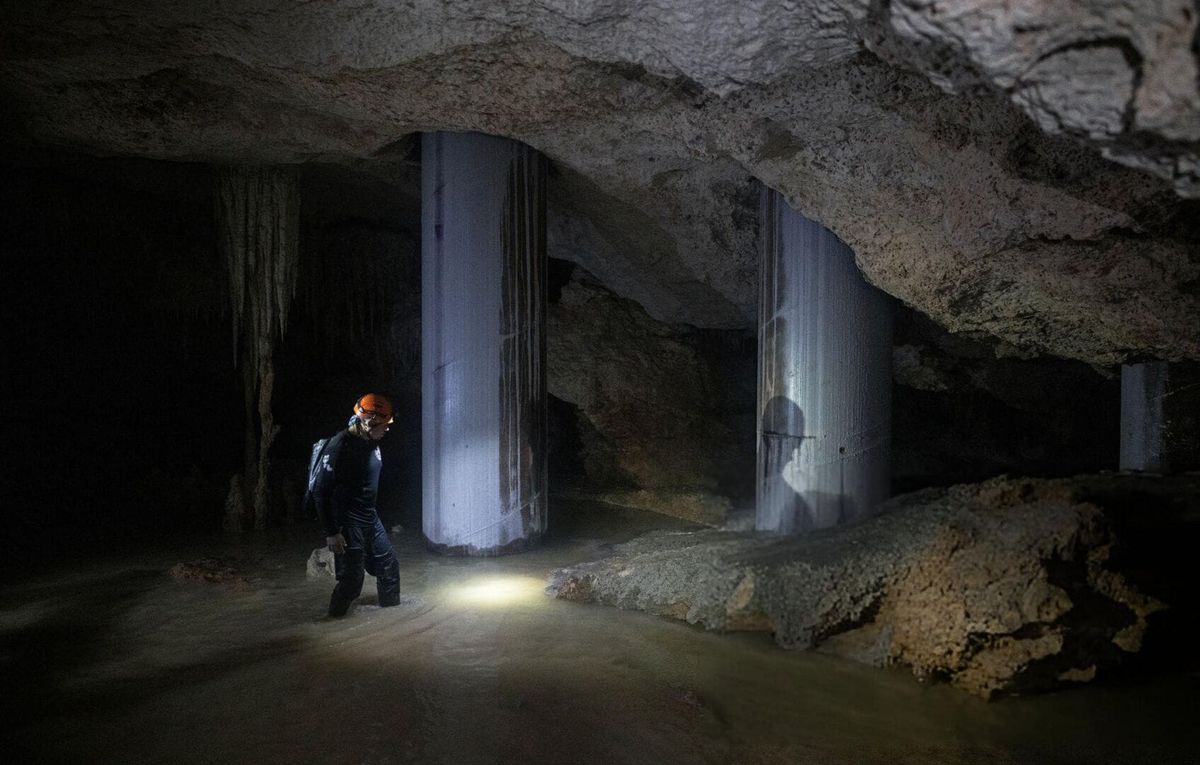
Tren Maya, a $30 billion, 966-mile rail project inaugurated in late 2024, was conceived as a bold leap forward for tourism and regional connectivity. But its construction has ignited fierce concern. To anchor the tracks, engineers drove 15,000 concrete pillars into the limestone, some directly into cenotes.
What began as a promise of economic revitalization quickly became a flashpoint. Urbina and Rojo, who had long worked separately to protect underground ecosystems, joined forces as the train’s path encroached. Their respective groups, Sélvame del Tren and Cenotes Urbanos, merged efforts, catalyzing a larger movement of over ten organizations aiming to document the subterranean world before it’s irrevocably changed.
For them, the stakes are existential. Cenotes are not static pools; they are porous, living conduits. Pollution introduced in one place will not stay there. It travels through rock, through water, through entire ecosystems.

Mapping Shadows: A Subterranean Frontier
There are more than 8,000 registered cenotes in the Yucatán Peninsula, but experts believe that’s just the beginning. Urbina and his fellow divers have mapped about 900 miles of underwater cave passages, a fraction of the total network. The system, constantly shifting as limestone gives way, remains largely unmapped and poorly understood.
One critical issue is pollution. Dr. Flor Arcega-Cabrera, an environmental geochemist at the National Autonomous University of Mexico, reports that industrial agriculture is now the dominant source of contamination. Fertilizers rich in nitrates, pesticides, and livestock waste laced with hormones and heavy metals seep into the aquifer.
The consequences are not abstract. Communities across the region rely on well water. Nitrates can replace iron in the bloodstream, leading to blue baby syndrome, a condition that prevents infants’ blood from carrying oxygen. “People use this water to feed their babies,” Arcega-Cabrera warns.
Rojo once heard the whoosh of a toilet above him while exploring a cave. Moments later, sewage rained down through the porous stone. “It was like watching the Earth bleed,” he said.

Steel in the Heart of Stone
Beyond pollution, researchers are alarmed by what the train may have buried. In 2014, a diver found the 13,000-year-old skeleton of a girl in a cenote. Her DNA reshaped migration theories about the peopling of the Americas. What else lies undiscovered, now trapped beneath concrete?
The caves are also home to rare and endangered species, like the translucent Mexican blind brotula (Typhliasina pearsei) and the blind swamp eel (Ophisternon infernalis), which have evolved to survive in total darkness. When the ecosystem is destabilized, these uniquely adapted creatures are the first to vanish.
Water consultant Guillermo D. Christy, who has advised hotels for over 25 years, is now collaborating with Cenotes Urbanos and Sélvame del Tren to test eight caves across Quintana Roo. His data reveals rising E. Coli levels and traces of iron oxide, a sign that steel from the train’s support pillars is leaching into the water. Iron oxide can stimulate harmful algae blooms, lethal to aquatic embryos.
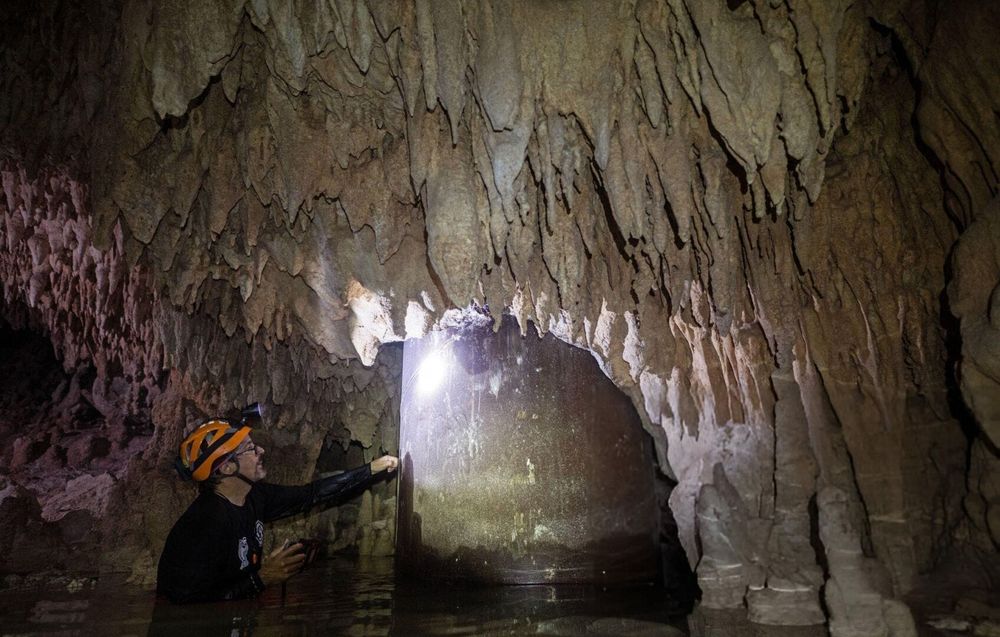
At Oppenheimer Cave, just outside Playa del Carmen, Christy joined Urbina and Rojo to lead government officials through a tour. The first chamber shimmered with turquoise beauty. The second, however, was clogged with muck and the reddish stain of corroding concrete.
Government Response: Action or Optics?
In the weeks after that visit, Mexico’s environment ministry, SEMARNAT, released a public statement. Over seven million trees had been felled. At least 125 cenotes and caves had been punctured. A rescue plan was announced, removing fences blocking animal migration, halting construction of secondary roads.
But many remain skeptical. In 2023, a brief court victory delayed the project after a lawsuit led by Urbina and others reached Mexico’s Supreme Court. President Andrés Manuel López Obrador quickly invoked national security and brought in the military to complete the rail line.
Still, some signs suggest these efforts are not in vain. In April, Urbina took Oscar Rébora Aguilera, Secretary of Ecology for Quintana Roo, diving in Sac Actún, one of the world’s largest flooded cave systems. After surfacing, he pointed to a proposed road site above them. Shortly afterward, the Federal Attorney for Environmental Protection issued a temporary suspension order.
“You can’t unsee beauty,” Urbina said.

Grassroots Against the Machine
Cenotes Urbanos, co-founded by Rojo along with Talismán Cruz and Ximena Chávez, has grown into a collective of nearly 500 members. They lead more than 20 re-dignifying expeditions annually, cleaning, testing, and educating. Meanwhile, Sélvame del Tren has evolved from a social media campaign into a multi-disciplinary force, tracking pollution patterns, animal migration, and changes to groundwater flow.
Their work reflects a rare alchemy: ancient knowledge, contemporary science, and relentless grassroots organizing. They aren’t just documenting a crisis. They are defending a living archive of history, culture, and biodiversity.
The Clock Is Ticking
Each day, the pressure mounts. More tourists arrive. More concrete is poured. More toxins seep underground. But the cenotes persist, deep, sacred, and still pulsing with life.
Rojo knows recovery may take generations. “I trust wholly that there are solutions,” he says, though he acknowledges the scale of the challenge. Yet hope endures. Because the water still flows. And as long as it flows, someone will be there, wading into the dark, ready to protect what cannot protect itself.
For continued coverage and insight into the future of Yucatán’s environment, follow the evolving story with The Tulum Times.