

In the dusk that settles over Tulum’s coastline, it’s easy to imagine a jaguar slipping through the undergrowth like a ghost. The ancient Maya city perched on the cliffs once revered the balam, the jaguar spirit, as a guardian of the night. Today, that revered name graces the newly established Parque del Jaguar in Tulum. But do any wild jaguars still roam this park’s dense mangroves and limestone caves? The question hangs in the humid air, charged with both hope and lament. A lone paw print by a cenote, a blurred shape caught on a worker’s flashlight – these tantalizing signs suggest that the jungles here have not completely forgotten their original lords. Yet the reality of jaguars in the Parque del Jaguar in Tulum is a complex story of habitat, history, and survival.
From Maya Sanctuaries to Tourist Mecca
Long before this land was a tourist magnet, it was true jaguar country. Decades ago, the area now called Parque del Jaguar was an unbroken expanse of coastal jungle and mangrove swamps flanking Tulum’s postcard-perfect beaches. In 1981, recognizing the ecological and cultural value of the Tulum ruins and its surroundings, Mexico established the Tulum National Park – a 664-hectare protected stretch hugging the coast and archaeological zone. Back then, jaguars prowled the Yucatán Peninsula’s forests freely, and it’s likely one could have stalked through what is now the park’s underbrush under the cover of darkness. The Maya ruins themselves stand as ancient testaments; carved depictions of jaguars in temples hint that these predators were once common even along the shore. Locals recall that as recently as a few decades past, sighting a paw track or hearing a distant roar was not unheard of in the broader Tulum region. The landscape was a rich mosaic of tropical dry forest, palm savannah, and wetlands – a paradise for creatures great and small.

That paradise, however, began to fragment as Tulum transformed. The quiet fishing village grew into a global destination, bringing resorts, roads, and an international airport on the horizon. The once-continuous selva was carved up by Highway 307, power lines, and now the incoming Tren Maya railway. Each new development nibbled away at the jungle. Old-timers watched as hotels and beach clubs sprouted along the coast where turtles once nested in solitude. By the 2000s, most large wildlife had retreated into the shrinking patches of forest south and west of town. The original Tulum National Park, while protected on paper, struggled with land disputes and illegal encroachments – many plots inside it were privately owned and hotly contested. Conservation took a backseat to quick development. “When Tulum National Park was created, it was a paradise ripe for exploitation,” says a local environmental historian. Corruption and land speculation plagued the park’s management for decades, to the point where parcels of supposedly protected land were sold multiple times over. In this tumult, whatever jaguars remained near Tulum quietly slipped away, driven by the noise of construction and the disappearance of their hunting grounds.

The Disappearing Jaguars
No one can say exactly when the last resident jaguar vanished from Tulum’s immediate vicinity, but their absence became noticeable. Smaller cats like ocelots and jaguarundis lingered in the thickets, and occasionally a puma might be spotted skirting the outskirts of town. But the jaguar – the apex predator, the park’s namesake – survived mostly in stories or deep in the neighboring Sian Ka’an Biosphere Reserve further south. The forces pushing them out were not unique to Tulum: deforestation, urban sprawl, and human encroachment have been brutal to jaguar populations across the Americas. In Quintana Roo state alone, an estimated five jaguars have been killed by collisions on the Tulum–Cancún highway in recent years, as these cats attempt to navigate an ever more fragmented habitat. As conservationist Raúl Padilla starkly puts it, “Jaguars do not cross the road; it’s the road that crosses the jaguar’s habitat.” His words ring true – each strip of asphalt and each new train track slices through territory the jaguars have used for millennia. A haunting incident in mid-2023 underscored this reality: workers building the Tren Maya caught a video of a jaguar padding through a cleared construction zone at night, looking disoriented by the heavy machinery. Within months, that same stretch of jungle saw a beautiful female jaguar–nicknamed Naku by biologists–fatalistically struck by a vehicle. She was found to be pregnant, a heartbreaking symbol of how progress has come at the expense of Tulum’s wild heritage.

In ecological terms, jaguars require vast ranges to thrive. A single male may patrol a territory of 60–100 square kilometers or more in search of prey and mates. Females need large, undisturbed areas to rear cubs. By the time Tulum’s growth surged in the 2010s, there simply wasn’t enough continuous forest left around the tourist zone for a jaguar to call home. Most remaining jaguars stuck to larger reserves inland and south. Occasionally, a bold individual might wander near the town’s edge, leaving behind tracks by a cenote or frightening a late-night motorist on the highway, but a sustained jaguar presence near Tulum’s beaches had become a relic of the past. One wildlife group even catalogued these rare forays, identifying jaguars by their rosette patterns caught on hidden cameras and noting how each encounter grew more perilous than the last. “A jaguar should die of old age in the deep jungle, not under the wheels of a car,” an activist lamented. The species that once reigned at the top of this ecosystem’s food chain was being reduced to a transient shadow, dodging traffic and bulldozers.

Birth of the Jaguar Park
It was against this sobering backdrop that the Mexican government announced the creation of Parque Nacional del Jaguar in late 2022. Part ecological reserve, part archaeological heritage site, this new park was conceived as a bold gesture to protect what remained of Tulum’s natural and cultural richness. Spanning roughly 2,250 hectares (about 22.5 km²), Jaguar Park stitches together several zones: the original Tulum National Park along the coast, the Tulum and Tankah archaeological areas, and a newly decreed Flora and Fauna Protection Area inland. The inland polygon – confusingly, one of two separate land blocks that make up the park – includes swaths of tropical forest, mangrove lagoons, and cenote networks on the city’s fringes. It even incorporates a decommissioned Mexican Navy airbase that, by a twist of fate, had kept a chunk of forest intact while under military use. When President Andrés Manuel López Obrador (AMLO) signed the decree, he framed it as a triumph of conservation over rampant development. The park, he vowed, would halt Tulum’s unchecked urban sprawl, prevent new hotels from gobbling up green space, and serve as an “international benchmark” for ecological and historical preservation coexisting.
On paper, the vision is inspiring. Jaguar Park is meant to function as a protective buffer around the wildly popular Tulum ruins and adjacent beaches, safeguarding them from the pressures of booming real estate. It’s also intended as a biological corridor: officials speak of creating wildlife underpasses and “green bridges” so animals can move freely through the region without peril. The park’s master plan emphasizes restoring degraded areas and replanting native vegetation. Crucially, it highlights the jaguar – Panthera onca – as a flagship species, symbolizing the commitment to guard all creatures in its domain. Park planners talk of monitoring programs to encourage jaguar reproduction and of educating visitors about this magnificent cat’s role in Mayan culture and the local ecosystem. There is a brand-new Museum of the Eastern Coast within the park that showcases Mayan artifacts and deities – including jaguar iconography – to drive that point home. In short, Parque del Jaguar is as much about human heritage as it is about wildlife. It’s an ambitious attempt to reconcile Tulum’s future with its primeval past.

Sanctuary or Showpiece?
Yet from the outset, the Jaguar Park project has been mired in debate and controversy. Conservationists, while welcoming any protected area, point out uncomfortable truths about the park’s limitations. For one, its territory is relatively small and fragmented, split into two non-contiguous segments separated by about 11 kilometers. Roberto Rojo, a biologist who leads a local conservation organization, doesn’t mince words: “In that park, there isn’t room for even a single jaguar.” His critique centers on the fact that even the entire 22 km² expanse is only about one-third of what a solitary male jaguar ideally needs. And because the park’s two pieces are isolated by development (with villages and roads in between), any jaguar would find it nearly impossible to traverse from one section to the other safely. No wildlife corridors currently link them – a situation Rojo calls “unprecedented” for a nature reserve. He and others worry that without connectivity to larger wilderness like Sian Ka’an or the inland forests, Jaguar Park might end up as a biological island, too small to host big cats long-term. In blunt terms, it could become a sanctuary in name only for jaguars, a place where they are honored in symbolism but not actually present in significant numbers.
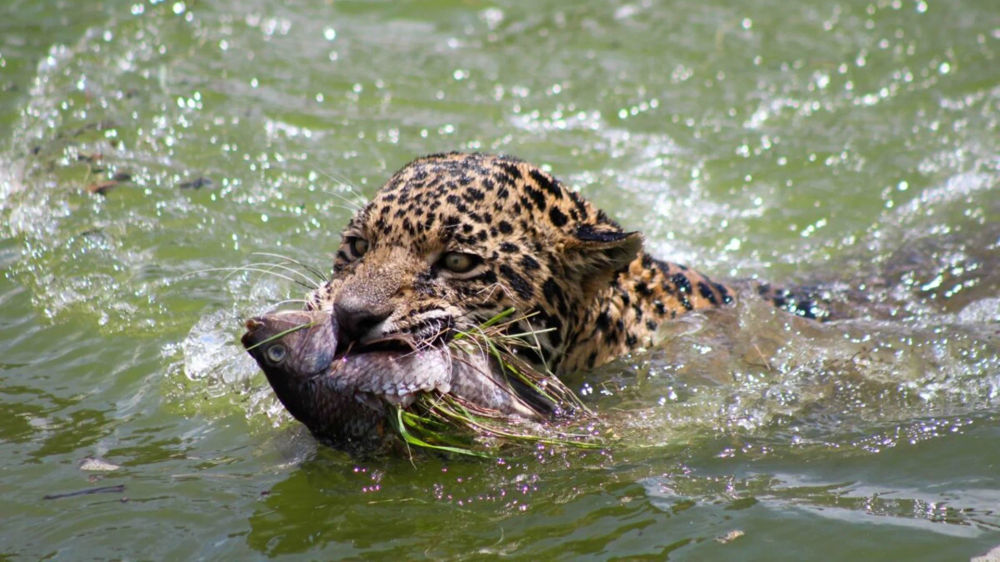
There’s also the context of why this park was fast-tracked. Even government officials admit Parque del Jaguar was, in part, a mitigation measure accompanying the controversial Tren Maya and a planned international airport near Tulum. Those massive projects have cleared large tracts of jungle, alarming environmentalists who decried it as an unfolding “ecocidio” – ecocide. In response, the federal government’s move to protect a slice of Tulum’s remaining green space can be seen as a trade-off. “A bandage on an open wound,” one observer dubbed it. Supporters argue, however, that something is better than nothing: formal protection status gives teeth to stop further clearing, and the park has already blocked new hotel permits in the zone. Indeed, armed National Guard units now patrol the park’s perimeter, a somewhat startling use of militarization in the name of conservation. Their mission is to deter illegal land invasions and construction, which were rampant before. As Jaguar Park took shape, dozens of squatters’ huts and unpermitted structures were cleared out – not without tension, but largely peacefully. The government has effectively drawn a line in the sand (and jungle), saying: beyond this line, no more expansion.
Still, questions swirl around the park’s true purpose. Critics note that Jaguar Park’s development has been closely tied to the tourist infrastructure for the Maya Train. A sleek new entrance, parking lots, and paved paths have been built to funnel visitors from the upcoming Tulum train station straight into the archaeological site and beaches. Glossy promotional materials promise an “eco-tourism paradise” where one can hike, bike, and learn about Maya culture – all very appealing, but skeptics fear the ecological part of the equation may take a back seat. There was even an uproar when it emerged that Sedena (Mexico’s Defense Ministry, which oddly is building and operating much of the train project) began constructing a luxury hotel inside Jaguar Park. The hotel, intended to cater to high-end visitors, went up so swiftly that it hadn’t secured a proper environmental impact study, drawing sharp criticism from watchdog groups. Only after public outcry did the military pause and submit the project for review. “It’s ironic,” an environmental lawyer commented, “to build a resort in a park that was created to curb exactly that kind of development.” These overlapping agendas – conservation, tourism, and political showcase – make the Jaguar Park story anything but straightforward.
Life Inside Parque del Jaguar
So, what is the park like today, and who or what lives in it? Since its inauguration in September 2024, Parque del Jaguar has been gradually opening its trails and sites to the public. Visitors who enter expecting something akin to a theme park might be surprised: much of Jaguar Park remains wild or only lightly managed. Dense scrub jungle extends on both sides of the new walking paths. You can wander through stands of gumbo-limbo trees and chit palm, hearing the chatter of birds high in the canopy. Spider monkeys swing overhead in the early mornings; their silvery-black shapes flit between branches before vanishing with rustles and curious peeps. Brightly colored toucans and Yucatán jays provide splashes of motion in the foliage. On a lucky day, an ocelot – a smaller spotted cat – might slink across a remote trail at dusk, utterly indifferent to the handful of tourists. White-nosed coatis with ringed tails sometimes emerge onto the pathways, scavenging for fruit, while iguanas sun themselves on exposed rocks, as they have done among Tulum’s ruins for centuries. In the quieter inland sectors, away from the seaside crowds, white-tailed deer tread softly through dappled light, and the occasional wild peccary snuffles in the underbrush. The park’s biodiversity is remarkably rich, boasting hundreds of species from tiny orchid bees to elegant herons stalking the lagoon shallows. Rangers have catalogued nearly 1,000 species of flora and fauna within these boundaries, including dozens found nowhere else on Earth. It’s a reminder that even a relatively small refuge, if protected, can harbor an incredible array of life in the tropics.
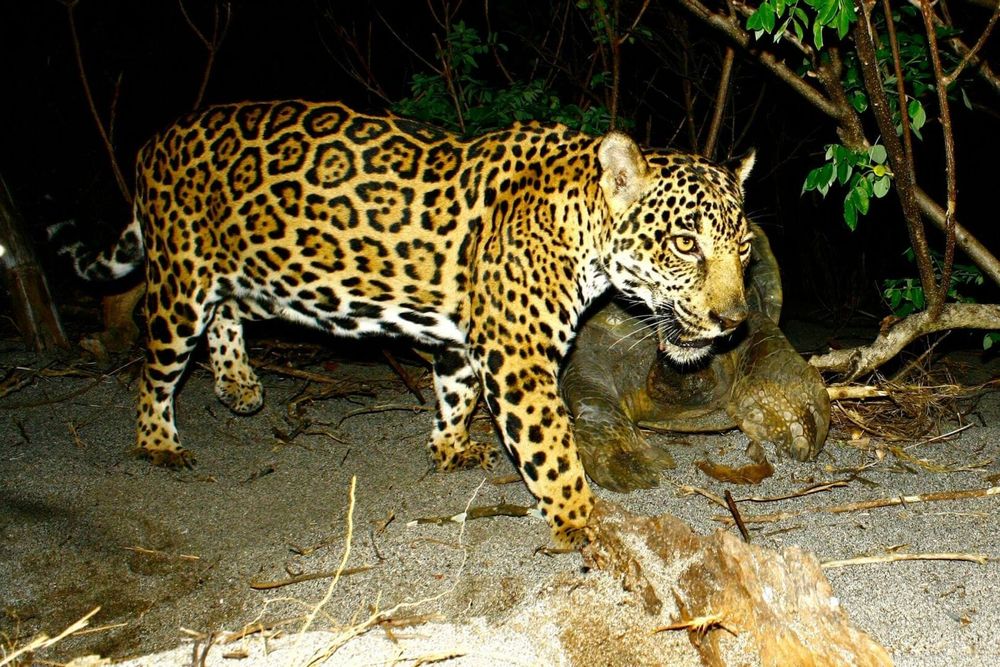
What you won’t see easily are the jaguars themselves – if they are there at all. As elusive apex predators, jaguars avoid human contact and typically move at night. Park authorities have set up camera traps in secluded spots to monitor any big cat activity. So far, evidence is scant. There are rumors that one juvenile male passed through the coastal section of the park last year, caught on a midnight trail camera and gone the next day. Another jaguar was reportedly filmed prowling just north of the park limits, closer to where the jungle stretches beyond Tulum’s outskirts. But no breeding population resides squarely inside Parque del Jaguar as of 2025. In effect, the park is currently more symbolic habitat than actual jaguar stronghold – a place that could be part of a jaguar’s range, but likely only a small part. For now, any wild jaguar in Tulum is a transient visitor, moving between larger wilderness areas that lie to the west and south. “The uniqueness of Tulum’s environment is worth preserving for its own sake,” one park ecologist explains, “even if the jaguars only pass through occasionally. If we maintain this land as wild, there’s always a chance they will return more frequently.” It’s a long-term hope: that with corridors reconnected and pressure kept at bay, a mother jaguar might one day raise cubs again somewhere in these protected acres, just as she would have decades ago.

And what about captive jaguars – has the park perhaps brought any in as an attraction or for breeding? The answer is no. Parque del Jaguar has no zoo enclosures or resident captive jaguars. The ethos is to preserve wildlife in its natural state, not to exhibit it behind fences. (For those wondering, the “jaguar island” exhibits and sanctuaries visitors hear about are in entirely different places, like Xcaret or other parks outside of Tulum.) Here, any jaguar presence must be earned the hard way – by making the land safe enough that wild jaguars choose to come. In that sense, the park’s management is focused on habitat quality: guarding water sources, preventing poaching, and restricting vehicle access at night. It’s an uphill battle, but small improvements are visible. The construction of fauna underpasses along the train and highway near Tulum is underway, guided by biologists’ maps of animal trails. Protective fencing now lines stretches of road where jaguars were frequently hit, funneling them toward safer crossing points. And thanks to the park, the coastal dunes and mangroves just south of the ruins – prime nesting ground for endangered sea turtles – remain undeveloped and pristine, giving loggerhead and green turtles dark, quiet beaches to lay eggs each summer. These are indirect benefits of Jaguar Park that, while not as dramatic as a jaguar sighting, are invaluable to the ecosystem.

Balancing Tourism, Community, and Conservation
Managing Parque del Jaguar is a delicate dance between inviting the public in and keeping the wilderness intact. The park is officially open to visitors – you can come, for a fee, to explore its beaches and trails, and to climb up the new oceanfront observation tower that offers sweeping views of Tulum’s ruins against the turquoise Caribbean. However, the rollout has faced criticism. Early visitors complained of steep entrance fees (which jumped suddenly from a nominal amount to around $20 USD), confusing rules, and areas still off-limits because construction wasn’t finished. “We paid to enter Jaguar Park, but half the sites were closed and we basically just walked to the same Tulum ruins we used to visit for free,” one tourist grumbled. Indeed, before the park, local residents could access some beaches and the archaeological zone freely or cheaply. The new system initially bundled everything into one ticket and even closed old access points, sparking anger among the Tulum community. In late 2024, tensions erupted as local artisans, who for generations sold handmade crafts at the original ruin entrance, found themselves bypassed by a new visitor route. “This sudden change will leave us without work,” protested Pedro Canul, a representative of the artisans, during a demonstration that blockaded the park gates. He explained that hundreds of families depended on the foot traffic that the old entrance provided. After hours of standoff, the municipal mayor agreed to meet with them and work out a compromise.
That wasn’t the only protest. Beachgoers bristled at the idea that stretches of shoreline they’d freely enjoyed might now require paid entry. Activists pointed out that, under Mexican law, all beaches are public property up to the high-tide line. To its credit, the park administration listened. By December 2024, free beach access for locals will be reinstated in certain zones of Jaguar Park – residents with an ID can now reach Playa Santa Fe and other beloved spots without buying a ticket, and three public access paths will be guaranteed to remain open. Tourists, too, saw some relief as park officials modestly reduced fees and clarified that visiting the museum or using the coastal boardwalk would be optional add-ons, not mandatory charges. The park authority brought in a community liaison and even hired some local guides who know the jungle lore, in an effort to share the benefits. Little by little, a balance is being sought so that Parque del Jaguar does not become just another exclusive attraction for outsiders, but a shared space that locals are proud to steward. After all, it is the local Maya communities that have the strongest cultural ties to the jaguar; their input and involvement may ultimately determine the park’s success as a living sanctuary.

The Jaguar’s Future in Tulum
As of 2025, wild jaguars are not common inhabitants within Parque del Jaguar, but the park represents a promise – that the jaguar’s echo will not fade entirely from Tulum. Whether this promise is kept will depend on how well the park is managed in the years to come and how effectively it connects to the broader landscape. Optimists imagine that Jaguar Park could form the northeastern link of a chain of protected corridors running through the Yucatán Peninsula, allowing jaguars and other wildlife to move between isolated refuges. Pessimists worry that without aggressive expansion or ecological bridges, the park will remain an isolated green island amid development, more useful for its educational value than for true conservation of big cats. The truth will likely fall somewhere in between.
In the meantime, life goes on in the park. The sun still sets each evening behind the silhouette of the jungle, painting the sky in mauves and golds beyond the stone temples of Tulum. On a quiet night, if you stroll away from the museum lights and down a sand path, you might hear the distant roar of the surf – and just maybe, if fortune favors you, the rasping cough of a jaguar far off in the darkness. It might be wishful thinking. It might be a roaming male calling out as he passes through toward larger forests inland. But that possibility, however slim, imbues these protected acres with a certain magic. Parque del Jaguar was born out of both desperation and inspiration – a reaction to environmental loss, and a declaration that it’s not too late to change course. In the narrative of Tulum’s explosive growth, this park is a poignant subplot: a young reserve trying to rewild the edges of a booming town, to bring back something wild and sacred that has nearly been lost.

As a narrative journalist walking these trails, one cannot help but feel a mix of emotions. There’s awe at the natural beauty that survives here against the odds – the butterflies dancing over dune flowers, the sacred ceiba trees standing tall. There’s anger at what was allowed to happen to the jaguar’s realm, at the sight of concrete creeping up to the park boundaries. And there’s cautious hope, symbolized by every small victory (a nest protected, a development halted, a community engaged). The jaguars in Tulum’s Jaguar Park are, for now, mostly unseen presences, like the fading echo of a roar. But they remain a powerful emblem. Their paw prints in the mud – when found – are like signatures in an ancient guest book, reminding us that this was their home long before it was our playground. Whether jaguars fully return to Parque del Jaguar in Tulum will be a measure of our ability to coexist with nature. If we make the right choices, perhaps one day the myth of the jaguar here will again become reality. And on that day, the night in Tulum will echo with the roar of the jungle’s true king, no longer a ghost but a living guardian of this coast once more.