

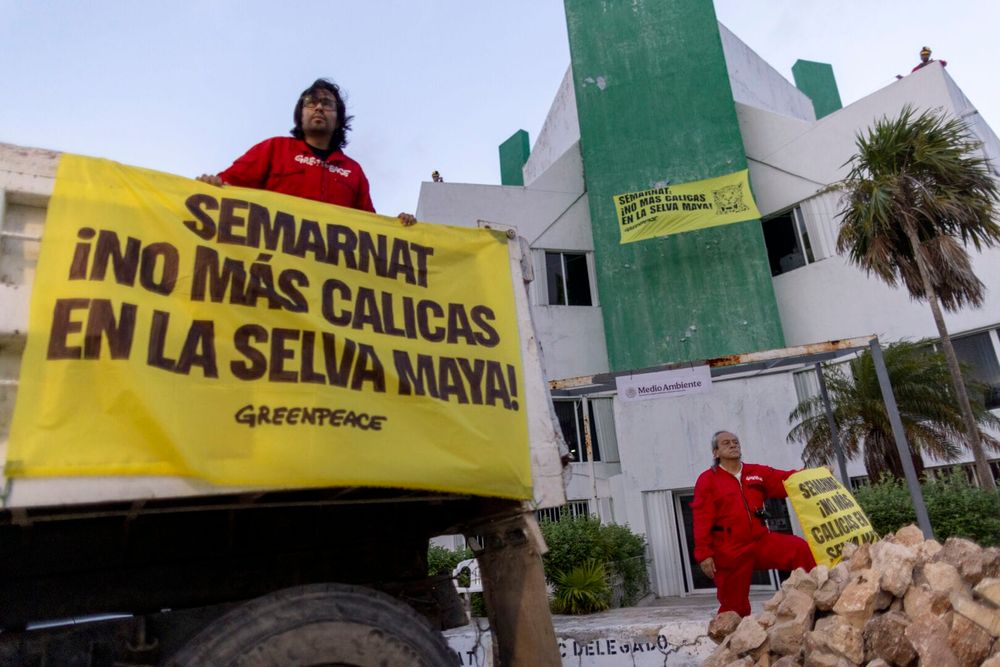
It wasn’t the heat or the traffic that turned heads Monday morning outside the SEMARNAT office in Cancún. It was the sound, sharp, grating, real. Stones tumbling onto concrete. Activists from Greenpeace México stood in front of the federal environmental agency and dumped raw material from a quarry at its front door. A symbolic act? Sure. But it was also a warning shot. The protest, part of the ongoing campaign “México al grito de Selva,” was more than theater. It was a howl, directed squarely at the heart of a system that keeps authorizing the destruction of the Selva Maya.
Above, a banner unfurled. It read: “SEMARNAT: ¡No más Calicas en la Selva Maya!” A stark message aimed at the legacy of Calica, the industrial stone-mining operation that chewed up the land for decades before it was shut down in 2022. That terrain, now designated as a protected natural area, is a ghost of what the region could become if things don’t change. And fast.
The Quarries That Bleed the Jungle
The keyword that stings here is Maya Jungle deforestation. Not because it’s trendy in eco-conscious circles but because it’s happening. Right now. Quietly, steadily, sometimes explosively, literally. Cemex, one of the companies called out by Greenpeace, has received federal blessing to dynamite and strip nearly 650 hectares of untouched jungle. That land lies dangerously close to Tulum, a place known more for yoga retreats and influencer beaches than for extraction zones. Yet beneath that Instagram gloss, another kind of excavation is underway.

Carlos Samayoa, Greenpeace campaign coordinator, didn’t mince words. “This model continues expanding across the Yucatán Peninsula,” he said, standing before that pile of quarry stones. He accused SEMARNAT of greenlighting destruction in different colors, this time under Mexican flags and with corporate partners like Cemex and even the military-run SEDENA.
The numbers are hard to argue with. Around 10,000 hectares of the jungle have already been torn apart and converted into the dusty, pockmarked remains of what once was the sacred canopy. And it’s not just the trees. Beneath the ground lies one of Mexico’s greatest hidden treasures: the aquifer. It’s the country’s largest reserve of fresh water, coursing through a network of underground rivers that form a fragile circulatory system for the entire peninsula. Dynamite doesn’t ask questions before it blows a hole in a cave ceiling. It just detonates.
The Community That Wasn’t Asked
What makes this even more galling is the silence. Not the silence of trees falling, that’s cliché. The silence of bureaucracy. Of paperwork quietly approved without real consultation. In Francisco Uh May, the small Maya community near the newly proposed quarry, no one came knocking. There were no assemblies, no informed dialogues. And that matters. Because international standards are clear, Indigenous communities must be consulted freely, prior to, and with full information, before their land becomes collateral damage in someone else’s blueprint.
But here, consultation has become a checkbox. An afterthought. A box ticked somewhere behind closed doors while the machines warm up.
Tren Maya: Catalyst or Cover?
This whole saga loops inevitably back to the Tren Maya, an ambitious rail project hailed by some as a developmental leap and derided by others as ecological suicide. According to Greenpeace, the materials ripped from the Cemex site are slated for use in this very project. Alongside tourist resorts. Alongside gated communities. Progress, they say. But at what cost?
SEMARNAT has acknowledged the environmental impacts of the train project. That’s on record. But acknowledgment without action is just lip service in bureaucratese. Greenpeace is calling for more. A real plan. A comprehensive framework to shield the Maya Jungle and the aquifer from the slow-motion disaster that’s already well underway.
The stones at SEMARNAT’s door weren’t just a stunt. They were a message in physical form. A warning carved from the earth itself. If that doesn’t stop us in our tracks, what will?
We’d love to hear your thoughts, join the conversation on The Tulum Times’ social media.