
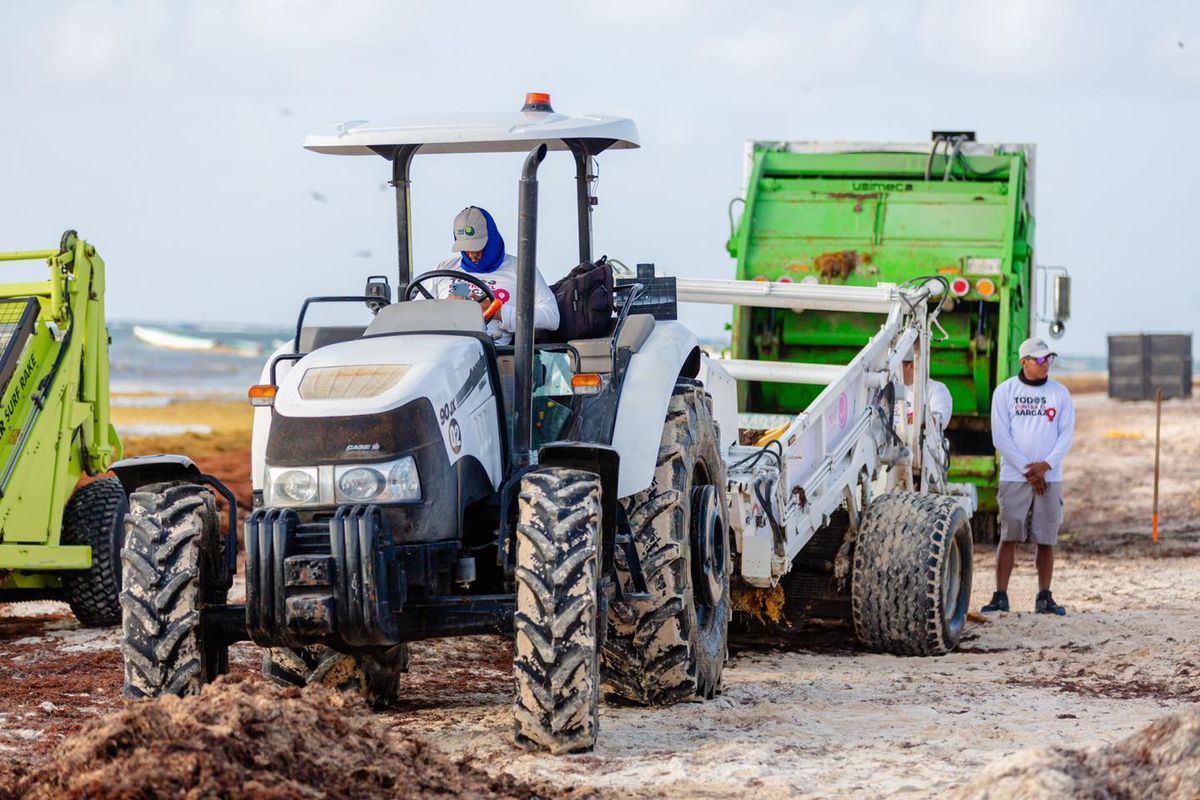
A tangled mat of Sargassum in Tulum lies across the shoreline, clinging like desiccated weeds to sun-baked sand, and beneath that shift and churn, there’s a squad quietly rising every dawn, the Zofemat Tulum crew. They slog through the muck, rakes scraping, buckets filling, boots trudging in salt and sweat, driven by a simple declaration: this shoreline is theirs, their community’s, and they won’t let a brown tide seize it.
Who are the Zofemat Tulum workers?
Zofemat, short for Zona Federal Marítima Terrestre, is the public agency responsible for Mexico’s federal coastal strip. In Tulum, its crews, under the leadership of director Juan Antonio Garza, have grown into a force. In April 2025, Zofemat faced a 20–35 % surge in seaweed volume compared to 2024, hauling in roughly 300–440 tons that month alone. Those numbers translate to dozens of daily hours, buckets brimming, beachfront roads clogged with tractors, and 4x4s hauling seaweed piles to dump zones.

On April 30, satellite mapping by USF’s Optical Oceanography Lab confirmed western Caribbean and Gulf Sargassum levels 150 % above records, even 40 % above the June 2022 peak. That influx overwhelmed conventional tools; Zofemat deployed drones for aerial reconnaissance and barrier nets offshore, alongside beach-sweeper machines funded by local hotels cooperating with public zones.
What is Sargassum, and why now?
Sargassum is a brown macroalgae genus naturally found in the Atlantic’s Sargasso Sea; buoyant gas bladders let it drift far afield. Since 2011, these mats have evolved into the Great Atlantic Sargassum Belt, an 8,000 km marine gigagarden spanning West Africa, the Caribbean, the Gulf, and U.S. coasts.
Scientists cite a combination of drivers, including warmer oceans linked to climate change, nutrient influxes from fertilizer runoff in South America, altered wind and currents, and aerosol dust that fertilizes ocean blooms. A recent Mongabay study challenged previous assumptions, stating that Amazon runoff accounts for only ~10% of the biomass, and most growth is occurring offshore. Regardless, these mats ride the North Atlantic and Caribbean currents straight into Tulum, and the scale in early 2025 is staggering.

The scale of the 2025 Sargassum spree
In May 2025, USF measured a new record: 37.5–38 million metric tons across the Atlantic basin, the highest since monitoring began in 2011. Satellite data confirms even more heading toward the western Caribbean this month. Reuters imagery showed beaches from Cancun to Puerto Rico buried in thick, stinking mats in early June. FoxWeather warned that entire swaths could be overwhelmed again this year.
Locally, 35 of 100 monitored beaches in Quintana Roo are now at high Sargassum levels; tourism venues struggle to stay open, and cleanup crews are near exhaustion. Zofemat projects that this intense influx could persist from May through at least November 2025.
Why Sargassum in Tulum matters
This isn’t just an eyesore. When washed ashore, decaying Sargassum emits hydrogen sulfide and ammonia, linked to respiratory irritation, nausea, and throat burning. It scuffs sea turtle nests and smothers corals and seagrass. And the tourism hit is immediate: Quintana Roo beach restaurants empty, hotel rates dip, and refund lines stretch longer than the stretch limos.

Yet in the open ocean, Sargassum is life: a floating ecosystem for turtles, fish, shrimp, crabs, and juvenile eels. It beds the marine food web. But that generosity turns sour when forced onto beaches en masse.
Zofemat’s methods and innovations
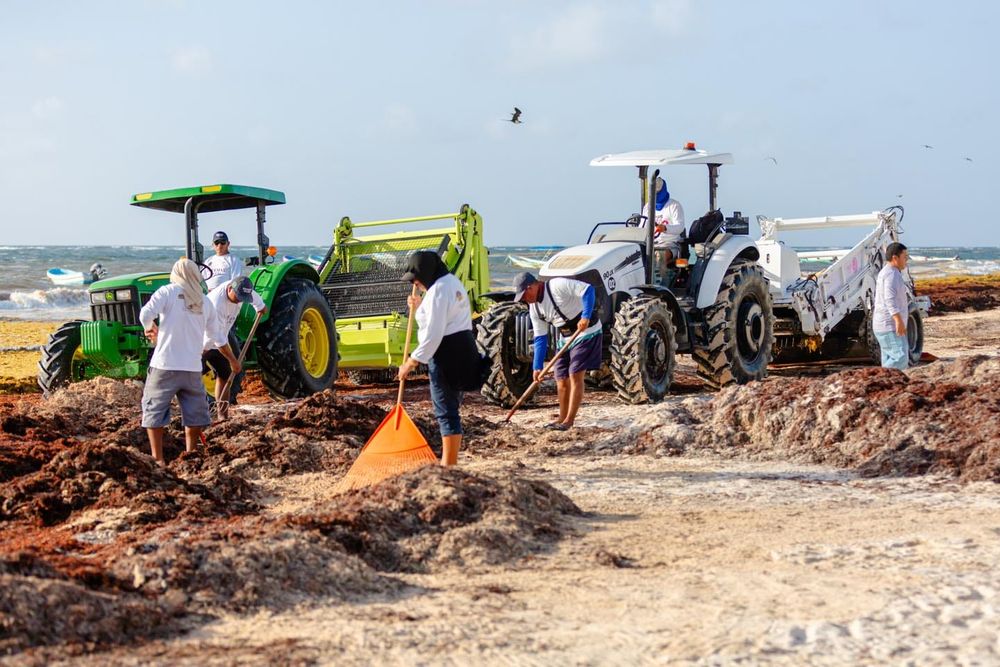
Zofemat’s frontline is blunt but evolving: it includes rakes, shovels, forklifts, sweepers, barrier booms, and drones, paired with officers patrolling from the air. The municipal government, private resorts, federal agencies, including the Navy, and volunteers converge, sometimes with as many as 50 workers per site, coordinating removal, transportation, offloading, and composting.
In Tulum Times coverage, this year’s season “swamps beaches” as Zofemat “introduces drones and equipment for strategic monitoring”. The Mayor personally thanked the crews, who were pulling up to 200 tons daily at peak. But it remains backbreaking work: dozens of personnel wrestling with a living, moving shoreline full of stink and salt.
Beyond cleanup: toward long‑term solutions
Riviera Maya businesses and the government are shifting their strategy, exploring uses beyond disposal, including biogas production, fertilizer, construction materials, and even cosmetics. The Caribbean region sees Sargassum not just as waste, but as an opportunity. Yet obstacles persist: processing clean (desalting) algae costs, arsenic risk tracks with chemical uptake in mats, and blooms remain unpredictable despite mapping.
Satellite forecasting and citizen science (Sargassum Monitoring app, NOAA CoastWatch, CariCOOS) help track movements, but local mitigation still falls on Zofemat’s boots and wheel loaders.
Forecasts, timelines, and preparation
Traditionally, between April and October, beach blooms last longer. In 2024, cleanup ran from November 14 to an unspecified date. Zofemat warns that 2025 may stretch even further into November. Monitoring semaphores, and on-site drone feeds, suggests near-constant red alerts.
Tourism operators are preparing with flexible booking, barrier maintenance, and composting hubs. Local media frames this not just as a crisis, but also as a fitness test of Tulum’s resilience, part logistics battle, part community ritual of reclaiming the shore.
The human toll and its triumph
Picture dozens of workers kneeling in seaweed dunes, faces clenched to shield them from stinging gases, their tools scraping each mat from the sand. Drivers rumble past loaded pallets toward segregated piles for composting or disposal. Volunteers hand out water and snacks. From the mayor’s praise to diplomatic exchanges with federal teams, cleanup is a multi-level, multi-agency effort.
The metaphor fits: Sargassum is a stubborn carpet unraveling across paradise. Zofemat crew are the stagehands, tirelessly rolling it back, shaggy edge by shaggy edge, to let the show carry on.
Final take
Watching Sargassum in Tulum isn’t passive, it’s a battle. Zofemat Tulum’s force of 50+ workers, drones, machine harvesters, barrier booms, Navy escorts, and volunteers is leveraging every resource to contain, mobilize, and repurpose this tide. It’s logistics, engineering, public relations, and human grit all entwined. And though forecasts signal a sticky season through November, every ton cleared is a claim staked, a statement that Tulum will not be buried.