

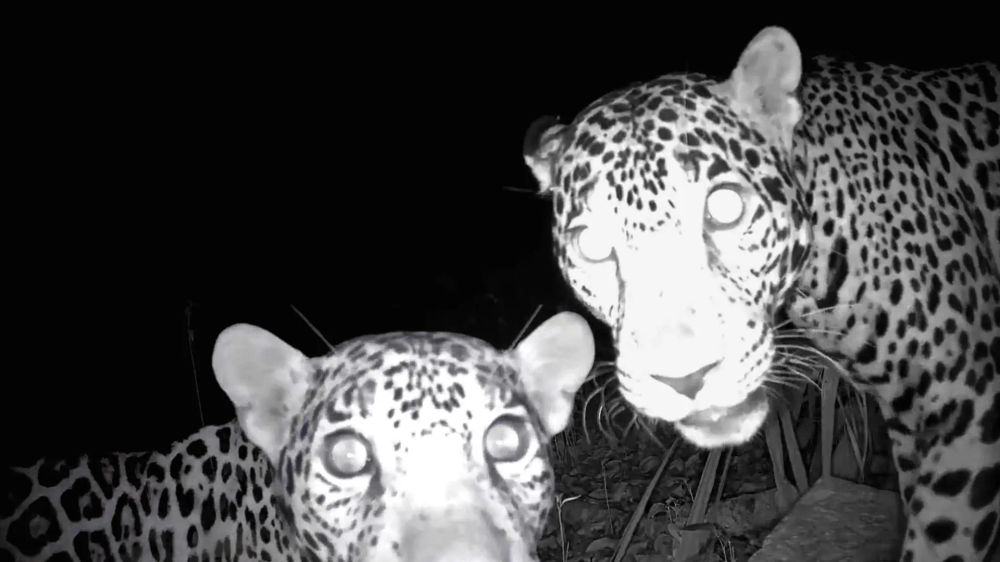
Some sunsets don’t just signal the end of a day. They feel like thresholds. Like moments suspended between the world we know and one we’ve forgotten. That’s what it felt like for the resident who stepped outside to water their garden and saw something moving just beyond the hedge. A form too sleek, too deliberate to be a stray dog. A body that didn’t belong to our ordinary catalog of wildlife. A jaguar. It paused in full view, the low amber light catching its coat, spotted, muscular, ancient. One photo was taken. A heartbeat later, it was gone.
But the moment stayed.
This wasn’t just a jaguar sighting. It was a rupture in the ordinary, a moment that seemed to stretch all the way back to the roots of this land. It was the jungle reminding us that it hasn’t vanished, it’s just been pushed to the margins, where it still waits. And sometimes, steps forward.
The Jaguar: Biology of a Shadow
To understand what it means to see a jaguar is to understand how rare that sight truly is. Panthera onca, the only big cat native to the Americas, is built like a poem written in muscle and silence. Its bite is the strongest of all felines, capable of piercing skulls and snapping turtle shells. It swims without fear, climbs with grace, and hunts with a precision honed over millions of years.
In the Yucatán Peninsula, the jaguar’s presence is especially vital. Unlike many predators, it doesn’t just hunt, it regulates. It shapes ecosystems by keeping herbivore populations in balance, which in turn affects vegetation, seed dispersion, and even soil health. In a way, the jaguar is both guardian and architect of the jungle.
Females give birth to one or two cubs after a gestation of around 100 days. These cubs stay with their mother for more than a year, learning how to stalk, how to remain unseen, how to avoid danger. But even these deep-rooted survival skills are no match for bulldozers and boundary walls.

Fragmented Forests, Fragmented Lives
The jaguar once ranged from the southern United States to Argentina. Today, its strongholds are scattered, isolated patches of forest hemmed in by human activity. The Yucatán still holds one of Mexico’s largest remaining populations, but even here, the jungle is being eaten from the edges.
The Riviera Maya is a living contradiction: a region that markets itself with images of nature, while laying concrete over its last wild corridors. Every luxury hotel, every new road that cuts through the understory, reduces the jaguar’s ability to move freely, to hunt, to mate, to exist.
So when one appears near a house, it isn’t seeking humans. It’s looking for a way out.
From Myth to Driveway: Why Jaguar Sightings Are Increasing
It’s tempting to see a jaguar sighting as something magical. And in a way, it is. But the reason they’re happening more often isn’t mystical. It’s logistical.
Development has fractured the natural corridors that allowed jaguars to move across vast territories without crossing into our world. A male jaguar can roam over 100 square kilometers in search of food or a mate. When that range is interrupted by fences, walls, and roads, the cat does not stop. It adapts. It follows its instinct, even if that path leads to a garden or a backyard.
Most sightings happen at night or dawn. Some involve juveniles recently separated from their mothers. Others are older males expanding their territory. And sometimes, they’re mothers searching for prey with cubs trailing silently behind. That’s the part we don’t see. The part that matters most.

The Road Is a Trap, Not a Crossing
Highways are among the most immediate and lethal threats to jaguars. Many of the main roads in Quintana Roo intersect key jaguar habitats. There are places where, during the rainy season, a jaguar might attempt to cross the same road several times in a single night. But unlike us, they don’t understand traffic patterns or headlights. They move with the logic of rivers and wind. The road is simply in the way.
In recent years, conservationists have documented an alarming number of jaguar deaths caused by vehicle collisions, many of them breeding females. Without proper wildlife crossings, the road becomes not a path, but a trap.
Driving through the jungle, especially between Tulum, Felipe Carrillo Puerto, and Bacalar, isn’t just a commute. It’s an encounter waiting to happen. And what you do behind the wheel can either protect life or end it.
If You See a Jaguar: What Every Encounter Asks of Us
Imagine you’re walking a trail in the early morning. The trees still dripping with night, the air dense with birdsong. And then, ahead, stillness. A shape. A jaguar.
You freeze. Time stretches. In that moment, your instinct might shout at you to run. Don’t. Running signals prey. Stand your ground. Breathe. Let your body be still. Avoid direct eye contact, but don’t turn your back. Slowly, and I mean slowly, step back the way you came. Speak softly if you must. Let it know you’re not a threat.
Now, imagine the same animal appears near your home. You hear it before you see it, a branch creaking, a low grunt. Your dog barks. You look outside. It’s there. Again, panic is your enemy. Stay inside. Pull your pet in. Close the windows. Turn off the lights. Do not try to film it. Do not go out with a flashlight. That flash could startle it into an action you’ll regret.
In both situations, after the animal has left, report the sighting to local authorities. In Quintana Roo, dialing 911 and choosing option 3 connects you with environmental protection services. Your report helps conservationists understand where jaguars are moving and where better protections need to be put in place.
More Than a Predator: The Jaguar in Maya Cosmology
Long before roads and fences, the jaguar was already walking through our stories. For the ancient Maya, it symbolized power, transformation, and the night. It was the ruler of the underworld, the protector of caves, the force that governed both fear and reverence.
They carved it into stone, painted it onto ceramic vessels, and placed it at the sides of kings and gods. It wasn’t feared. It was respected. It wasn’t hunted. It was honored.
And today? The image remains on murals, souvenirs, and tourist branding. But the living creature, the spirit behind the symbol, is being erased. Slowly. Quietly.

Conservation Is Not Sentiment, It’s Responsibility
According to recent studies, there may be fewer than 300 adult jaguars left across the Yucatán Peninsula. That’s not just a small number. It’s a whisper from extinction. Conservation groups, biologists, and community leaders are working to slow the decline. But without support, local, political, economic, the pace of loss will outstrip the pace of hope.
Preserving jaguars means more than protecting a single species. It means preserving the entire network of life that depends on the forest being whole. It means understanding that what the jaguar needs, corridors, quiet, territory, is also what keeps the forest alive for us.
We don’t save the jaguar by loving it. We save it by leaving room for it to live.
The Sighting as Signal
A jaguar sighting is more than rare. It’s sacred. It’s a sign that the world we think we’ve lost is still breathing, just barely, at the margins. If you’ve seen one, you’ve been given something few will ever experience, a glimpse of the original order.
But that sight comes with a contract. It asks what you’ll do now. Will you reduce your speed at night? Will you talk to your neighbors about coexistence? Will you vote for leaders who protect more than profit?
Because the next time a jaguar appears, it might not vanish quietly. It might be met with fear, or a weapon, or a headline that says Tragedy instead of Wonder.
It’s not just a jaguar sighting. It’s a question. The answer is still up to us.
We’d love to hear your thoughts, join the conversation on The Tulum Times’ social media.