
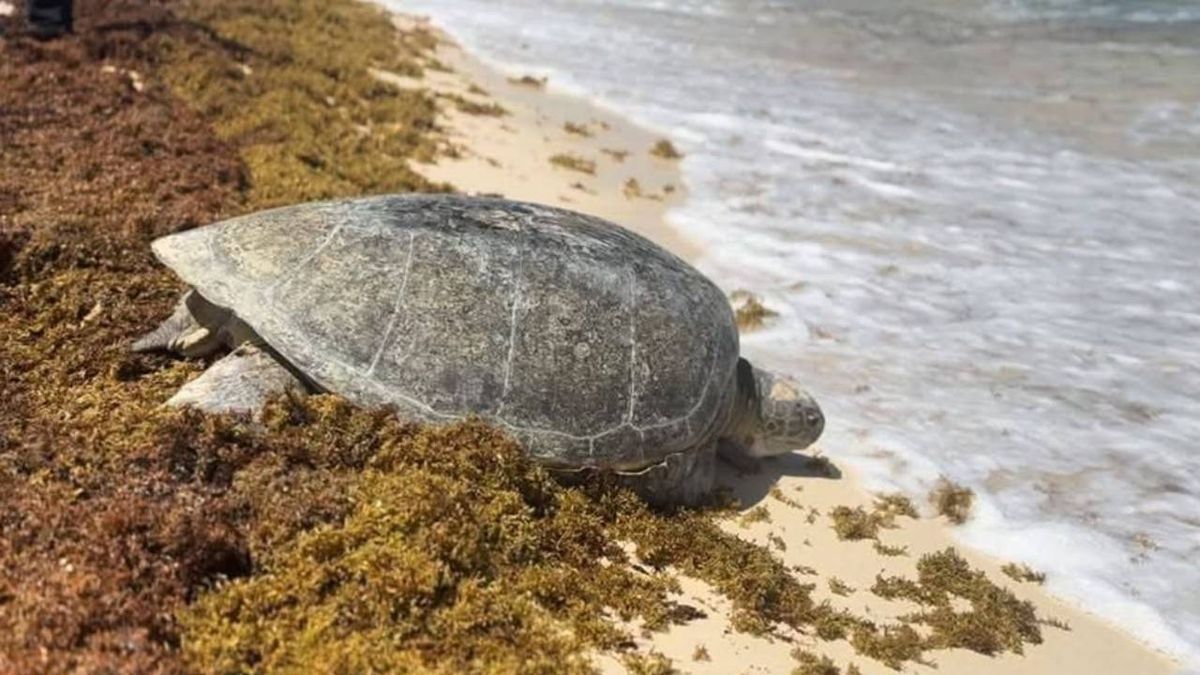
Sometimes, the ocean sends messengers. Not in storms or rising tides, but in hushed, urgent whispers, like a lone loggerhead turtle (Caretta caretta) crawling across the wrong stretch of sand at the wrong time of day. That’s what happened early Wednesday morning on Playa Paraíso, inside the heart of Tulum’s Jaguar National Park. A full-grown female, exhausted and tangled in thick sargassum, struggled under the weight of both algae and uncertainty.
She didn’t belong there, not like that. Not in daylight. Not alone.
The first to notice her weren’t scientists or rangers, but hotel workers. They recorded video footage and, moved by instinct, rushed to help. With bare hands and good hearts, they returned her to the sea.
But here’s the rub: good intentions aren’t always good enough.
Between Help and Harm
Rocío Peralta Galicia, a collaborator with Tulum’s Department of Environmental Sustainability, didn’t scold, she clarified. Yes, she said, the public’s concern is appreciated. Yes, it matters that people care. But when it comes to endangered species, compassion has to walk hand-in-hand with protocol.
“Even though we appreciate the will to help, no civilian is authorized to touch or move these animals,” she explained. “Sea turtles are fragile, and any mistake, even one made with kindness, could hurt them.”
By the time environmental officials arrived at Playa Paraíso, the turtle had already disappeared into the surf. That absence, rather than providing closure, sparked more questions. Loggerhead turtles rarely come ashore during daylight unless something’s wrong. Was she sick? Injured by a propeller? Entangled in plastic? The only thing certain was uncertainty.
An official investigation is now underway to determine the cause of the turtle’s unusual behavior. But Peralta Galicia cautioned against drawing premature conclusions. While many assume the sargassum was to blame, there’s no hard evidence, not yet, anyway.
“We can’t say it was the seaweed,” she said. “There’s no confirmed link between sargassum and direct harm to turtles or their hatchlings. The turtle could’ve been ill, disoriented, or suffering from something we haven’t identified.”
Still, the image of this vulnerable creature trying and failing to find her way hit a nerve. The video quickly made the rounds on social media, prompting an outpouring of concern from locals, environmentalists, and business owners.
Sargassum: The Unseen Villain?
Each year, the Mexican Caribbean braces for the invasion. Ton upon ton of floating sargassum blankets beaches, rots under the sun, and smothers marine life. It’s a natural phenomenon, yes, but made worse by warming seas and pollution.
And in places like Tulum, where tourism thrives on the illusion of untouched paradise, the tension between nature and commerce becomes palpable.
For turtles, the consequences are particularly harsh. Thick mats of seaweed obscure the shorelines where females return to lay their eggs. Hatchlings, smaller than a child’s palm, can become trapped before they ever reach the water. Even adult turtles, strong, ancient, wise, aren’t immune.
This is where hotels and resorts play a crucial role. Lounge chairs placed too close to nesting zones, lights that disorient hatchlings, and foot traffic over sensitive dunes all make survival harder. And while some establishments go to great lengths to preserve these areas, others still treat the beach as a blank canvas, theirs to arrange.
But it’s not.
“These are ancient routes,” Peralta Galicia emphasized. “Turtles have been coming back to these exact beaches for generations. We must keep them safe.”

The Right Way to Help
So, what should someone do if they encounter a turtle in distress?
Simple: call 911.
“That one call activates the correct chain of response,” she explained. “The municipality is notified, and from there, specialized environmental groups, people trained and equipped, are dispatched. That’s how we ensure the turtle receives proper care without added risk.”
Too often, well-meaning people rush in. They want to help. They want to film. They want to post. But turtles, already stressed, don’t need an audience. They need stillness. They need expertise.
What’s more, handling a turtle incorrectly can result in injury not just to the animal, but to the person intervening. These aren’t pets. They’re protected species, and their biology is more delicate than most realize.
“Remember, these creatures are endangered,” Peralta Galicia said. “Their numbers are falling. Every encounter matters. Every decision counts.”

Preserving the Future, One Shore at a Time
Quintana Roo, for all its tourist glamour, is also one of the leading regions in sea turtle conservation. And that didn’t happen by accident. It took decades of coordination, education, and local engagement.
But those efforts are only as strong as the people upholding them.
That means being informed. That means recognizing that sometimes, the best way to help is to step back. Let the experts take over. Call the authorities. Protect the space. And if you own beachfront property, hotel, hostel, or home, take special care. Don’t encroach on nesting zones. Don’t let profit bulldoze preservation.
Because of that turtle? She wasn’t just a fluke. She was a warning. A living signal that these coasts, beautiful, fragile, and rapidly changing, need more from us than admiration.
They need action. Thoughtful, informed, collective action.
So next time you see tracks in the sand or a lone turtle under the sun, pause. Don’t assume. Don’t crowd. Don’t touch.
Make the call. Make it count.
We’d love to hear your thoughts, join the conversation on The Tulum Times’ social media.