
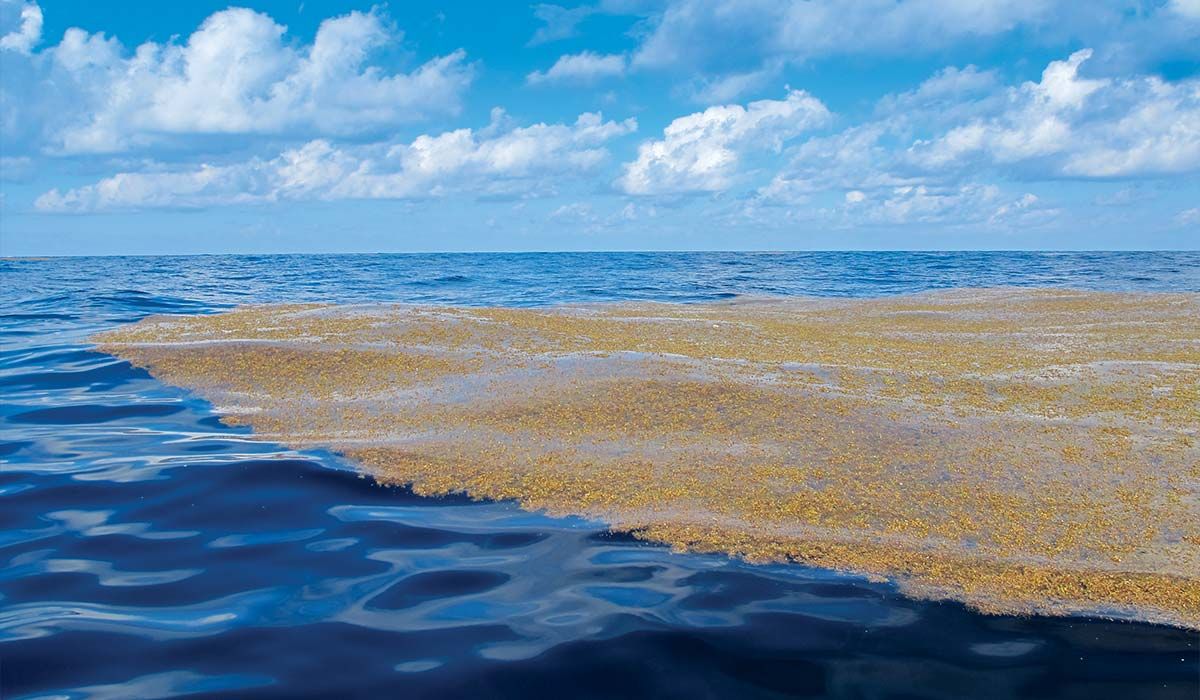
The faint scent of salt and something else, something briny, almost sulfurous, clings to the humid air, a prelude of what might be an unprecedented arrival. This season, an unprecedented Sargassum belt threatens the Mexican Caribbean, a sprawling, shifting island of seaweed that’s not just a passing phenomenon but a looming environmental spectacle. From the vast, unblinking eye of satellite imagery, it’s a brown ribbon stretching thousands of kilometers across the Atlantic, an ecological force on a scale rarely witnessed.
This isn’t just a localized bloom; it’s a continental drift. Scientists at the University of South Florida’s Optical Oceanography Laboratory have been tracking its progress, mapping its inexorable journey across the ocean currents. They call it the Great Atlantic Sargassum Belt, a name that carries the weight of its immense scale. Measuring approximately 8,000 kilometers in length and encompassing an estimated 13 million metric tons of biomass, it traces an arc from the coast of West Africa, across the equatorial Atlantic, and directly into the Caribbean Sea. It’s a natural process, yes, but intensified, amplified, an ecosystem out of balance.
The expectation is for a significant impact beginning in May, with a sustained presence throughout the summer months of June and July. This projection is based on a complex interplay of ocean currents, sea surface temperatures, and nutrient availability, factors that have aligned to supercharge this year’s growth. Historically, sargassum arrived in smaller, more manageable quantities, a cyclical event. But something has shifted. The scale has become alarming.
The implications for the coastal environment are profound. When this vast quantity of seaweed makes landfall, it doesn’t merely wash ashore. It decomposes, consuming oxygen and releasing hydrogen sulfide, a gas with a distinct and unpleasant odor that permeates the air for miles. This anoxic environment can suffocate marine life, from coral reefs, already stressed by warming waters and ocean acidification, to seagrass beds that serve as vital nurseries for countless species. The delicate balance of these nearshore ecosystems is acutely vulnerable to such a sudden and massive imposition. Researchers are particularly concerned about the potential for widespread die-offs among benthic organisms, those living on the seafloor, due to extended periods of oxygen depletion.
Beyond the immediate ecological consequences, there are economic tremors. The arrival of massive Sargassum blooms directly impacts tourism, a cornerstone of the regional economy. Beaches, once postcard-perfect strips of white sand, can become matted with thick, decaying mats of seaweed. The smell alone can deter visitors, and the logistical challenge of clearing millions of tons of biomass is monumental. Municipalities and hotel operators invest significant resources in manual and mechanical removal, but even with these efforts, the sheer volume can be overwhelming. The economic downturn isn’t just a hypothetical; previous, smaller blooms have already demonstrated a measurable impact on visitor numbers and revenue.
The scientific community points to a confluence of factors driving this unprecedented proliferation. Elevated sea surface temperatures, a clear hallmark of climate change, accelerate the growth rate of sargassum. Changes in ocean currents, potentially influenced by shifting weather patterns, are also playing a role, directing these vast mats towards the Caribbean. Furthermore, increased nutrient runoff from both agricultural activities and industrial discharges along coastlines, particularly from the Amazon River basin, acts as a potent fertilizer for the seaweed in the open ocean. It’s a complex feedback loop, where human activity interacts with natural processes to create an accelerated, more intense phenomenon.
Experts from institutions like the National Autonomous University of Mexico (UNAM) have been vocal in their warnings, emphasizing the need for comprehensive, interdisciplinary approaches to manage the crisis. The conversation has shifted from mere clean-up operations to proactive monitoring, early warning systems, and ultimately, a deeper understanding of the underlying causes. It’s a complex equation without simple answers, demanding collaboration across scientific fields and international borders. The sargassum doesn’t respect maritime boundaries.
As May approaches, the sense of anticipation is palpable along the coastline. Whether the forecasts hold precisely true, or if subtle shifts in wind and current patterns offer a slight reprieve, remains to be seen. But the sheer scale of the observed biomass suggests that some level of significant impact is inevitable. It’s a natural event magnified, a mirror reflecting broader environmental changes, and a potent reminder of the interconnectedness of global ecosystems. The question isn’t if it will arrive, but how profoundly it will reshape the immediate future of this iconic stretch of coastline.
We invite you to share your thoughts and experiences on this unfolding situation on The Tulum Times’ social media channels.