

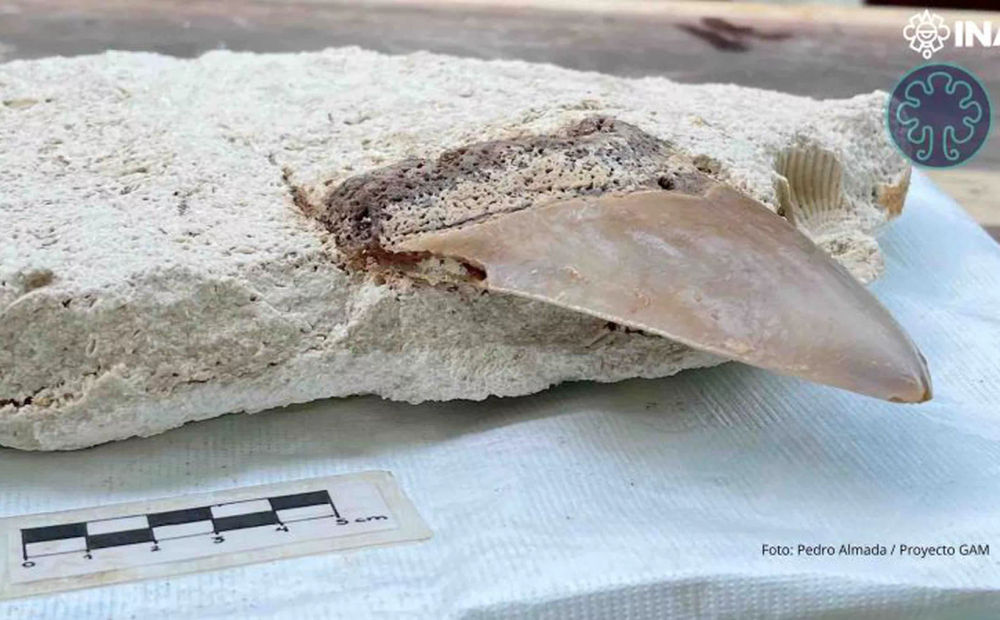
Twenty-eight meters below the surface, where the world grows quiet and the light bends like memory, something ancient stirred. Not a myth. Not a rumor. A megalodon tooth, broad as a man’s palm, embedded in the limestone silence of Cenote Maravilla in Puerto Morelos.
It wasn’t a movie plot. This is the first scientifically recorded discovery of Otodus megalodon remains in Quintana Roo, and like many stories that matter, it began with a whisper, not a roar.
Where the Sea Once Kissed the Sky
In 2019, cave diver Juan Cardona was winding his way through the submerged catacombs of the Yucatán Peninsula. There, nestled in the stone, was a serrated tooth, one that hinted at something long gone but impossibly immense. He handed the find to the researchers at the Gran Acuífero Maya (GAM) project, specialists in deciphering the dead.
What they found wasn’t just a fossil, it was two. One possibly belongs to a juvenile.
Enter Gerardo González Barba, paleontologist at Universidad Autónoma de Baja California Sur and veteran in the fossilized shark trade. His analysis confirmed it: the teeth belonged to a top-tier predator that once hunted where vacationers now sip cocktails.
A stunning irony, where snorkelers now float and Instagrammers strike a pose, once swam a killer with jaws wide enough to swallow dolphins whole.
The Megalodon: Giant of the Fossil Record
The Size of a Legend, the Appetite of a Nightmare
Otodus megalodon wasn’t just large, it was laughably large. Stretching up to 18 meters, it rivaled city buses and made great white sharks look like chew toys. Between 23 and 2.5 million years ago, during the Miocene and Pliocene epochs, it roamed tropical seas as an apex predator. It didn’t just feed, it annihilated.
Now, we know: it also swam here.
The recovered teeth were dated to the Miocene-Pliocene boundary, from a time when the Yucatán was the ocean floor, long before rainwater etched the cenotes into the limestone.
Barba explains it this way: the massive teeth likely fell into soft seabed silt, were entombed in lime-rich mud, and slumbered there, waiting for human curiosity (or perhaps fate) to dig them up.
Could Quintana Roo Have Been a Megalodon Nursery?
The Case of the Smaller Tooth
The smaller fossil tooth may have belonged to a juvenile megalodon. That one detail cracks open a profound possibility: Were these waters once a nursery for the world’s largest shark?
It’s a bold theory, but not a wild one. The warm, shallow sea that covered the region millions of years ago would have made a perfect playground for young predators. Gentle depths, rich feeding grounds, no polar chills, ideal for growing up fast and fierce.
Today, where marine giants once reigned, archaeologists drift slowly in the dark, their bubbles rising like forgotten thoughts.

From Ancient Ocean to Museum Glass: The Fate of the Fossils
In 2021, fearing looters and the slow erosion of time, the GAM team moved to preserve the find. They extracted the larger tooth, still fused in limestone and tangled with remnants of prehistoric marine life.
Now, both fossils are on display at the Museum of the Eastern Costa Region (INAH) in Tulum. Behind glass, they sit, silent, powerful, oddly humbling. Visitors peer in, some awestruck, others skeptical, into the gaping jaws of a time far older than humanity.
Digital Preservation: Technology Meets Deep Time
High-Resolution Scans Secure the Fossils’ Legacy
But this is more than paleontology, it’s digital resurrection. To ensure long-term protection and public access, the GAM team launched a preservation effort using high-resolution scanning capable of capturing even the faintest wear on the teeth’s enamel.
Supported by the Swiss Embassy in Mexico and the National Geographic Society, this initiative forms part of a larger project to document the submerged cultural and natural heritage of the Yucatán Peninsula.
There’s something poetic in that. Beneath the water, amid darkness and stone, lies history, not dead, but waiting. And now, pixel by pixel, it’s being brought back into the light.
The Legacy of the Megalodon in the Riviera Maya
These aren’t just fossils. They are reminders. That our planet is older than our arrogance. That beneath every tourist paradise lies a prehistory full of monsters and marvels. That curiosity, not conquest, reveals the deepest truths.
The megalodon’s legacy isn’t just teeth or terror, it’s a testament to the hidden past beneath our feet, and the stories still rising from the depths.
Want more discoveries like this? Follow the pulse of the past with The Tulum Times. Dive into the conversation on our social media and help us unearth the forgotten corners of the Yucatán.