
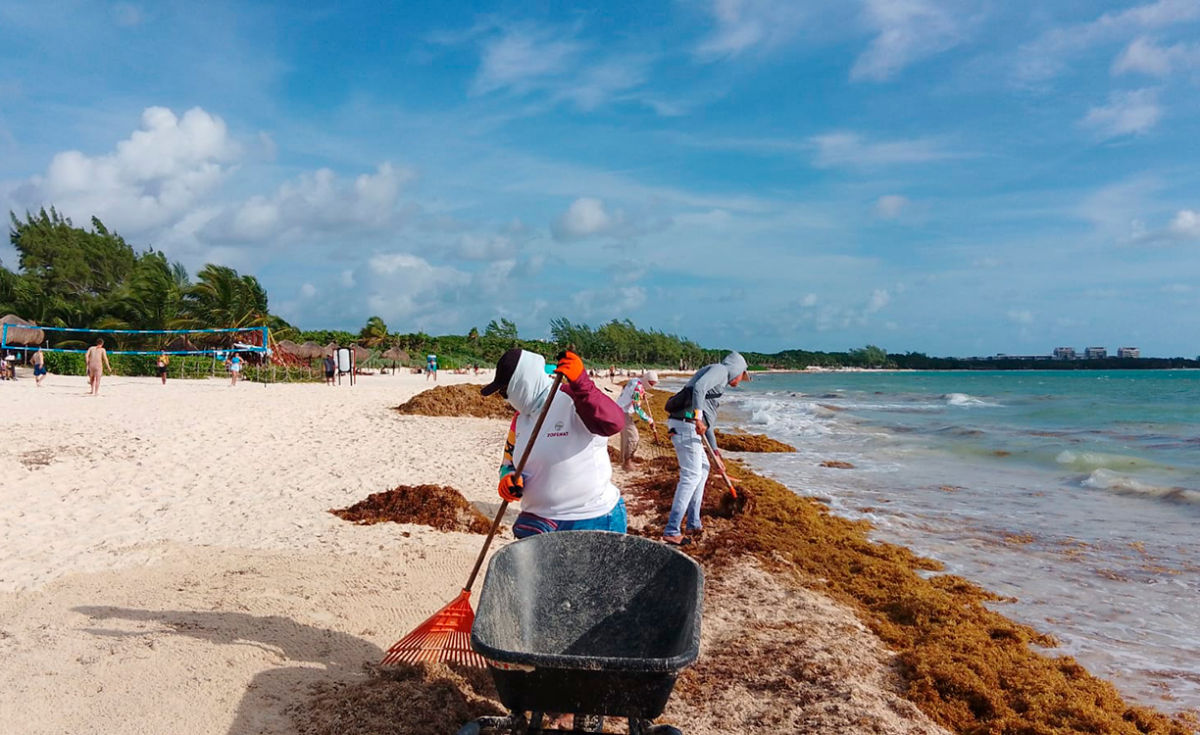
The government of Quintana Roo has strengthened its strategy to address sargassum arrivals after detecting atypical behavior of the macroalgae along the Caribbean coastline, increasing its budget and maintaining a permanent operational response while stopping short of declaring a formal state contingency.
State officials confirmed this week that the administration led by Mara Lezama considers current conditions manageable, citing available financial resources, personnel, and coordinated operations to contain the impacts of sargassum landings reported in several coastal areas. While accumulations are visible at specific points, authorities emphasize that the phenomenon is neither generalized nor constant across all beaches of the Mexican Caribbean.
The reinforced approach reflects a shift in how the state is responding to sargassum, increasingly treating it as a structural and evolving environmental challenge rather than a short seasonal disruption.
State strategy focuses on a sustained response
According to the state government, sargassum management is being handled through targeted and coordinated actions rather than blanket measures. The Secretaría de Gobierno has underscored that operations are deployed where conditions require them, based on real-time monitoring and site-specific assessments.
A central component of the strategy is the ongoing involvement of the Secretaría de Marina, whose role has become critical in offshore containment, nearshore collection, and shoreline cleanup. Naval assets, including vessels and specialized equipment, are being used to intercept sargassum mats before they reach sensitive coastal areas when possible, while land-based crews manage removal and disposal once the algae reaches the beaches.
State officials argue that this coordinated model allows for faster responses without triggering emergency declarations that could create unnecessary concern among residents and visitors.
Monitoring center changes response timing
One of the most significant policy developments under the current administration has been the creation of a specialized sargassum monitoring center, described by authorities as unprecedented at the state level. The facility integrates satellite data, oceanographic modeling, and field reports to track the movement of macroalgae in the Caribbean basin.
This monitoring capability enables early warnings and preventive action, allowing crews to be deployed before landings reach critical volumes. Officials say the data-driven approach has improved planning and reduced reaction times, particularly in areas with historically high exposure.
Based on current projections and scientific assessments, the state has opted not to declare an alert or contingency at this stage. Authorities maintain that observed arrivals remain within manageable parameters, although they acknowledge that conditions are being reviewed continuously as forecasts for the rest of the year evolve.
Early arrivals raise concerns in Tulum
Despite official assurances, concern is growing in several high-profile tourist destinations, particularly Tulum, where sargassum accumulations have already become visible during peak tourist season. The timing has drawn attention because it suggests the phenomenon is advancing earlier than patterns recorded in previous years.
Local tourism operators have expressed unease privately, noting that even limited sargassum presence can affect visitor perceptions. While state officials insist the situation does not warrant alarm, the visibility of the algae in such a prominent destination underscores the challenges of balancing environmental management with economic stability.
The state government has reiterated that response teams are active in Tulum and that cleanup efforts are being adjusted according to daily conditions rather than fixed schedules.
South-to-north spread reflects an irregular pattern
Initial impacts this year were concentrated in the southern part of the state, particularly in Mahahual and Xcalak, areas that have historically faced heavier sargassum exposure due to prevailing currents. In recent days, however, reports have expanded northward.
Arrivals have also been confirmed in Puerto Morelos, along the eastern coast of Cozumel, and on beaches in and around Tulum. This broader geographic spread reinforces assessments that sargassum dynamics are becoming less predictable.
Environmental specialists advising the state note that the phenomenon no longer adheres strictly to seasonal windows, complicating response planning and requiring continuous readiness rather than periodic mobilization.
Permanent policy replaces seasonal response
For the Quintana Roo government, the irregular behavior of sargassum has confirmed the need to treat it as a permanent coastal management issue. Officials say surveillance and response frameworks are being redesigned to operate year-round, with budget allocations adjusted accordingly.
The objective, according to state authorities, is to mitigate environmental damage and protect tourism revenue without escalating rhetoric or declaring emergencies that may not be scientifically justified. Early intervention, interagency coordination, and expanded resources are being presented as the pillars of this long-term strategy.
The approach also reflects a broader understanding that sargassum is likely to remain a recurring feature of the Caribbean ecosystem, requiring adaptation rather than short-term fixes.
As the high season continues and monitoring data evolves, what remains at stake is the state’s ability to manage sargassum proactively while sustaining confidence in one of Quintana Roo’s most important economic sectors. We’d love to hear your thoughts. Join the conversation on The Tulum Times’ social media. How should coastal destinations adapt as sargassum becomes a year-round challenge?